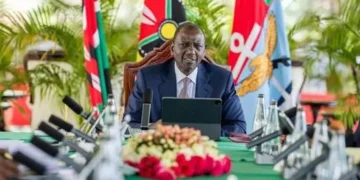


President Bola Tinubu has asked a United States federal court to reject a bid to release unredacted records relating to investigations involving him, arguing that American privacy laws protect the documents and that the request is driven largely by Nigerian political interests.
The submission, filed by his lawyers before the U.S. District Court for the District of Columbia, comes in response to a Freedom of Information Act (FOIA) lawsuit brought by American transparency activist Aaron Greenspan.
Related Post



Greenspan is seeking, among other documents, the FBI’s entire file on Tinubu and FBI interview records from 1992 and 1993. The case does not amount to a criminal prosecution or establish that Tinubu committed a drug-trafficking offence.
Tinubu’s four reasons
According to the President’s legal team, the records should remain redacted or withheld because:
- Privacy laws protect the records
Tinubu’s lawyers cited exemptions under the U.S. FOIA and Privacy Act, particularly Exemption 7(C), which protects personal information contained in law-enforcement records.
- There is no legally recognised public interest
The lawyers argued that public curiosity about Tinubu’s personal history does not automatically constitute the kind of government-related public interest FOIA was designed to serve.
- The request is politically motivated
Tinubu’s team argued that Greenspan’s focus on documents bearing the President’s name suggests that the FOIA process is being used to obtain information for political purposes in Nigeria.
- Claims of a secret prosecution remain speculative
The lawyers rejected suggestions that the records could expose a secret prosecution or an agreement by U.S. authorities not to prosecute Tinubu, arguing that such claims have not been supported by sufficient evidence.
Why the issue keeps coming back
The controversy dates back to a 1993 U.S. civil forfeiture case involving about $460,000 held in an account linked to Tinubu. The case became a major political issue during the 2023 presidential election.
The APC maintained that the forfeiture proceeding was civil and did not amount to a criminal conviction. The Presidential Election Petition Court subsequently held that the petitioners had failed to establish that Tinubu had been arrested, arraigned, convicted or sentenced in a criminal case in the United States.
But attempts to obtain more information from U.S. government files have continued.
In April 2025, Judge Beryl Howell ruled that the FBI and DEA could no longer rely on their previous “Glomar” responses to simply refuse to confirm or deny whether records existed. The agencies were directed to process the requests subject to applicable exemptions.
The FBI has since argued that some withheld information could reveal investigative techniques or potentially endanger individuals, with the agency recently asking the court to consider some of its arguments privately.
ADC, NDC turn the spotlight on 2027
The latest development has already taken on a political dimension as Nigeria moves towards the 2027 presidential election.
African Democratic Congress (ADC) spokesman Bolaji Abdullahi questioned why Tinubu would oppose the release if the records could ultimately clear his name. The party has positioned itself as a major opposition force against Tinubu ahead of 2027, with Atiku Abubakar as its presidential candidate.
The Nigeria Democratic Congress (NDC), whose 2027 presidential candidate is Peter Obi, also argued that Nigerians deserve transparency and that the President should allow the records to come out and settle the controversy once and for all. Obi has separately challenged all presidential candidates to defend their records and credentials publicly ahead of the election.
The timing is significant. The ADC has already taken Tinubu to court over his eligibility to contest the 2027 election, while the NDC is campaigning on a platform that places scrutiny of candidates’ records and credentials at the centre of the coming presidential contest.
The unanswered question
For Tinubu, the legal argument is about privacy, FOIA exemptions and the proper limits of U.S. government disclosure.
For his opponents, it is about transparency and whether Nigerians should have access to information concerning the past of the man seeking another four-year mandate.
And as the 2027 presidential race gathers momentum, one question may prove impossible to avoid:
If the records contain nothing capable of damaging Tinubu’s reputation, why fight so hard to keep the remaining portions secret and what exactly will Nigerians find if the court eventually orders their full release?
The FOIA case remains ongoing, and the allegations surrounding the historical U.S. investigation should not be treated as proof of criminal wrongdoing.