

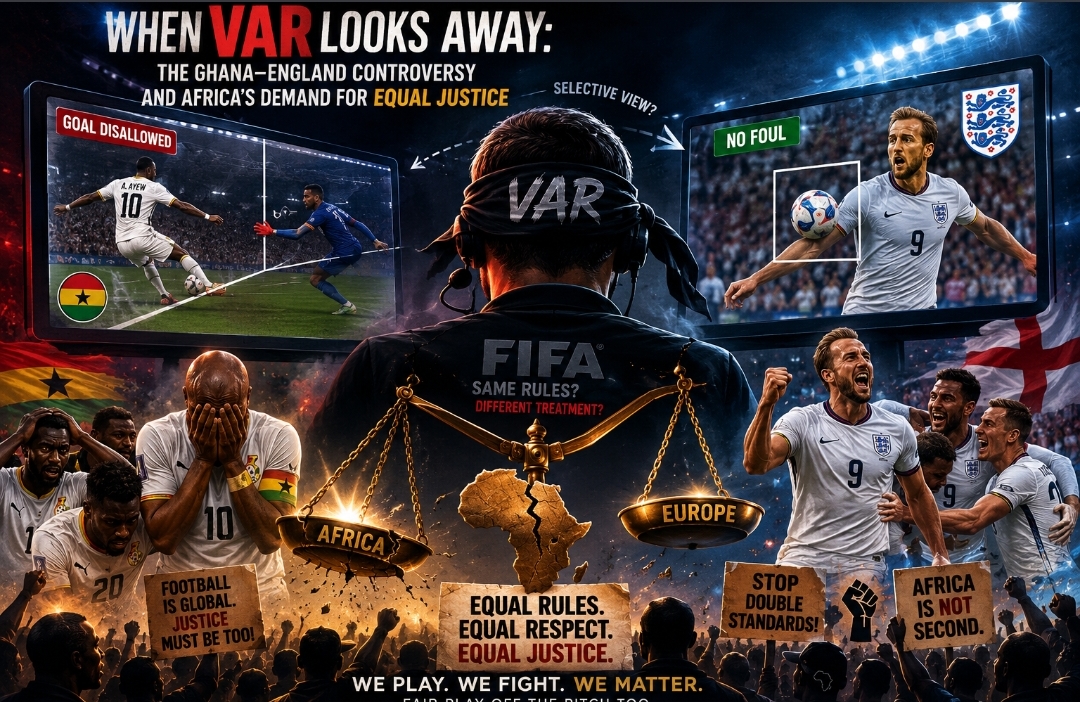
When Fairness Is Questioned,Football Loses
The FIFA World Cup is often celebrated as humanity’s greatest sporting event, a tournament where geography, economic strength, political influence, and footballing history are supposed to disappear for ninety minutes. Every nation is meant to compete under one set of rules, judged by one standard of justice.
Yet, on Tuesday, 23 June 2026, during the Group L encounter between Ghana and England at Boston Stadium in Foxborough, that ideal was once again called into question.
Related Post




With the match delicately poised at 0–0, Ghanaian forward Prince Kwabena Adu brilliantly rounded England goalkeeper Jordan Pickford before being challenged by defender Ezri Konsa inside the penalty area. To the astonishment of millions watching across Africa and beyond, play continued.
There was no whistle.
There was no penalty.
Most surprisingly, there was no on-field VAR review.
What followed was not merely disappointment among Ghanaian supporters. It was the revival of a question that has lingered over international football for decades:
Are African nations truly treated as equals on football’s biggest stage?
The Incident That Sparked a Continental Conversation
Football has always accepted that referees are human and capable of making mistakes.
That is precisely why the Video Assistant Referee (VAR) system was introduced, to reduce clear and obvious errors in decisive moments.
Ironically, the Ghana–England incident appeared to be exactly the type of situation VAR was designed to examine.
Instead, millions watched as the game continued without even an invitation for the referee to review the challenge.
Former referees, football analysts, and commentators from several countries later argued that Ghana had strong grounds for a penalty and questioned why the incident was not reviewed.
Whether one ultimately believes the challenge deserved a penalty or not, one fact remains beyond dispute:
The absence of an on-field review became as controversial as the challenge itself.
A Familiar Feeling Across Africa
To many outside Africa, this may appear to be just another disputed refereeing decision.
For many Africans, however, it felt painfully familiar.
Across generations, controversial officiating involving African nations at major tournaments has fuelled a persistent perception that established football powers often receive the benefit of doubt in marginal situations.
Perception is not proof.
Yet perception matters because trust is the foundation upon which every sporting competition is built.
When millions of supporters instinctively believe that a similar incident involving England might have produced a different outcome, FIFA should regard that belief as a serious institutional concern, even if the officials acted without conscious bias.
Confidence in football is built not only on fairness but also on the visible appearance of fairness.
Would the Decision Have Been Different?
No one can state with certainty that England would have been awarded a penalty had the roles been reversed.
Such a claim cannot be proven.
But the very fact that this question is being asked across Africa exposes a credibility challenge that football’s governing bodies cannot afford to ignore.
If supporters increasingly believe that football’s biggest nations enjoy greater protection from match officials than emerging football nations, then the integrity of international competition inevitably suffers.
Justice should never depend upon reputation.
Nor should it depend upon commercial value, broadcasting power, or historical success.
The Laws of the Game recognise no hierarchy between England and Ghana.
Neither should those entrusted with enforcing them.
Africa Is Not Seeking Sympathy
This discussion should not be misunderstood.
Africa is not asking referees to invent penalties.
Africa is not requesting favourable treatment.
Africa is not demanding special privileges.
Africa is demanding consistency.
If a challenge involving one nation deserves careful review, then an identical challenge involving another nation deserves precisely the same scrutiny.
Equality cannot exist selectively.
It either exists for every nation or it exists for none.
VAR Must Strengthen Confidence, Not Undermine It
Technology was introduced into football to increase transparency and reduce controversy.
When controversial incidents pass without meaningful review, VAR risks becoming the very source of distrust it was designed to eliminate.
FIFA should consider greater transparency in officiating decisions, including releasing VAR communications after controversial matches and explaining why certain incidents were or were not reviewed.
Such reforms would not eliminate disagreement.
But they would strengthen confidence.
Football’s credibility depends as much upon openness as it does upon accuracy.
A Defining Moment Beyond One Match
History may remember Ghana’s draw with England as another competitive World Cup encounter.
Africa may remember it differently.
Not because of the final score.
But because one controversial moment reignited an old conversation about equality, fairness, and respect on football’s biggest stage.
The issue extends far beyond Ghana.
Tomorrow it could be Senegal.
Next year it could be Morocco.
Another tournament could bring Nigeria, South Africa, or Cameroon into similar circumstances.
The principle remains unchanged.
Every nation deserves equal justice.
Every player deserves equal protection.
Every supporter deserves equal confidence that the result will be determined by football, not by inconsistent officiating.
The Future of Football Must Be Fair
The FIFA World Cup belongs to every continent.
Its credibility depends upon every nation believing that victories and defeats are decided solely by performance on the pitch.
The Ghana–England VAR controversy presents FIFA with an opportunity, not merely to defend its officiating, but to strengthen public confidence in it.
African football has earned its place among the world’s elite through talent, resilience, and decades of progress.
It should never have to earn equality.
Because equality is not a reward.
It is the foundation upon which the beautiful game was built.
When justice is applied equally, football wins.
When doubt overshadows fairness, everyone loses.
Africa asks for no favours.
Africa asks only that the whistle sounds the same for every nation.
References
Fédération Internationale de Football Association. (2025). Video Assistant Referee (VAR). https://inside.fifa.com/technical/football-technology/var
International Football Association Board. (2025). Laws of the Game 2025/26. In https://www.theifab.com/laws/latest/
Reuters. (2026, June 23). England fail to break down stubborn Ghana in 0–0 draw. https://www.reuters.com/sports/soccer/england-hit-crossbar-late-goalless-draw-with-ghana-2026-06-23/
The Guardian. (2026, June 24). Tuchel tells England fans not to lose belief while Ghana fume at penalty decision. https://www.theguardian.com/football/2026/jun/24/tuchel-tells-england-fans-not-to-lose-belief-while-ghana-fume-at-penalty-decision