

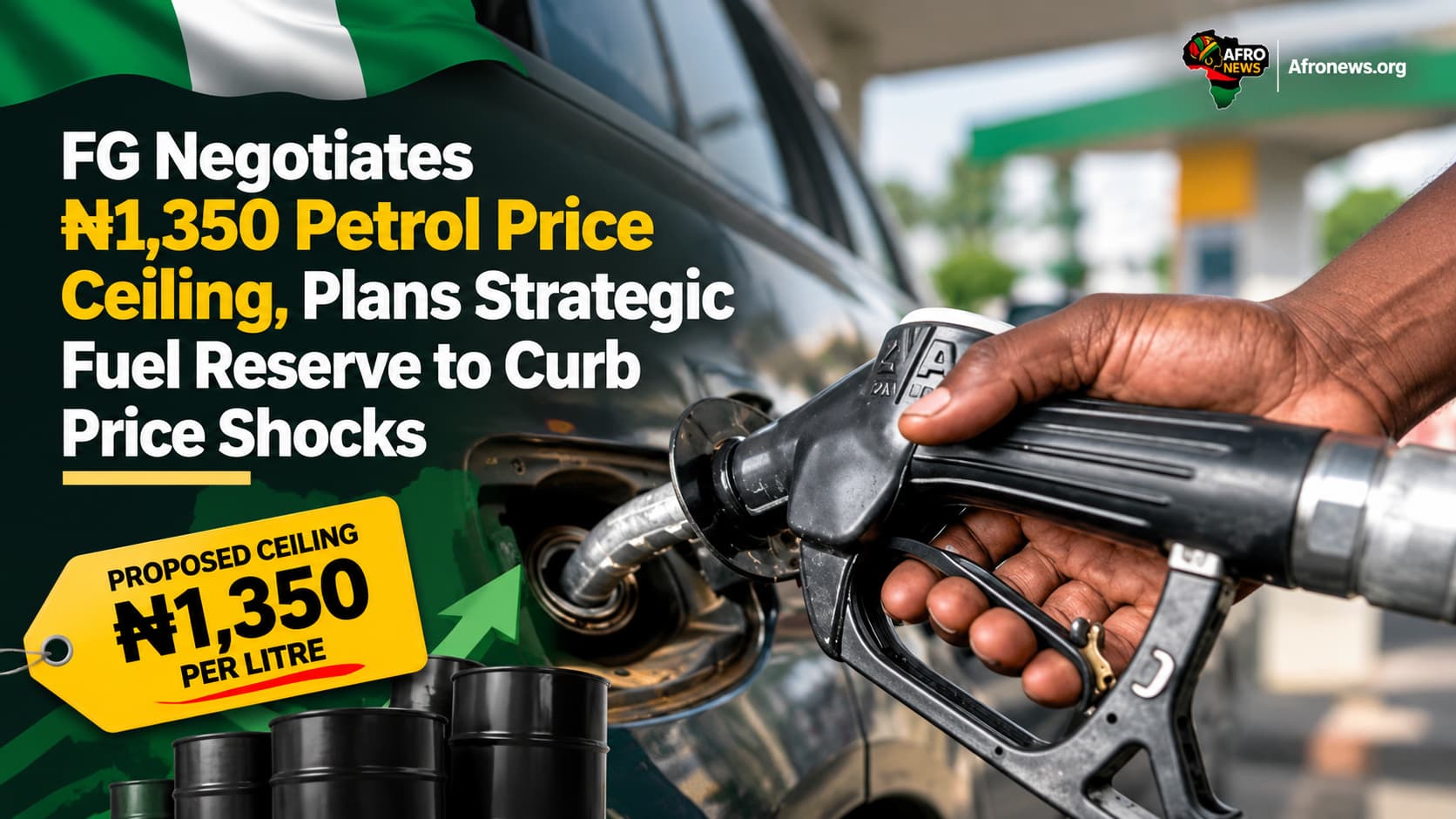
The Federal Government is negotiating a ₦1,350-per-litre ceiling on the ex-gantry or landing cost of petrol as part of measures to reduce price volatility, protect consumers from sudden fuel price increases and strengthen Nigeria’s energy security.
Taiwo Oyedele, Minister of Finance, disclosed this on Thursday at a news conference on petrol subsidy in Abuja, explaining that the proposed framework would allow petrol prices to adjust more gradually to changes in global crude oil prices and foreign exchange rates.
According to Oyedele, the government intends to introduce a system known as price modulation, under which petrol pump prices would not necessarily respond immediately to every movement in international oil markets or the exchange rate.
Related Post




“The government is negotiating a ceiling of 1,350 naira a litre on the ex-gantry or landing cost of petrol, to keep pump prices stable,” the minister said.
Under the proposed arrangement, when production or importation costs rise above the agreed ceiling, refiners and importers would initially absorb the difference and recover it later when market conditions improve, without exceeding the ceiling.
Oyedele said the approach was designed to smooth out price fluctuations over time rather than suppress market prices through government subsidies or direct price controls.
He argued that maintaining relatively stable prices could offer households and businesses greater certainty than allowing sharp increases and subsequent reductions within short periods.
“₦1,400 a litre today and ₦1,400 tomorrow is better than ₦1,500 today and ₦1,300 tomorrow, because volatility itself adds to uncertainty and cost,” he said.
The minister also observed that increases in transport fares following fuel price hikes are often not reversed as quickly when petrol prices fall, leaving consumers exposed to the effects of rising living and operating costs.
FG to Review Petrol Price Ceiling Monthly
Oyedele said the proposed price ceiling would be reviewed monthly and adjusted when necessary to reflect prevailing costs.
He added that the relevant figures would be published to promote transparency and allow the public to monitor the operation of the framework.
The proposal, however, hinges on the outcome of the government’s negotiations and the eventual implementation of the mechanism. The ₦1,350 figure is therefore a proposed ceiling on ex-gantry or landing costs, not an announced fixed retail price at filling stations.
Strategic Fuel Reserve to Prevent Scarcity
Beyond price modulation, the Federal Government plans to establish a national strategic fuel reserve to protect households and businesses against future energy supply disruptions.
Oyedele said refined petroleum products would be released into the market under clear, publicly disclosed rules whenever global disruptions or hoarding threaten supply and price stability.
He maintained that the reserve would not operate as a subsidy scheme or a mechanism for fixing pump prices, but as a safeguard against supply shortages and excessive market volatility.
According to the minister, the initiative is intended to prevent artificial scarcity, discourage market manipulation and strengthen long-term energy security within Nigeria’s deregulated petroleum market.
The effectiveness of the proposed reserve would depend on its implementation, including the availability of adequate stock, transparent release procedures and the government’s ability to respond promptly to disruptions.
FG Pushes CNG Rollout, Considers Excess Profit Tax
The government is also expanding the deployment of compressed natural gas (CNG) in collaboration with state governments as part of efforts to reduce transport costs and limit the impact of petrol prices on commuters.
Oyedele said transport operators benefiting from CNG adoption were being encouraged to pass the resulting savings on to passengers through lower fares.
The minister further disclosed that the government would consider introducing an excess profit tax targeting operators across the energy value chain who take undue advantage of consumers.
He said proceeds from the proposed measure would be used exclusively to cushion the effects of fuel prices on vulnerable groups, potentially through transport assistance or vouchers for urban minimum-wage earners.
The proposal would add a targeted relief component to the government’s broader strategy, which combines price stabilisation measures, supply security and alternative transport energy.
2027 Finance Bill May Include Tax Relief for Low-Income Earners
Oyedele also said the Federal Government would work with the National Assembly to consider enhanced tax relief for low-income earners under the 2027 Finance Bill.
The proposed relief is intended to provide additional support to workers facing pressure from fuel costs and broader household expenses.
Taken together, the planned measures point to an attempt by the government to manage the effects of petrol price fluctuations without formally returning to a general fuel subsidy regime.
However, the practical impact on consumers will depend on the final terms of the price-ceiling negotiations, how refiners and importers recover costs, the operation of the strategic fuel reserve and whether transport savings and targeted relief reach the intended beneficiaries.
For Nigerian households and businesses, the central question will be whether the proposed policies can deliver more predictable fuel costs and meaningful relief without creating new financial pressures elsewhere in the energy market.