
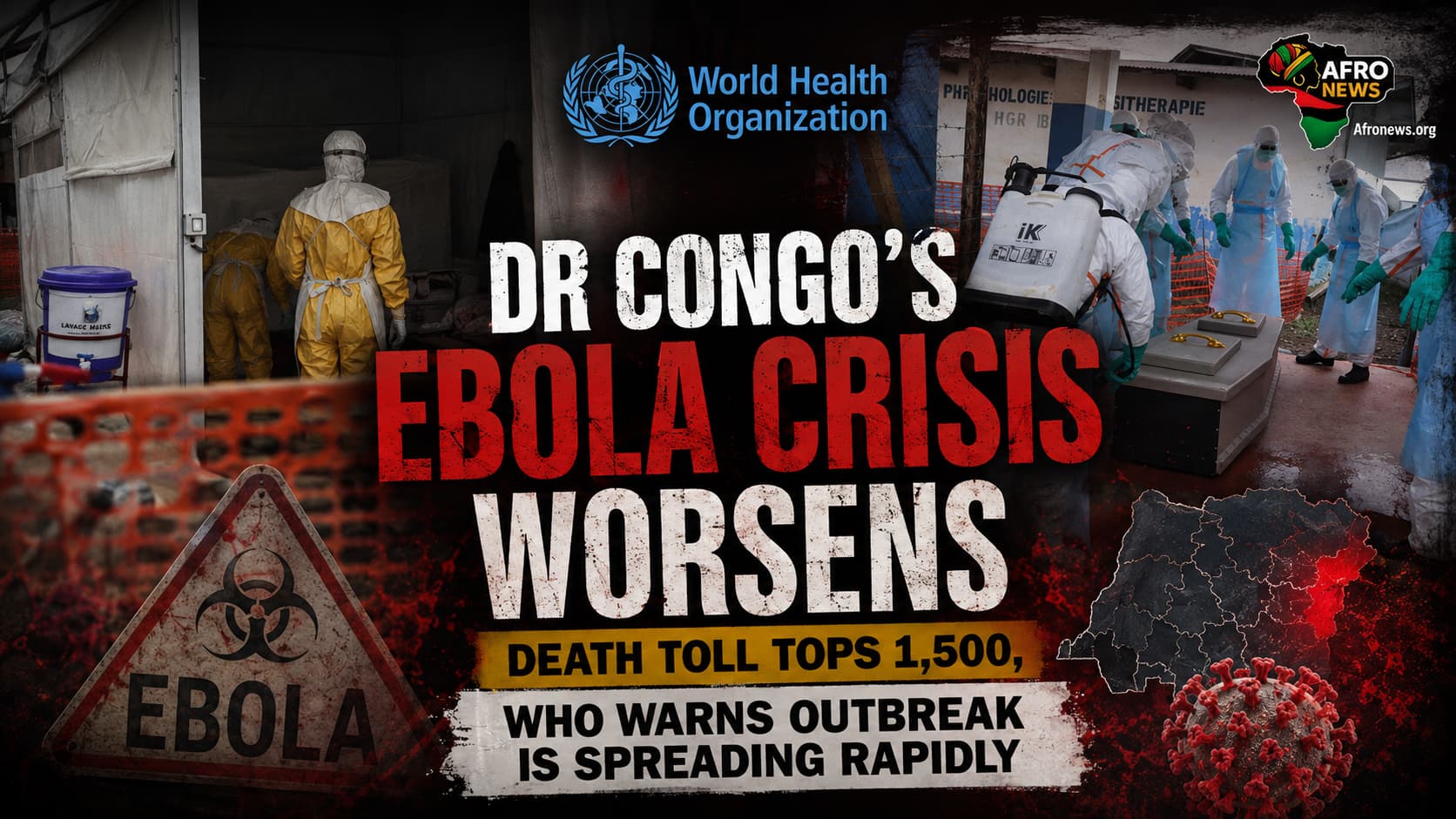
The Democratic Republic of the Congo (DRC) is battling its worst-ever Ebola outbreak, with the World Health Organization (WHO) warning that the rapidly spreading Bundibugyo virus continues to outpace response efforts as infections and deaths climb at an alarming rate.
According to the latest WHO situation update, released on Saturday, the outbreak has reached 3,605 confirmed cases and 1,587 deaths as of 30 July 2026, making it the largest Ebola outbreak ever recorded in the country
Virus Spreads Across Five Provinces
The outbreak, which was initially confined to the Mongbwalu Health Zone in Ituri Province, has expanded dramatically over the past two months.


WHO said the virus has now spread to 49 health zones across five provinces Ituri, North Kivu, South Kivu, Haut-Uélé, and Tshopo significantly increasing the risk of further transmission.
The agency reported that epidemiological week 30 recorded the highest weekly figures since the outbreak began, with 567 new confirmed infections and 296 deaths.
“The continued increase in cases, expanding geographic spread, and persistently high mortality underscore the rapidly evolving nature of this public health emergency,” WHO said.
Conflict and Displacement Fuel Transmission
Health officials say efforts to contain the outbreak are being undermined by insecurity, armed conflict, mass displacement, and frequent cross-border movement.
WHO noted that violence and attacks on health facilities, coupled with poor access to affected communities, continue to hamper surveillance, contact tracing, treatment, and safe burial operations.
Although the Congolese government, WHO and international partners have intensified emergency measures,including surveillance, laboratory testing, case management, contact tracing and community engagement,the UN health agency says the response requires significantly greater funding and resources.
“A substantial scaling up of response activities is needed to get ahead of the outbreak,” WHO said.
Uganda Declares Ebola Outbreak Over
In a positive development, neighbouring Uganda has officially declared an end to its Bundibugyo Ebola outbreak after completing the mandatory 42 consecutive days without any locally transmitted confirmed case.
Uganda’s Ministry of Health made the declaration on 28 July, following WHO guidelines after the last locally transmitted patient was discharged on 16 June. The country’s most recent imported case also recovered and was discharged after testing negative twice for the virus.
Despite the declaration, WHO warned that Uganda remains vulnerable to fresh imported infections because the outbreak continues to rage across the border in eastern DRC.
The agency has urged countries across the region to maintain heightened surveillance, strengthen border screening, and reinforce infection-prevention measures, particularly in high-mobility border communities.
No Approved Vaccine for Bundibugyo Strain
Public health experts say the current outbreak presents a unique challenge because it is caused by the Bundibugyo strain of the Ebola virus, which differs from the Zaire strain responsible for the devastating 2014–2016 West African epidemic.
Unlike the Zaire strain, there is currently no licensed vaccine or approved targeted treatment for Bundibugyo virus disease, making rapid detection, isolation, contact tracing, and strict public health interventions the most effective tools for limiting transmission.
References
- World Health Organization (WHO) Disease Outbreak News: WHO Ebola Disease Outbreak News
- World Health Organization (WHO): WHO Emergencies Portal
- Associated Press: AP report on DRC Ebola outbreak
- Reuters: Reuters report on Uganda declaring end of Ebola outbreak