

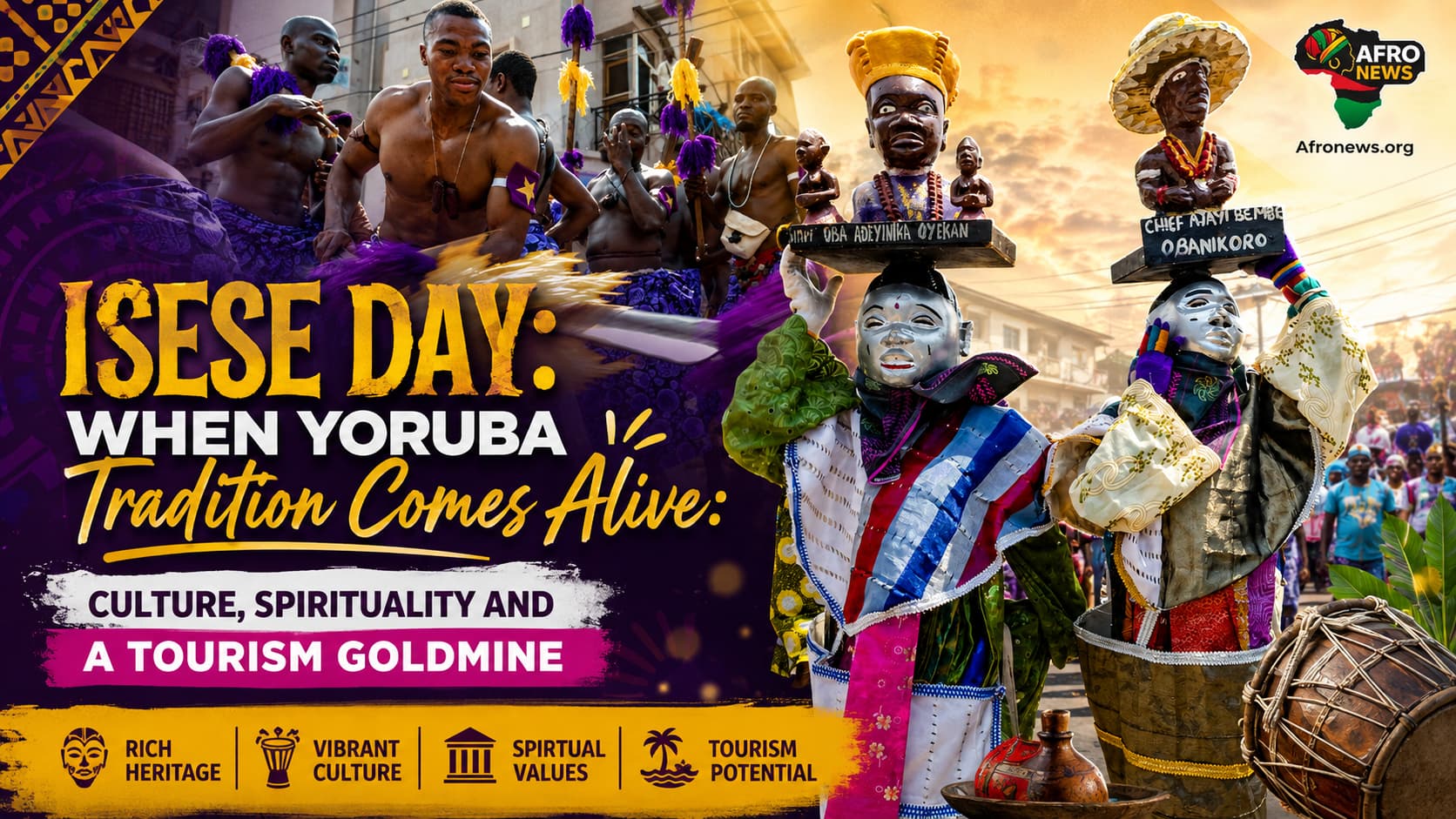
On August 20, parts of southwestern Nigeria take a colourful step back into history not to live in the past, but to remember where they came from.
It is Ìṣẹ̀ṣe Day, a celebration rooted in Yoruba tradition, spirituality, identity and ancestral heritage. The word Ìṣẹ̀ṣe broadly means tradition, and the day provides adherents of the Yoruba traditional religion an opportunity to honour their deities, ancestors and the cultural values handed down through generations.
What began as a religious observance has increasingly become a powerful expression of cultural identity, with enormous potential for tourism, creative enterprise and economic development.



From Ancient Tradition to Modern Recognition
Yoruba traditional religion predates the arrival and spread of Christianity and Islam in Yorubaland. Its worldview is deeply connected to the relationship between the Supreme Being, the Òrìṣà, ancestors, humanity and nature.
The modern recognition of August 20 as Ìṣẹ̀ṣe Day, however, is relatively recent. Osun State pioneered formal recognition of the day, while other southwestern states subsequently joined the movement. In recent years, Lagos, Ogun, Osun and Oyo have recognised August 20 in various forms, with public-holiday declarations made in different years. In 2025, the Lagos State House of Assembly also formally recognised August 20 as an annual Ìṣẹ̀ṣe Day.
For 2026, available holiday listings identify Ogun, Osun and Oyo as states observing August 20 as a regional holiday, while the status of Lagos differs from the annual state-government holiday declarations.
The significance, therefore, goes beyond whether workers receive a day off. It is about giving an ancient belief system and cultural heritage space in a modern Nigeria.
The Rituals, the Music and the Meaning
Ìṣẹ̀ṣe celebrations can involve prayers, traditional chants, drumming, dancing, processions, consultations with Ifá priests, offerings and other rites performed according to the particular tradition or deity being honoured.
The Yoruba spiritual universe includes revered Òrìṣà such as Ọ̀ṣun, Ṣàngó, Ògún, Ọ̀bàtálá and Èṣù, while Ifá divination, associated with Òrúnmìlà, remains an important intellectual and spiritual tradition.
Different communities have their own customs and rituals. Some ceremonies take place at shrines, sacred groves, rivers or traditional palaces. Traditional priests, priestesses, chiefs, devotees and members of traditional institutions often play important roles.
Dress is also part of the spectacle. White, red, black and other culturally significant colours feature prominently, while talking drums, praise poetry, traditional songs, dancing, masquerades and elaborate Yoruba attire turn many celebrations into a vibrant cultural display.
But beneath the music and pageantry is a deeper purpose: continuity.
Traditions survive when they are practised, taught and respected.
Why It Matters to Yoruba Identity
For many adherents, Ìṣẹ̀ṣe is not simply a festival. It is a link between the present and generations that came before.
It preserves oral history, indigenous language, traditional knowledge, music, fashion, philosophy, folklore, craftsmanship and communal values. It also keeps alive traditional institutions and the knowledge of priests, priestesses, drummers, artisans, historians and custodians of sacred spaces.
This is particularly important in an era when globalisation is rapidly reshaping cultural identities.
A young Yoruba person who watches an elder explain an ancestral proverb, learns a traditional song, witnesses a procession or visits a sacred site is receiving something that cannot be downloaded from the internet: living heritage.
And that heritage has global relevance.
UNESCO describes the Osun-Osogbo Sacred Grove as one of the last surviving sacred groves of its kind in Yorubaland and a symbol of Yoruba identity. The grove contains shrines, sculptures, sacred spaces and worship points and remains an active religious site.
The UNESCO-recognised Gẹ̀lẹ̀dẹ́ oral heritage is another example of Yoruba cultural traditions extending across Nigeria, Benin and Togo.
A Tourism Goldmine Waiting to Be Properly Unlocked
This is where Ìṣẹ̀ṣe could become much bigger than a religious celebration.
Imagine a properly organised annual cultural tourism circuit linking Osun-Osogbo, Ile-Ife, Oyo, Abeokuta, Lagos, Badagry and other historic Yoruba communities.
Visitors could experience traditional music, cuisine, fashion, arts and crafts, storytelling, palace history, indigenous architecture, festivals and guided visits to heritage sites.
Osun-Osogbo alone demonstrates what is possible. Its sacred grove has international recognition, while its annual festival attracts visitors and reconnects Yoruba communities in Nigeria with the wider diaspora. UNESCO notes that the site has become a place of pilgrimage and a symbol of identity for Yoruba people and their descendants across the world.
With serious investment in accommodation, transportation, security, tour guides, digital promotion, museums, cultural centres, local cuisine, handicrafts and event management, Ìṣẹ̀ṣe-related tourism could create jobs for young people while generating income for hotels, restaurants, transport operators, artisans, entertainers and local businesses.
Nigeria’s tourism sector already has significant economic weight. The Federal Government said tourism contributed about $17.3 billion, or 3.65% of Nigeria’s GDP, in 2022, illustrating the size of the opportunity if cultural tourism is strategically developed.
Ìṣẹ̀ṣe could become another powerful piece of that economic puzzle.
Preserving Prestige Without Freezing Tradition
There is also an important cultural argument for the celebration.
Every society protects the things that tell its story.
For Yorubaland, traditional rulers, sacred sites, ancestral histories, festivals, praise poetry, indigenous spirituality and communal rituals are part of a heritage that survived colonialism, religious transformation and decades of cultural pressure.
Recognising Ìṣẹ̀ṣe gives traditional institutions and their adherents a platform to preserve that heritage with dignity.
But preservation should not mean refusing to evolve.
The challenge is to ensure that the celebration remains authentic while becoming accessible, organised and attractive to younger generations and international visitors.
That means explaining the rituals rather than merely displaying them. It means respecting sacred spaces while creating designated areas where tourists can observe cultural performances. It means protecting heritage sites from overcrowding and commercial exploitation,an issue UNESCO itself has highlighted in relation to Osun-Osogbo.
And Then Comes the Controversy
For all its cultural possibilities, Ìṣẹ̀ṣe Day does not exist in a vacuum.
The celebration has faced strong opposition from sections of Nigeria’s Christian and Muslim communities, with critics describing aspects of traditional worship as paganism or incompatible with their faiths.
That tension raises an uncomfortable but necessary question: Can Ìṣẹ̀ṣe present itself to a modern, religiously diverse Nigeria and to the international tourist as a celebration of heritage, spirituality, history and culture rather than a threat to other faiths?
The answer may ultimately rest with the adherents themselves.
If Ìṣẹ̀ṣe is to become a global cultural attraction, its custodians will have to demonstrate that its rituals can coexist peacefully with Nigeria’s religious diversity, while presenting the celebration in a way that informs rather than frightens, educates rather than alienates, and welcomes visitors without compromising its sacred values.
Because beyond the shrines, chants and rituals lies a much bigger question:
Can August 20 become the day the world discovers that one of Africa’s oldest living traditions is not merely something to worship but a heritage to understand, experience and celebrate?
References / Further Reading
UNESCO World Heritage Centre — Osun-Osogbo Sacred Grove Read source�
UNESCO Intangible Cultural Heritage — Ifa Divination System Read source�
UNESCO — Safeguarding of the Ifa Divination System Read source�
National Commission for Museums and Monuments — Osun-Osogbo Sacred Grove Read source�
UNESCO — Oral Heritage of Gelede UNESCO Intangible Cultural Heritage List�