
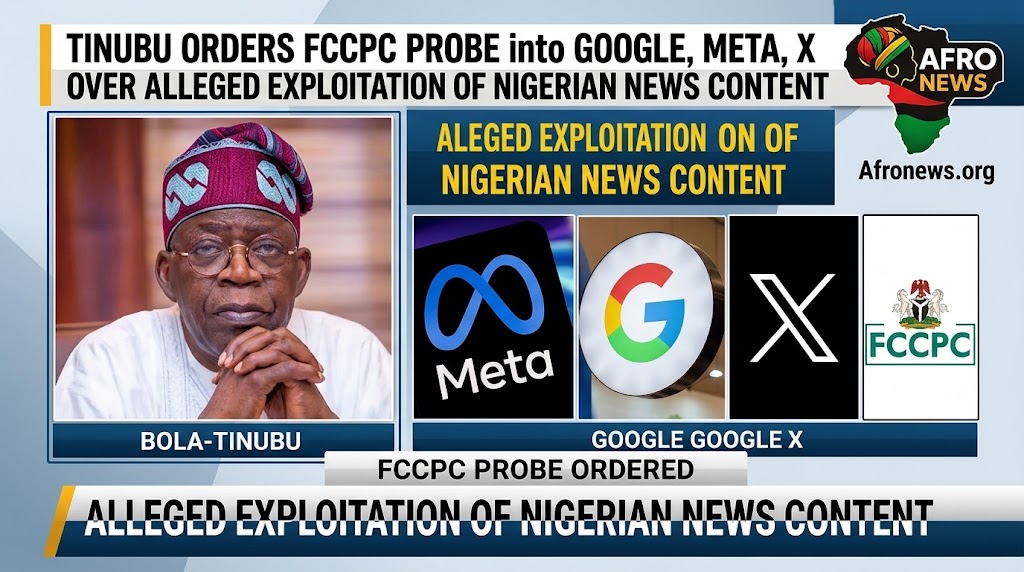
President Bola Tinubu has ordered a sweeping investigation into some of the world’s biggest technology companies, including Google, Meta, X and several Generative Artificial Intelligence platforms, over allegations that they are exploiting Nigerian news content without fair compensation.
The directive, issued through the Minister of Information and National Orientation, Mohammed Idris, empowers the Federal Competition and Consumer Protection Commission (FCCPC) to examine claims of anti-competitive practices and the unauthorised use of copyrighted journalistic materials.
The move follows a joint petition submitted to the Presidency by the Nigerian Press Organisation (NPO), an umbrella body representing the Newspaper Proprietors’ Association of Nigeria (NPAN), the Nigeria Union of Journalists (NUJ), the Broadcasting Organisations of Nigeria (BON), and the Guild of Corporate Online Publishers (GOCOP).
Related Post




Publishers Demand Fair Compensation
Nigeria’s media industry has long argued that global technology companies profit from news content produced by local publishers while providing little or no financial return to the organisations that create it.
According to the FCCPC, the investigation will examine allegations that companies including Meta, Alphabet (Google’s parent company), X (formerly Twitter), and several AI platforms have engaged in practices capable of undermining fair competition, weakening the commercial sustainability of Nigerian media organisations and violating the rights of content creators.
In a statement issued by the FCCPC’s Director of Corporate Affairs, Ondaje Ijagwu, the commission confirmed that the probe was initiated following President Tinubu’s directive.
The statement said the investigation would focus on allegations of anti-competitive conduct, unlawful exploitation of news content and other potentially unfair business practices within Nigeria’s rapidly evolving digital ecosystem.
FCCPC Promises Fair and Transparent Investigation
Executive Vice Chairman and Chief Executive Officer of the FCCPC, Tunji Bello, stressed that the commission would conduct an independent, transparent and evidence-based inquiry.
According to Bello, the investigation is not intended to presume wrongdoing by any company but to objectively establish the facts and determine whether any actions violate Nigerian competition or consumer protection laws.
He assured all affected parties that they would be given a fair opportunity to present evidence before any conclusions are reached.
“We recognise the strategic importance of the media to Nigeria’s democracy and the equally significant role of technology in driving innovation and economic growth,” Bello said.
“Our responsibility is to ensure that competition within Nigeria’s digital economy remains fair, transparent and consistent with existing laws.”
AI Platforms Also Under the Spotlight
A key aspect of the investigation will focus on allegations that Generative AI platforms have been scraping, extracting and commercially using copyrighted Nigerian news articles, broadcast content and other original journalistic works to train artificial intelligence models without obtaining permission or providing compensation.
The commission will also investigate complaints from publishers who claim they have been denied meaningful opportunities to negotiate licensing agreements or fair commercial terms for the use of their content.
The FCCPC will determine whether the practices breach the Federal Competition and Consumer Protection Act 2018 or any other applicable Nigerian laws.
Nigeria Joins Global Push for Fair Digital News Payments
Nigeria’s investigation mirrors a growing international effort to compel technology companies to compensate news publishers for the content that drives engagement on their platforms.
Countries including Australia, Canada and South Africa have introduced measures requiring digital platforms to negotiate payment agreements with media organisations.
In South Africa, investigations by the Competition Commission resulted in Google agreeing to pay local news publishers approximately R688 million (about $40 million) annually for a period of three to five years.
Industry observers believe Nigeria’s investigation could reshape the country’s digital media landscape and establish new rules governing how global technology firms use and monetise locally produced journalism.
Fresh Scrutiny After Meta Penalty
The latest probe comes less than a year after the FCCPC secured a landmark judgment against Meta over alleged violations of Nigeria’s competition and consumer protection laws, including data privacy breaches.
The commission imposed a $220 million penalty on the technology company, a decision Meta is currently appealing.
The new investigation signals the Federal Government’s growing determination to ensure that multinational technology companies comply with Nigerian regulations while guaranteeing that local publishers receive fair value for the original content that powers today’s digital information economy.
If the FCCPC finds evidence of anti-competitive conduct or copyright violations, the outcome could significantly influence the future relationship between global technology firms, AI developers and Nigeria’s media industry.