
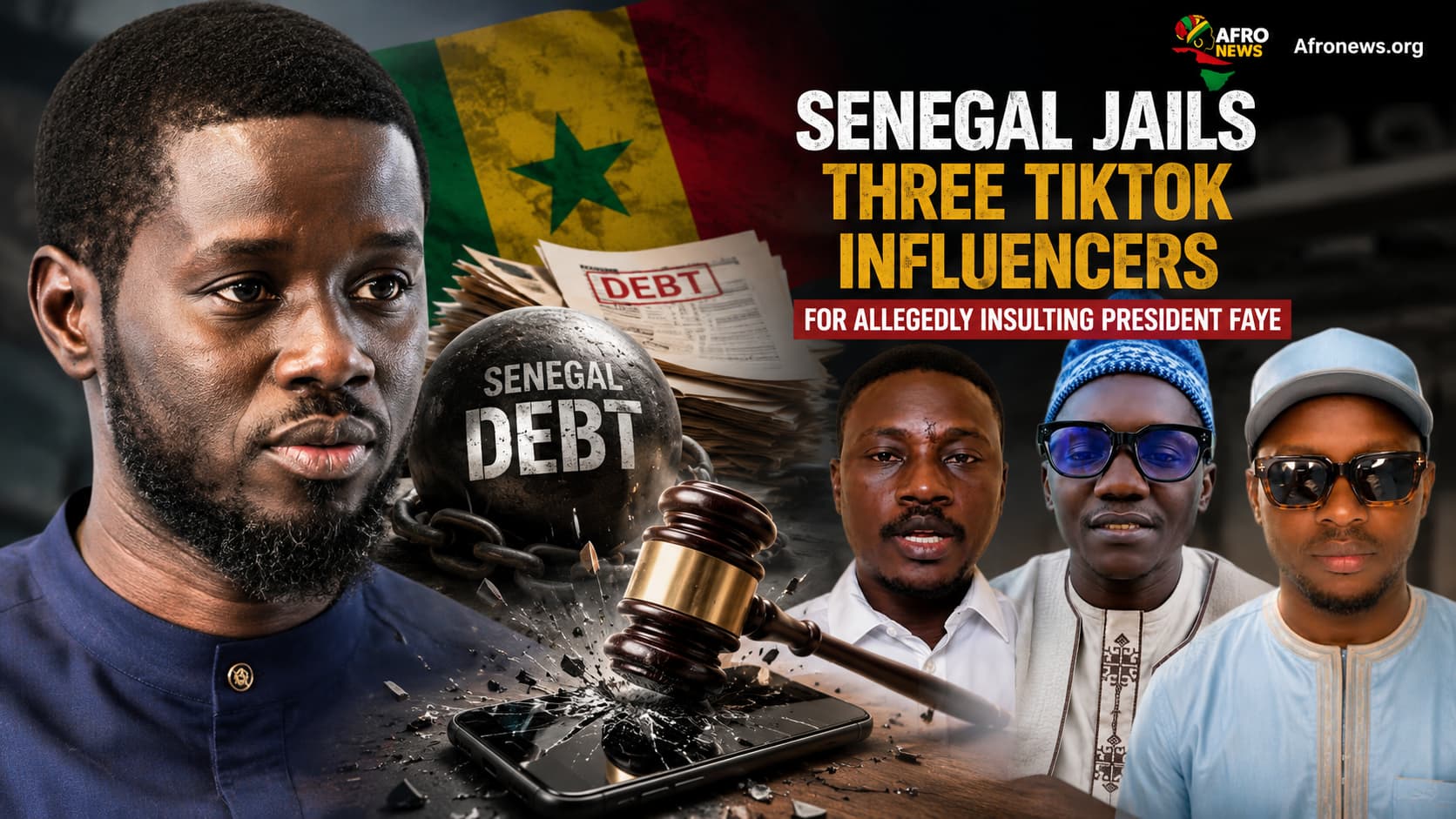
A Senegalese court has sentenced three popular TikTok influencers to prison over videos deemed insulting to President Bassirou Diomaye Faye, a decision that has ignited fresh concerns over freedom of expression and the criminalisation of online criticism in one of West Africa’s most celebrated democracies.
The ruling has shocked many political observers who expected President Faye, Africa’s youngest democratically elected leader and a politician who rose to power on promises of reform, transparency and democratic renewal to adopt a more tolerant approach toward criticism, particularly on social media.
Instead, the convictions have intensified debate over whether Senegal is drifting toward a broader continental trend in which governments increasingly use criminal laws to silence dissent.



Who Are the Convicted TikTok Influencers?
The harshest sentence was handed to Mandoumbe Diop, popularly known on TikTok as Lamignou Darou, who received three months in prison without suspension.
Diop commands an audience of more than 500,000 followers, with many of his videos attracting tens of thousands of views.
Two other creators affiliated with Feenal Digital, Magueye Diaw (Oustaz Thiep) and Moustapha Ndiaye (Ndiaye Touba) were each sentenced to two months in prison without suspension
In addition to their jail terms, both men were fined 500,000 CFA francs (approximately $800) each.
Their lawyer, Abdy Nar Ndiaye, argued before the court that the videos were comedic and satirical in nature and did not warrant criminal prosecution.
Feenal Digital describes itself as an online media platform that promotes government and private-sector activities through social media.
Political Rift Deepens in Senegal
The convictions come against the backdrop of growing political tensions between President Faye and his former political ally, Ousmane Sonko.
The two men jointly led the rise of the PASTEF movement and secured a historic electoral victory in 2024. However, relations have deteriorated significantly in recent months after President Faye reportedly moved to establish his own political platform, exposing widening cracks within the country’s ruling establishment.
Some observers believe the prosecution of influencers perceived to be sympathetic to Sonko may further fuel political tensions, although authorities have maintained that the case is purely a matter of enforcing the law.
A Growing Pattern Across Africa
Senegal is far from alone.
Across Africa, several governments have invoked criminal defamation, cybercrime or false publication laws to prosecute citizens accused of insulting presidents or senior government officials.
In Uganda, critics have repeatedly been arrested under the Computer Misuse Act for online posts deemed offensive to President Yoweri Museveni and members of the First Family.
In Zimbabwe, activists, journalists and opposition supporters have faced prosecution under cyber laws for allegedly undermining President Emmerson Mnangagwa or spreading information considered harmful to the state.
In Tanzania, authorities have used cybercrime legislation to arrest bloggers, activists and social media users over posts critical of government leaders
In Rwanda, several online commentators and YouTubers have been detained over content authorities considered insulting or threatening to the state and President Paul Kagame.
Even in Nigeria, although there is no specific offence criminalising insults against the president, journalists and social media users have occasionally been prosecuted under provisions of the Cybercrimes Act or other laws following criticism of public officials, raising persistent concerns among free speech advocates.
Why Rights Groups Are Concerned
Human rights organisations argue that imprisoning citizens for insulting political leaders undermines democratic values and creates a chilling effect on free expression.
While governments have a legitimate interest in combating incitement to violence, hate speech and deliberate misinformation, critics say criminal penalties for satire, mockery or harsh political criticism often become tools to intimidate journalists, activists and ordinary citizens.
International human rights standards generally favour civil remedies over imprisonment in cases involving alleged defamation of public officials, stressing that elected leaders should be prepared to tolerate a higher level of public scrutiny than private citizens.
For Senegal, long regarded as one of Africa’s strongest democracies, the convictions risk damaging its reputation as a country where political freedoms have traditionally been more robust than in many neighbouring states.
The irony is difficult to ignore. A president who inspired millions of young Africans with promises of democratic renewal is now presiding over a government accused of punishing online criticism—a development few anticipated when he swept to power.
As the debate over free speech and digital rights intensifies across the continent, Senegal’s latest court ruling raises a troubling question: if criticism of elected leaders increasingly becomes a criminal offence, who will dare hold those in power accountable tomorrow?
- Reuters – Senegal court jails three TikTok influencers for insulting the president (August 6, 2026)
Reuters: Senegal court jails three TikTok influencers for insulting the president
Primary report detailing the convictions, sentences and statements from the defence lawyer. - Reuters – Bassirou Diomaye Faye sworn in as Senegal’s President (April 2, 2024)
Reuters: Faye sworn in as Senegal president, cites “profound desire for change”
Background on President Faye’s election and reform agenda. - Reuters – Senegal releases opposition figures Sonko and Faye (March 15, 2024)
Reuters: Senegal releases opposition leader Sonko and presidential candidate Faye from prison
Background on the political alliance between Faye and Ousmane Sonko before they assumed power. - Amnesty International – Freedom of Expression
Amnesty International: Freedom of Expression
- Human Rights Watch – Africa
- Committee to Protect Journalists (CPJ) – Africa