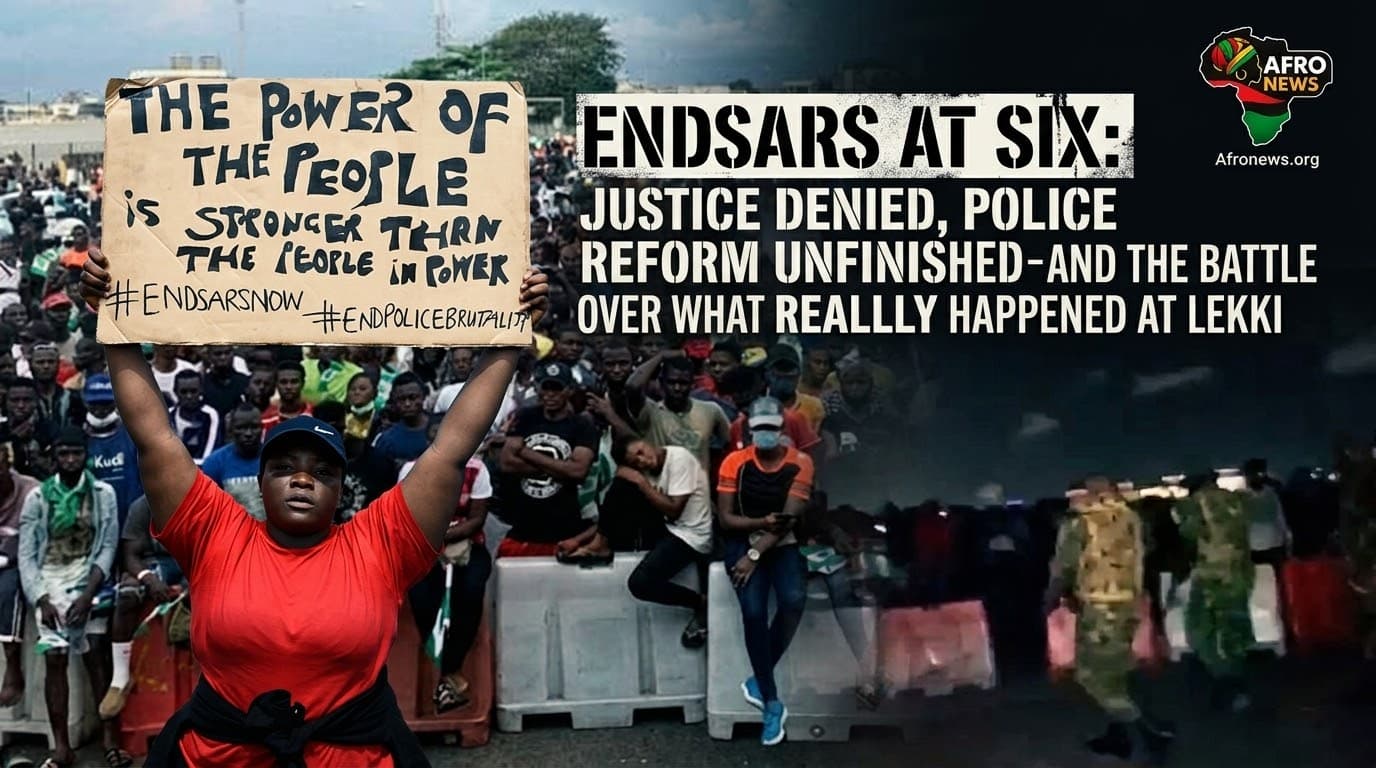
Six years after thousands of Nigerians took to the streets demanding an end to police brutality, the #EndSARS movement remains a defining moment in the country’s recent history. What began as a campaign against abuses by the now-disbanded Special Anti-Robbery Squad (SARS) grew into a nationwide demand for accountability, police reform and a government that protects rather than intimidates its citizens.
But as Nigeria marks the sixth anniversary of the protests, a difficult question remains: Have the promises made after the uprising translated into justice for victims, meaningful police reform and an end to extrajudicial killings?
Six years on, why #EndSARS still matters



The protests erupted in October 2020 after years of allegations of arbitrary arrests, extortion, torture, harassment and extrajudicial killings, particularly by SARS officers. Young Nigerians also complained about profiling based on their appearance, smartphones, dreadlocks and perceived wealth.
The movement quickly expanded beyond the demand to disband SARS. Protesters called for the release of detained citizens, compensation for victims, prosecution of abusive officers, better police welfare and a fundamental overhaul of Nigeria’s policing system.
On October 11, 2020, the police announced the dissolution of SARS. The administration of the late President Muhammadu Buhari subsequently promised broader reforms and accepted the protesters’ five-point demands, including accountability for misconduct and compensation for victims. State judicial panels were also established to investigate allegations of police brutality.
However, the dissolution of SARS did not automatically resolve the underlying problems. A 2024 report by The Guardian found that, of an estimated ₦2.7 billion in compensation recommended nationwide, about ₦923 million had been paid by Lagos, Osun, Ekiti and the Federal Capital Territory, leaving approximately ₦1.77 billion outstanding. The report also found that no accused officers had been prosecuted in the jurisdictions covered by its findings.
Six years later, rights advocates continue to report allegations of torture, unlawful detention, extortion and excessive use of force. The Rule of Law and Accountability Advocacy Centre says the gap between reform promises and actual policing practices remains substantial.
What is the Tinubu administration doing?
President Bola Tinubu’s administration has continued to face demands to demonstrate that police reform goes beyond policy announcements. One significant development is the push towards state police, intended to decentralise policing and improve responses to local security challenges.
In June 2026, the Presidency said work on the constitutional framework for state police had advanced. The House of Representatives also passed a constitutional amendment bill in June, although further constitutional approval and safeguards against political abuse remain essential.
Yet, state police alone cannot guarantee accountability. The crucial tests include transparent investigations into police misconduct, prosecution where evidence supports charges, implementation of judicial-panel recommendations, compensation for victims and safeguards against political interference.
The question is whether these measures will deliver a demonstrable change in how Nigerians experience policing or whether the country will continue to repeat the cycle of public outrage, official promises and limited accountability.
Atiku and Obi demand justice
The sixth anniversary has revived calls for answers from two prominent opposition figures as Nigeria approaches the 2027 general election.
Former Vice-President and the African Democratic Congress,ADC Presidential candidate,Atiku Abubakar, in a post on his X account on October 20, asked: “Six years after the Lekki shooting, Nigeria is still waiting for a clear answer to one devastating question: Who gave the order?”
Atiku criticised the APC-led government for failing to provide satisfactory answers and argued that families and young Nigerians deserve accountability rather than silence.
Former Anambra State governor and the Nigerian Democratic Congress,NDC Presidential candidate,Peter Obi also commemorated the anniversary, describing the shooting as a painful chapter in Nigeria’s history. He said peaceful protesters had been met with gunfire and called for justice, respect for human rights and a country where citizens could demand good governance without fear of brutality.
“We must never forget. We must never normalise injustice,” Obi deculared in his anniversary message.
Atiku criticised the APC-led government for failing to provide satisfactory answers and argued that families and young Nigerians deserve accountability rather than silence.
Former Anambra State governor Peter Obi also commemorated the anniversary, describing the shooting as a painful chapter in Nigeria’s history. He said peaceful protesters had been met with gunfire and called for justice, respect for human rights and a country where citizens could demand good governance without fear of brutality.
“We must never forget. We must never normalise injustice,” Obi declared in his anniversary message.
Both messages have renewed pressure on the government to address lingering questions surrounding the incident, although their political positions also place the anniversary within the wider contest for public confidence ahead of 2027.
GRV and Funso Doherty visit Lekki Toll Gate
The anniversary took a tense turn in Lagos on October 20, 2026, when Gbadebo Rhodes-Vivour, popularly known as GRV, and Funso Doherty joined others at the Lekki Toll Gate to pay tribute to protesters who were allegedly killed during the October 20, 2020, military operation.
According to reports, police fired tear gas to disperse the gathering, forcing participants to flee. The incident revived concerns about citizens’ right to peaceful assembly and the use of force against people commemorating the protest.
For many Nigerians, the confrontation was a troubling reminder that six years after the original demonstrations, even commemorating the movement can become contentious. It also raises a fundamental question: how much has changed if citizens still encounter force while seeking to remember victims and demand accountability?
Did a massacre happen at Lekki?
The Lekki Toll Gate shooting remains the most disputed and politically charged aspect of #EndSARS.
The Lagos State Judicial Panel of Inquiry concluded in 2021 that soldiers shot at unarmed protesters and that deaths occurred. Amnesty International also reported that its investigation had found evidence of security forces killing protesters and documented videos, eyewitness accounts and hospital reports.
However, the Lagos State Government rejected key conclusions of the panel’s report in its White Paper, disputing the evidence supporting the claimed deaths and rejecting the characterisation of the incident as a massacre.
It would therefore be inaccurate to say that no evidence of shootings exists. Evidence of gunfire and the presence of soldiers has been documented, but the precise number and circumstances of deaths, the chain of command and individual criminal responsibility remain subjects of dispute and calls for accountability.
As politicians increasingly invoke Lekki in their appeals to voters, the anniversary risks becoming another battleground for competing political narratives. Yet, neither political rhetoric nor official denial can substitute for credible evidence, transparent investigations and justice for anyone whose rights were violated.
Six years after the gunfire, the question is no longer simply whether Nigerians remember Lekki. It is whether the country can establish the truth beyond political argument and hold those responsible accountable. As the 2027 election approaches, will Lekki finally receive the justice its victims and survivors have demanded, or will the truth remain trapped between unresolved evidence, official denials and political interests?
References
Channels Television — Police fire tear gas at Lekki Toll Gate on the sixth anniversary
Vanguard — Atiku asks who ordered the Lekki shooting
Amnesty International — Investigation into the Lekki Toll Gate shootings
The Guardian — EndSARS victims await compensation years after the judicial panels
The State House — Progress on the state police constitutional framework