

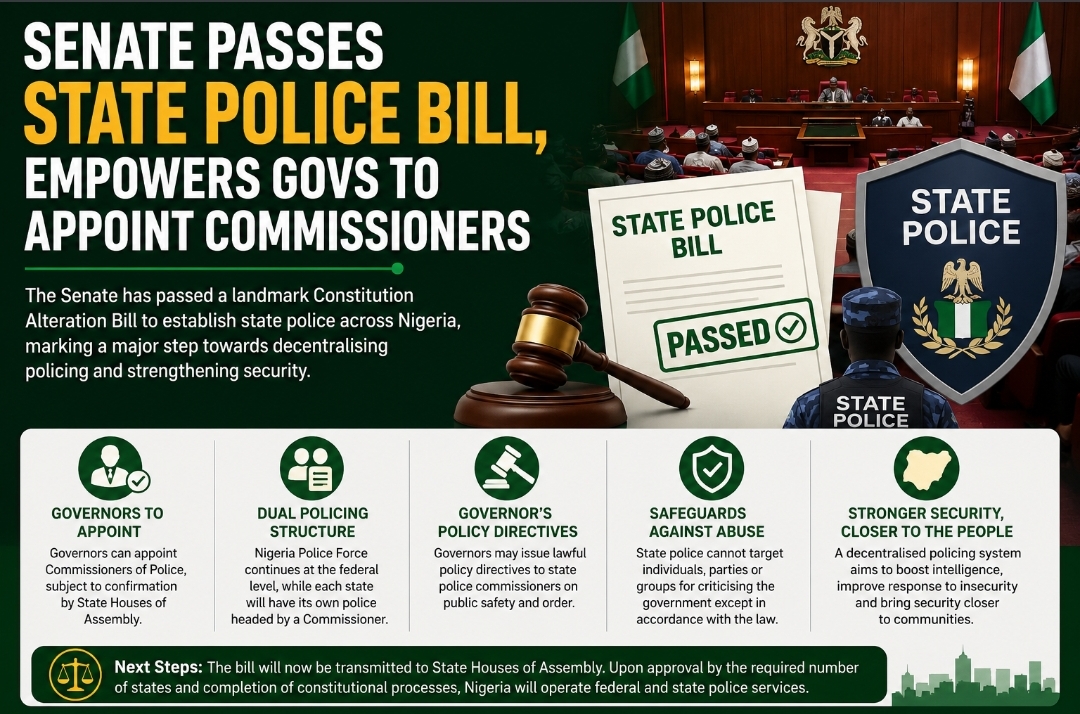
The Nigerian Senate on Wednesday passed the Constitution Alteration Bill seeking to establish state police, a landmark move that could significantly reshape Nigeria’s security architecture.
The bill was approved after a clause-by-clause consideration and secured the support of more than two-thirds of senators through a manual voting process conducted during plenary.
Announcing the passage, Senate President, Godswill Akpabio, described the development as a major step in ongoing efforts to address the country’s security challenges through a more decentralised policing system.



The legislation was adopted following the presentation of the report of the Senate Committee on the Review of the Constitution by Deputy Senate President, Barau Jibrin, who chairs the committee.
A key provision of the bill empowers state governors to appoint Commissioners of Police for their respective states, subject to confirmation by the state Houses of Assembly. While the Nigeria Police Force will continue to be headed by the Inspector-General of Police, each state police command will be led by a commissioner appointed at the state level.
The proposed amendment also grants governors the authority to issue lawful policy directives to state police commissioners on matters relating to public safety and order within their states.
To address fears of political interference, the Senate included safeguards aimed at protecting civil liberties and preventing abuse of power. The bill expressly prohibits state police from targeting individuals, political parties, or groups solely for criticising the government, except where actions are taken in accordance with the law.
The passage of the State Police Bill marks one of the most significant constitutional reforms undertaken by the 10th National Assembly. If approved by the required number of state Houses of Assembly and other constitutional processes are completed, Nigeria will operate a dual policing structure comprising federal and state police services.
Supporters of state policing argue that a decentralised system will improve intelligence gathering and strengthen responses to insecurity, including banditry, terrorism, kidnapping and communal violence. Critics, however, caution that state police could be misused by governors to intimidate political opponents and suppress dissent.
With the Senate’s approval, the proposal has cleared a major legislative hurdle, bringing Nigeria closer to establishing state-controlled police services alongside the federal police system.