
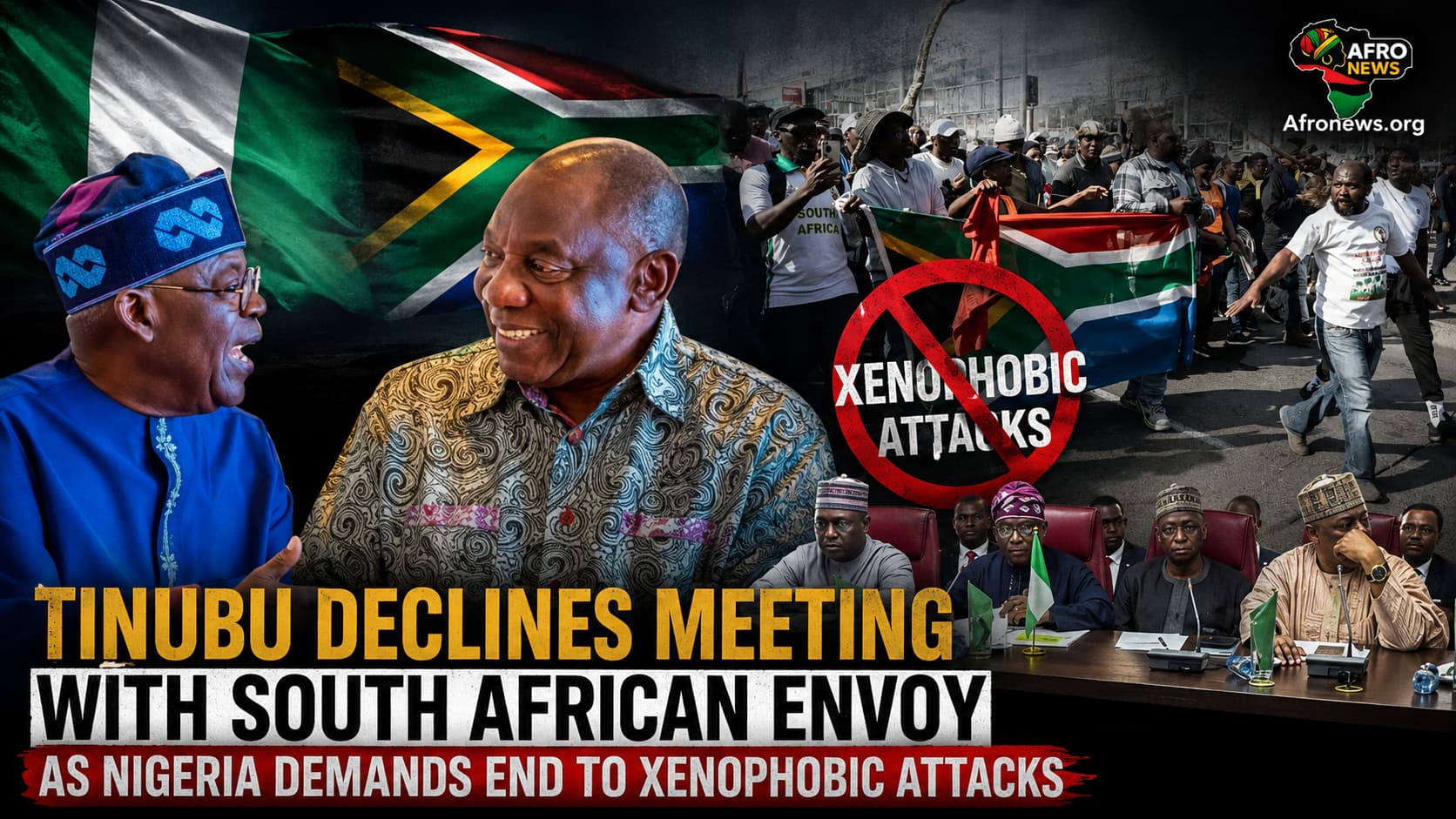
President Bola Ahmed Tinubu on Monday declined to personally receive a special envoy dispatched by South African President Cyril Ramaphosa over the renewed wave of xenophobic attacks against Nigerians, opting instead to delegate the meeting to the Minister of State for Foreign Affairs, Ambassador Sola Enikanolaiye.
The diplomatic move came amid growing outrage in Nigeria over the continued attacks, killings and displacement of Nigerians living in South Africa, with Abuja demanding stronger action from Pretoria to protect foreign nationals.
Leading the South African delegation in Abuja, the country’s Minister of International Relations and Cooperation, Ronald Lamola, said he was delivering a personal message from President Ramaphosa while reaffirming South Africa’s commitment to its long-standing relationship with Nigeria.

Lamola acknowledged Nigeria’s historic role in supporting South Africa’s liberation from apartheid, describing the country’s contribution as one that South Africans would never forget.
“We remain deeply indebted to the people of Nigeria for their sacrifice,” Lamola said.
He stressed that the Ramaphosa administration firmly rejects xenophobia, racism, discrimination, homophobia and all forms of intolerance. However, he maintained that South Africa has a sovereign responsibility to enforce its immigration laws and tackle crimes such as drug trafficking, internet fraud and other criminal activities.
According to Lamola, irregular migration has become a continental challenge requiring African countries to work together under the African Union’s framework on orderly and regular migration.
Responding on behalf of President Tinubu, Enikanolaiye said the Nigerian government considered the meeting an opportunity for frank discussions on the recurring attacks against Nigerians in South Africa.
He urged Pretoria to move beyond condemnations by taking urgent and concrete steps to end what Nigeria described as persistent Afrophobic attacks against Nigerians and other African nationals.
The minister disclosed that official records indicate 98 Nigerians have been killed in xenophobic and mob attacks in South Africa since 2022, with five deaths recorded this year alone. He added that some repatriated Nigerians claimed the actual figures could be even higher.
Enikanolaiye stressed that while Nigeria does not defend criminality, anyone accused of committing crimes should be arrested, investigated and prosecuted through the judicial system rather than subjected to mob violence.
“Nigeria will not support drug traffickers or any criminal activity, but those accused of crimes must be treated in accordance with the rule of law, South Africa’s Constitution and international human rights standards,” he said.
The minister also questioned why security agencies failed to prevent several of the attacks, noting that many of the victims were legally residing in South Africa when they were targeted.
Recalling the recent evacuation of nearly 1,500 Nigerians from South Africa, Enikanolaiye described the humanitarian situation as heartbreaking.
“I shed tears when I received the first batch of evacuees. I saw children, women and the elderly returning home with almost nothing after their properties had been looted and destroyed. That is not the Africa we want,” he said.
Despite the diplomatic strain, both countries reaffirmed their commitment to preserving their historic ties and strengthening dialogue. The meeting also included a closed-door session during which Lamola formally conveyed President Ramaphosa’s message to the Nigerian government.
Tinubu’s decision not to personally receive the South African envoy has been widely interpreted as a strong diplomatic signal of Nigeria’s dissatisfaction with Pretoria’s handling of the recurring xenophobic attacks, even as both nations pledged to continue working together in the spirit of African solidarity.