

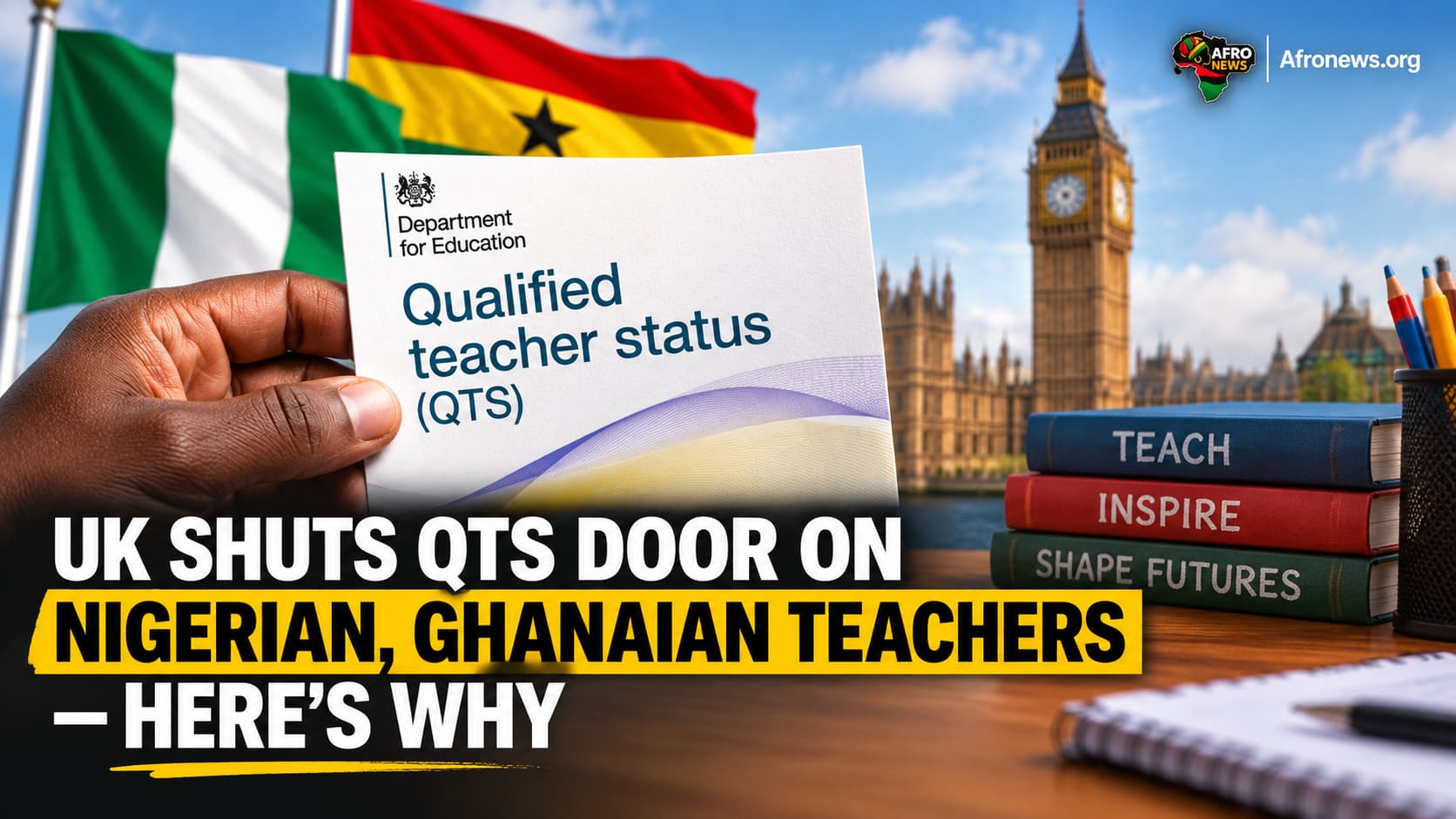
UK SHUTS QTS DOOR ON NIGERIAN, GHANAIAN TEACHERS — HERE’S WHY
The United Kingdom has tightened the rules for overseas-trained teachers seeking to work in England, with teachers trained in Nigeria, Ghana and India losing access to the country’s direct application route for Qualified Teacher Status (QTS).
The change took effect on September 9, 2026, and could affect thousands of teachers looking to build careers in England’s schools.
QTS is the professional status that makes teachers more likely to be employed by schools in England, although it is not itself a job or a visa.
Related Post




Why Nigeria and Ghana were removed
The UK Department for Education says the decision is linked to concerns over the verification of teachers’ professional records.
According to the department, more than 70% of applications from teachers in Nigeria and Ghana contain work-history references using public email services such as Gmail or Hotmail, instead of official school email domains.
The department says this creates additional work for assessors trying to verify the information provided by applicants.
Its stated position is that it must be confident that information submitted by overseas teachers is genuine before awarding QTS.
India was removed for a different reason: the UK says it does not have a national regulator capable of confirming teachers’ professional standing.
South Africa remains eligible
With the latest changes, South Africa is among the African countries whose teachers can still access the QTS route, subject to meeting the other requirements.
Teachers trained in countries including Australia, Canada, New Zealand, the United States, Hong Kong, Switzerland and countries in the European Economic Area also remain eligible under the applicable rules.
Jamaica, Singapore and South Africa have additional conditions, particularly for teachers who are not already working in eligible teaching roles in England.
What does a teacher need for QTS?
Under the current rules, eligible overseas-trained teachers generally need a qualification equivalent to a UK bachelor’s degree, full professional teaching status in their training country and evidence that mandatory training and induction requirements have been completed.
They must also be qualified to teach children aged 5 to 16 and have at least one school year of teaching experience after qualifying.
Their experience must include independently planning and delivering lessons, assessing pupils and reporting on their progress.
Applicants must also satisfy England’s English-language requirements.
Is the door completely closed to Nigerian teachers?
Not necessarily.
The new rule means teachers trained in Nigeria can no longer use the direct Apply for QTS in England service.
However, the Department for Education says those who are no longer eligible can explore alternative routes into teaching.
The UK also makes clear that schools employ teachers directly rather than the Department for Education. This means individual schools may consider alternative qualification routes, even though QTS remains a status that can improve a teacher’s employment prospects.
The change therefore does not amount to a blanket ban on Nigerian or Ghanaian teachers working in England. Instead, it closes one specific route to professional recognition and pushes affected teachers towards other pathways.
For applicants already considering the move, the message is clear: the qualification may still open doors, but the route to getting recognised in England has changed.
Source: UK Department for Education, updated September 9, 2026.