
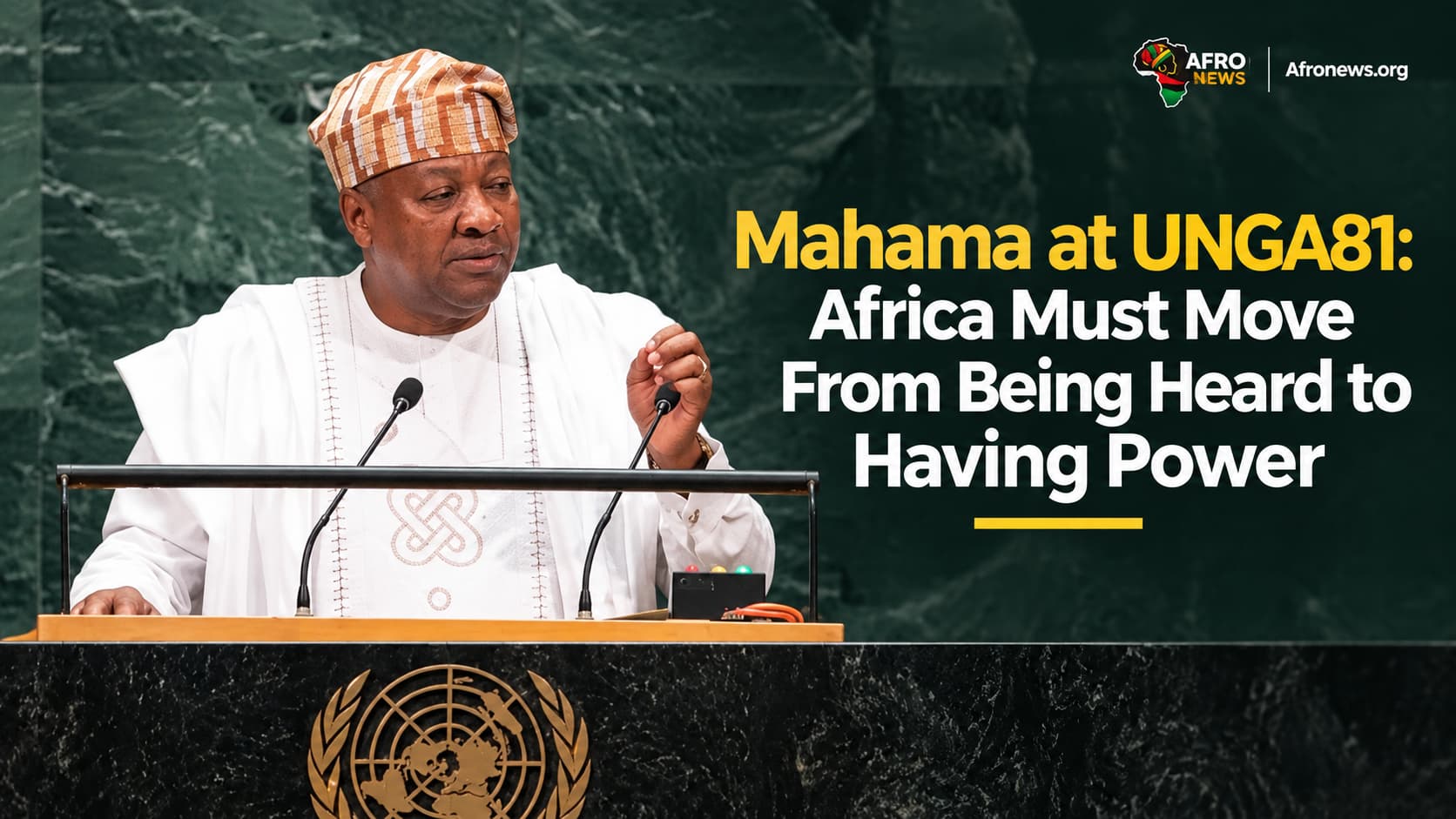
When President John Dramani Mahama stood before world leaders at the 81st United Nations General Assembly in New York on September 24, 2026, he was not simply delivering Ghana’s national statement. He was making a broader argument about Africa’s place in a changing international order.
His message was clear: Africa cannot continue to be present in global conversations while remaining largely absent from the rooms where the most consequential decisions are made.
Speaking against the backdrop of the UNGA81 theme, “Restoring Trust, Managing Transformation: A United Nations That Delivers for All,” Mahama connected Africa’s historical experience with some of the biggest challenges facing the international system today.
Related Post



Africa needs more than a voice
One of the strongest parts of the Mahama UNGA81 speech was his call for permanent African representation on the UN Security Council, including the same rights and responsibilities enjoyed by existing permanent members.
Africa has more than 1.5 billion people and constitutes the largest regional voting bloc in the General Assembly, yet it has no permanent seat on the Security Council. Mahama argued that this is no longer consistent with the realities of the 21st century.
For him, Security Council reform is therefore not simply an African demand. It is a test of whether the UN’s claim to represent the international community can match the realities of the world it governs.
The past is still shaping the present
Mahama also placed historical injustice and reparatory justice at the centre of his address.
He argued that the consequences of the transatlantic trafficking and racialised chattel enslavement of Africans cannot be separated entirely from present-day inequalities. He connected the historical discussion to contemporary issues such as unequal trade, debt, resource extraction and Africa’s continued position as an exporter of raw materials.
This makes the reparations debate bigger than compensation for historical suffering. It raises a broader question about whether some of the economic structures that disadvantage African countries today require fundamental reform.
Africa must stop exporting wealth and importing poverty
Perhaps the most economically significant part of the speech was Mahama’s argument about Africa’s natural resources.
The continent possesses many of the critical minerals needed for the global energy transition. Yet simply possessing these minerals does not guarantee that African countries will capture the greatest economic value from them.
Mahama argued that critical mineral extraction must not reproduce the patterns of colonial-era exploitation. Instead, Africa should increasingly process its resources locally, develop industries around them, create jobs and retain more value within the continent.
The argument can be reduced to a simple question: Why should Africa remain the place where resources are extracted when the greatest value is created somewhere else?
That is not only a question about mining. It is a question about industrialisation, technology, jobs and economic sovereignty.
But Africa must also look inward
Mahama’s message was not directed exclusively at the rest of the world.
Greater African influence internationally must also be matched by stronger institutions at home. African governments must confront corruption, strengthen accountability, improve economic management and create conditions in which the continent’s enormous human and natural resources can produce broad-based prosperity.
This is an important part of the conversation because greater representation at the UN will not, by itself, solve Africa’s development challenges.
Africa needs both a fairer international system and stronger institutions within Africa.
Climate justice and global inequality
Climate change was another major theme.
Mahama described climate change as an important test of global equity, arguing that Africa contributes a relatively small share of global greenhouse-gas emissions while facing severe consequences, including erratic rainfall, coastal erosion, desertification and extreme weather events.
His argument was that climate finance should not leave vulnerable African countries with even greater debt after disasters they did relatively little to cause.
This fits into a broader demand from African governments for climate action that considers both responsibility for emissions and vulnerability to their consequences.
Ghana’s opportunity in 2027
Mahama also looked beyond the UN podium to Ghana’s expected assumption of the African Union chairmanship in January 2027.
He said Ghana intends to use the position to promote continental integration, accelerate implementation of the African Continental Free Trade Area, support peace and security, and help Africa speak with a stronger and more united voice internationally.
That ambition places an important responsibility on Ghana.
It is one thing to call for a stronger African voice. It is another to help build the unity required for that voice to carry weight.
The real test begins after the speech
UN speeches can capture attention, but speeches alone do not reform international institutions, transform economies or change the balance of global power.
The difficult work begins afterwards.
Africa must strengthen its economies, develop its industries, process more of its natural resources, deepen continental integration and build institutions capable of turning its enormous potential into measurable power.
That is ultimately what made Mahama’s UNGA81 intervention significant.
The argument was not simply that Africa deserves to be heard.
It was that Africa must move from being represented to being represented with power.
For decades, African leaders have spoken about political and economic independence. The challenge of this generation is to turn that aspiration into practical influence over the institutions, resources and decisions that shape Africa’s future.
Mahama’s speech therefore leaves us with a question that goes beyond the UN Security Council:
Is Africa prepared not merely to demand a seat at the table, but to build the economic and political power required to make that seat matter?
References
3News. (2026, September 24). Full text: President Mahama’s address to 81st UN General Assembly. https://3news.com/news/full-text-president-mahamas-address-to-81st-un-general-assembly
Ghana News Agency. (2026, September 24). President Mahama’s statement to the 81st Session of UNGA – Full text. https://gna.org.gh/2026/09/president-mahamas-statement-to-the-81st-session-of-unga-full-text/
United Nations. (2026). General debate of the 81st session: Ghana. https://gadebate.un.org/en/81/ghana
Ghana News Agency. (2026, September 24). Climate change ultimate test of global equity – President Mahama. https://gna.org.gh/2026/09/climate-change-ultimate-test-of-global-equity-president-mahama/
Ghana Broadcasting Corporation. (2026, September 24). Ghana to use AU chairmanship to push African integration, peace. https://www.gbcghanaonline.com/general/au-chairmanship/2026/