
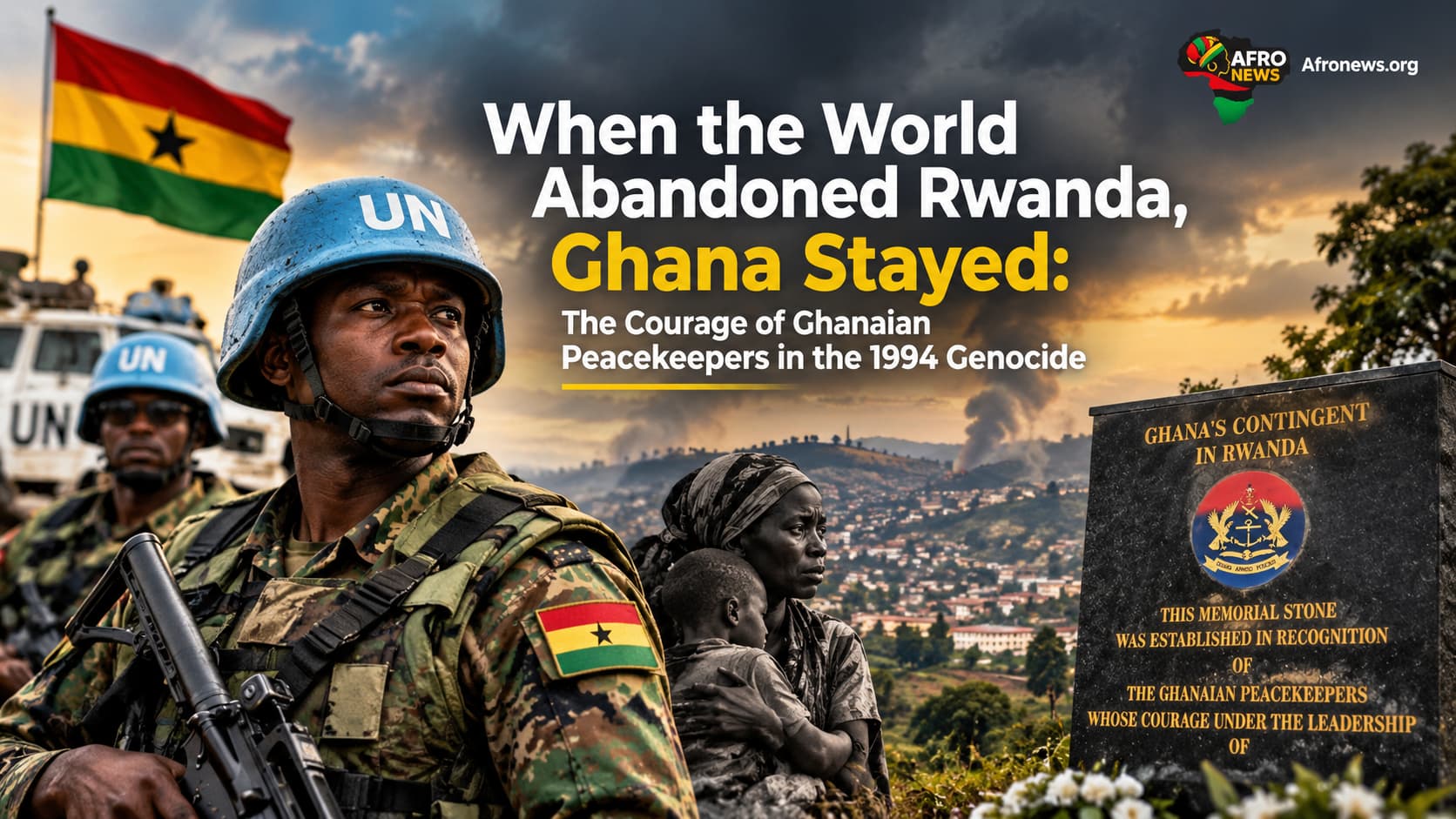
In April 1994, as Rwanda descended into one of the darkest chapters in human history, the international community failed to act decisively to protect innocent lives. While the United Nations Security Council reduced its peacekeeping force and foreign governments withdrew their troops, hundreds of thousands of Rwandans were left exposed to systematic violence. Yet, amid the international retreat, a contingent of Ghanaian soldiers made a different choice: they stayed.
Over approximately 100 days, the 1994 Genocide against the Tutsi claimed the lives of more than 800,000 people, predominantly Tutsis, as well as moderate Hutus who opposed the killings. As the violence spread across Rwanda, Ghanaian soldiers serving under the United Nations Assistance Mission for Rwanda (UNAMIR) demonstrated extraordinary courage, discipline and humanity in circumstances where protecting civilians had become a dangerous undertaking.
At the centre of this remarkable story was Major General Henry Kwami Anyidoho, Ghana’s deputy force commander of UNAMIR, serving under Canadian Lieutenant-General Roméo Dallaire. When the international mission faced withdrawal, Anyidoho confronted a defining moral question: abandon the people they had been deployed to protect or remain despite the risks.
Related Post


For Anyidoho, the answer was clear. He believed that leaving Rwanda would mean turning his back on people who desperately needed protection. His determination, together with that of the Ghanaian contingent, became an enduring example of courage in the face of international inaction.
When Others Withdrew, Ghana Stayed
Following the assassination of Rwandan President Juvénal Habyarimana on 6 April 1994, organised violence erupted across the country. The situation deteriorated further after ten Belgian peacekeepers were killed, prompting Belgium to withdraw its contingent. Other countries also withdrew their personnel, while the UN Security Council adopted Resolution 912 on 21 April 1994, reducing UNAMIR to a much smaller force.
With the mission severely weakened, Dallaire faced the prospect of losing much of the international support needed to protect civilians. He turned to his deputy, Anyidoho, whose response would become an important part of Ghana’s peacekeeping history.
Anyidoho maintained that Ghanaian soldiers should remain in Rwanda, despite the escalating violence and inadequate resources. He believed that, as an African general serving in the mission, abandoning the Rwandan people would be morally unacceptable.
The Ghanaian contingent, comprising approximately 454 to 456 soldiers, continued its operations even as the international mission contracted. These predominantly young soldiers were now confronting armed militias, mass killings and a humanitarian catastrophe far beyond the original expectations of their deployment.
Their decision was not based on the belief that they could defeat the forces responsible for the genocide. It was a commitment to protect as many people as possible with the limited personnel, equipment and authority available to them.
Dallaire later captured the significance of their commitment in a simple statement: “Others ran while the Ghanaians stayed.”
Turning Safe Havens into Lifelines
The Ghanaian peacekeepers continued to protect civilians who had gathered around UN positions, transforming locations such as stadiums and Kigali International Airport into places of refuge. They guarded displaced people, supported humanitarian operations, negotiated safe passage through militia-controlled areas and helped establish humanitarian corridors.
Their work was conducted under extremely difficult conditions. The soldiers had limited equipment, inadequate firepower and little capacity to confront large groups of armed extremists. Nevertheless, they continued to rely on professional discipline, negotiation and personal courage to protect vulnerable civilians.
Their presence offered a measure of safety to people who had nowhere else to turn. Although they could not prevent every killing or protect everyone in danger, they helped maintain a humanitarian presence at a time when the mission was under severe pressure.
The Ghanaian contingent’s contribution was also part of the wider efforts of other peacekeepers who remained in Rwanda, including Senegalese and Tunisian personnel. Their collective actions helped preserve a degree of protection for civilians amid the unfolding catastrophe.
Colonel Clayton Yaache: Twelve Hours Between Life and Death
One of the most extraordinary accounts of Ghanaian courage in Rwanda involves Colonel Clayton Yaache, who faced a dangerous confrontation while trying to protect approximately 80 Tutsi and moderate Hutu civilians.
The civilians were being transported in covered trucks when hundreds of Interahamwe militiamen surrounded them, armed with grenades and machetes. Yaache had only ten Ghanaian soldiers with insufficient firepower to confront such a large crowd.
The situation quickly became life-threatening as the militiamen reportedly pulled the pins from their grenades and threatened Yaache. Recognising that a military confrontation could result in the deaths of the civilians and his own men, the Ghanaian officer chose negotiation.
In an extraordinary demonstration of composure, Yaache picked up the grenade pins that had fallen to the ground and placed them back into the grenades. He continued negotiating with the militiamen, attempting to persuade them to allow the civilians to leave safely.
The confrontation lasted approximately twelve hours. Eventually, the civilians were permitted to move, escaping a situation that could easily have ended in a massacre.
Yaache’s actions demonstrated that courage in peacekeeping is not always expressed through the use of force. Sometimes, it lies in the ability to remain calm, negotiate with armed aggressors and protect human lives when every available option carries considerable risk.
The Human Cost and the Lives Saved
The Ghanaian peacekeepers were not immune to the violence surrounding them. Five Ghanaian personnel were reportedly killed or wounded during the mission, reflecting the risks they faced while protecting civilians and supporting humanitarian operations.
Despite their limited numbers and resources, the contingent made a significant contribution to the protection of civilians. Dallaire estimated that the Ghanaian peacekeepers helped save approximately 30,000 lives. Although this is a retrospective estimate rather than an independently verified count, it reflects the importance he attached to their role in keeping UNAMIR operational.
Their actions helped preserve safe havens, support humanitarian assistance and maintain a UN presence when the mission was close to collapse. Dallaire also acknowledged the importance of Anyidoho’s leadership in enabling him to continue operating in Rwanda.
However, the Ghanaian contribution must be understood within the wider failure of the international community to prevent the genocide. The courage of individual soldiers could save lives, but it could not replace the political commitment, resources and coordinated intervention needed to stop mass atrocities.
Rwanda’s Recognition of Ghana’s Sacrifice
More than three decades after the genocide, Rwanda continues to recognise the contribution of Ghanaian peacekeepers. Major General Henry Kwami Anyidoho and Major General Joseph Narh Adinkra received Rwanda’s National Order of Bravery in 2022 in recognition of their leadership and service during the genocide.
On 17 June 2026, Ghana and Rwanda unveiled two permanent monuments at Burma Camp in Accra. One, the Kwibuka Flame of Hope, honours the victims of the 1994 Genocide against the Tutsi, while the second recognises the Ghanaian peacekeepers who remained in Rwanda despite the worsening security situation.
The ceremony, organised by the Ghana Armed Forces and the Rwandan High Commission, marked the 32nd anniversary of the genocide and reaffirmed the relationship between the two countries. It also provided an opportunity to honour the sacrifices of the Ghanaian contingent and remember the victims whose lives were lost.
The monuments serve not only as symbols of gratitude but also as educational reminders of the dangers of hatred, discrimination and mass violence. They preserve the memory of those who suffered and those who risked their lives to protect others.
The Lessons of Rwanda and Ghana’s Peacekeeping Legacy
The Rwandan genocide remains a defining example of the consequences of international inaction in the face of mass atrocities. The withdrawal of peacekeepers and the reduction of UNAMIR exposed the limitations of a mission without sufficient political support, resources and authority.
Ghana’s decision to retain its troops demonstrated a commitment to international peacekeeping and the protection of civilians. However, the experience also raises important questions about the responsibilities of governments, international institutions and the United Nations when populations face systematic violence.
The legacy of the Ghanaian peacekeepers is therefore not simply a story of national pride or military heroism. It is a reminder that protecting human life requires more than good intentions. It demands effective international cooperation, timely decisions, adequate resources and the willingness to act when civilians are in danger.
Major General Anyidoho’s leadership and Colonel Yaache’s extraordinary negotiations represent different dimensions of this responsibility. One helped preserve the presence of a peacekeeping force, while the other demonstrated how restraint and determination could protect civilians in an extremely dangerous situation.
Ghana’s contribution also forms part of its broader history of international peacekeeping, through which its military personnel have served in missions aimed at supporting peace, security and humanitarian protection across the world.
When the World Abandoned Rwanda, Ghana Stayed
The story of Ghanaian peacekeepers in Rwanda is a powerful reminder that even in the midst of overwhelming tragedy, individual decisions can make a profound difference. The Ghanaian soldiers could not stop the genocide, nor could they guarantee the safety of every civilian. Yet, through their courage, discipline and determination, they helped protect thousands of people at a time when international support was severely weakened.
History will rightly remember the failure of the international community to prevent the 1994 genocide. But it must also remember the commanders who accepted responsibility, the soldiers who continued to serve and the people who refused to abandon those in danger.
The recognition of Ghana’s peacekeepers by Rwanda, including the establishment of permanent monuments at Burma Camp, ensures that their contribution remains part of the historical record and continues to inspire future generations.
When others withdrew, Ghana stayed. And in staying, its peacekeepers helped save lives, uphold human dignity and establish a legacy of courage and solidarity that continues to connect Ghana and Rwanda more than three decades later.
Sources
1. Al Jazeera — Ghana Peacekeepers Remember Rwanda’s Genocide (2014)
https://www.aljazeera.com/features/2014/4/6/ghana-peacekeepers-remember-rwandas-genocide
2. United States Holocaust Memorial Museum — Henry Anyidoho
https://www.ushmm.org/genocide-prevention/simon-skjodt-center/work/research/studies-of-past-mass-atrocities/failure-to-prevent/rwanda-conference/voices-on-rwanda/henry-anyidoho
3. Danish Institute for International Studies — Ghana and India in UN Peacekeeping (2020)
https://pure.diis.dk/ws/portalfiles/portal/3442951/Ghana_and_India_UN_peacekeeping_DIIS_Report_4_2020.pdf
4. Graphic Online — Those Who Stayed: Why the Rwanda Memorial in Ghana Matters (2026)
https://www.graphic.com.gh/features/opinion/ghana-news-those-who-stayed-why-genocide-against-the-tutsi-rwanda-memorial-in-ghana-matters.html
5. Ghana News Agency — Ghana and Rwanda Unveil Genocide Memorials (2026)
https://gna.org.gh/2026/06/ghana-rwanda-unveil-genocide-memorials/
6. Ghana Armed Forces — GAF Unveils Kwibuka Flame of Hope (2026)
https://gafonline.mil.gh/blog-details/gaf-unveils-kwibuka-flame-of-hope
7. Rwandan High Commission in Ghana — Two Monuments Unveiled in Ghana (2026)
https://www.rwandainghana.gov.rw/actualites/info-details/two-monuments-in-commemoration-of-the-1994-genocide-against-the-tutsi-unveiled-in-ghana
8. MyJoyOnline — Rwanda Honours Ghanaian Peacekeepers with Monuments at Burma Camp (2026)
Rwanda honours Ghanaian peacekeepers with monuments at Burma Camp