
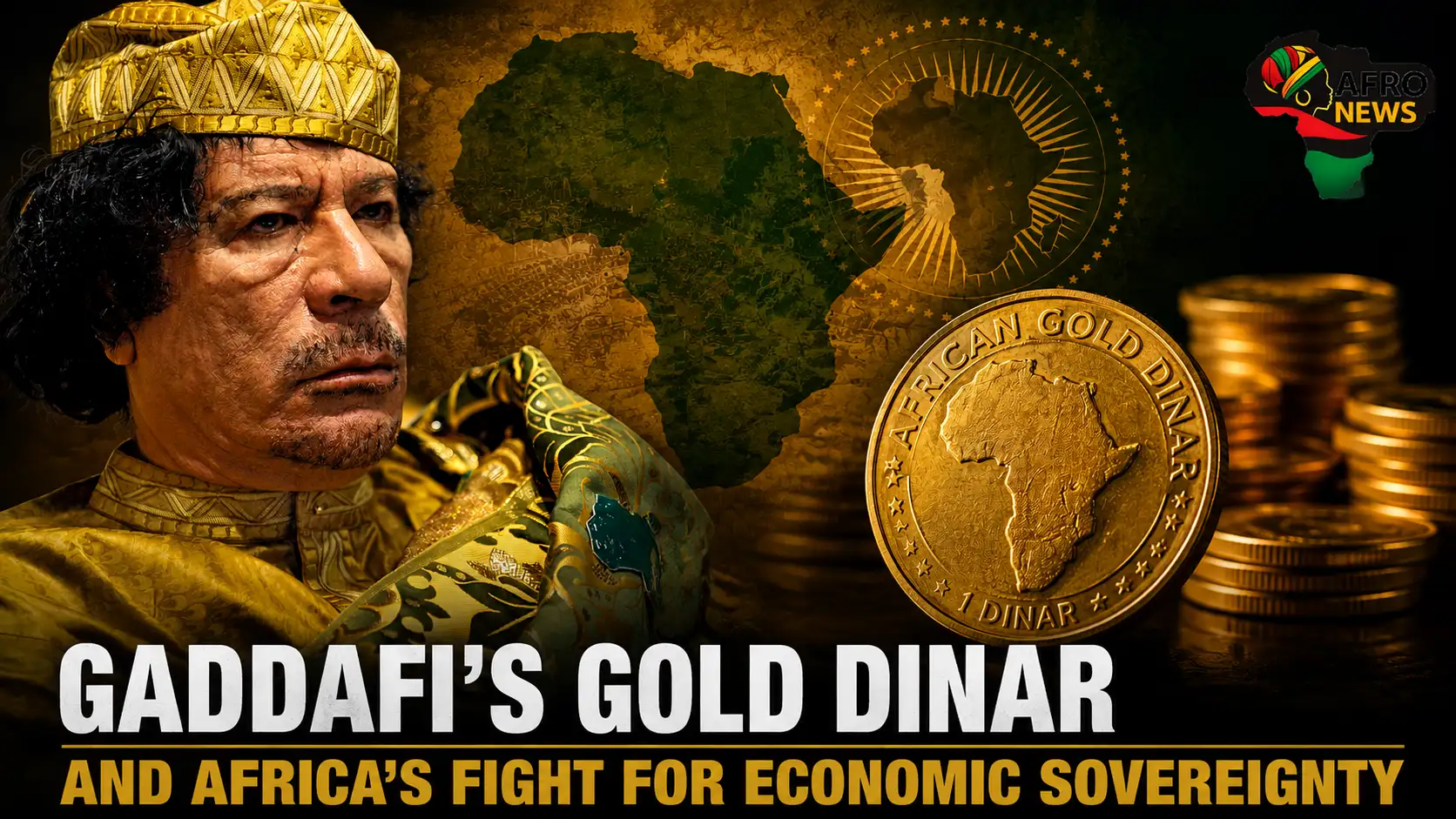
The dreamed Gaddafi gold dinar and the economic sovereignty of African nations. Africa’s struggle for independence did not end with the lowering of colonial flags. Decades after political sovereignty was achieved, questions around economic control, technology ownership, and financial independence have remained central to the continent’s development debate.
Few proposals captured this debate as strongly as the proposed gold-backed African currency promoted by Libya’s Muammar Gaddafi as part of a broader vision for reducing dependence on external monetary systems.
The Gaddadi gold dinar was controversial. Supporters viewed it as an attempt to strengthen African financial independence and increase intra-African trade. Critics questioned whether a gold-backed continental currency was economically practical given Africa’s diverse economies and political structures.
Related Post




However, the debate surrounding the Gaddafi gold dinar proposal was not only about currency. It represented a wider question: whether Africa could build independent systems for communication, finance, and development.
One earlier example of this ambition was Africa’s attempt to control its own satellite communications infrastructure.
RASCOM: Africa’s Attempt to Own Its Digital Future
For years, African countries depended heavily on foreign satellite operators for telecommunications services, including voice communication, broadcasting, and internet connectivity. The limited availability of continent-owned infrastructure increased the cost of connectivity and highlighted Africa’s technological dependence (International Telecommunication Union [ITU], 2009).
To address this challenge, African states established the Regional African Satellite Communications Organization (RASCOM) in 1992. The organisation was created to develop an African-owned satellite communications system that could improve connectivity and reduce reliance on external providers (RASCOM, official records).
The project represented more than a telecommunications initiative; it was part of a broader effort to strengthen Africa’s strategic capacity in critical infrastructure.
After years of financial and technical challenges, the RASCOM-QAF1 satellite was launched on 26 December 2007, becoming Africa’s first communications satellite project under the organisation. The initiative received support from African institutions, including the African Development Bank, as well as contributions from participating African governments (African Development Bank; RASCOM).
The satellite’s significance extended beyond technology. It demonstrated that African cooperation could produce major infrastructure projects when resources and political commitment were aligned.
The same argument about self-reliance later appeared in discussions around monetary independence and the proposed gold dinar.
The Gaddafi Gold Dinar Proposal
The proposal emerged from Muammar Gaddafi’s broader vision of African political and economic integration. During his tenure as Chairperson of the African Union in 2009, Gaddafi advocated for stronger continental institutions and argued that Africa’s political independence needed to be supported by greater control over its financial systems.
At the centre of this vision was the idea of a gold-backed African currency that could reduce reliance on foreign reserve currencies, particularly the US dollar and euro, in regional and international trade. Unlike modern fiat currencies, which derive value from government monetary policy and economic confidence, a gold-backed currency links monetary value to physical gold reserves.
The proposal was therefore presented as a potential tool for increasing African monetary sovereignty. Supporters argued that it could strengthen intra-African trade, reduce exposure to external currency fluctuations, and give African countries greater influence over their economic decisions. However, the Gaddafi gold dinar proposal remained a political vision and was never implemented as an operational currency till his time of death, and no other African leader has taken it up.
Beyond Currency: Building African Financial Institutions
The Gaddafi gold dinar proposal was connected to a wider plan for developing independent African financial institutions.
The African Union has long supported the creation of continental financial bodies, including:
African Central Bank
The proposed African Central Bank was intended to serve as a future continental monetary authority. Its objective was linked to long-term African economic integration and the possibility of a common monetary framework. However, establishing such an institution would require significant economic coordination among African states, including fiscal discipline, policy alignment, and strong governance structures (African Union, Financial Institutions).
African Monetary Fund
The proposed African Monetary Fund was designed to provide African-led financial support mechanisms and reduce excessive dependence on external financial institutions during economic crises.
The African Union adopted a protocol establishing the African Monetary Fund in 2014, although the institution has not yet become operational. The proposal reflects ongoing efforts to strengthen Africa’s financial independence through continental institutions (African Union, Protocol Establishing the African Monetary Fund).
African Investment Bank
The African Investment Bank was envisioned as a continental development finance institution that could support infrastructure, industrialisation, and private-sector growth.
These initiatives reflected a broader debate: whether Africa should rely primarily on external sources of financing or develop stronger internal mechanisms for funding its own development.
Libya’s Gold Reserves and the Debate Over Motives
Libya possessed significant gold reserves before the 2011 conflict. According to the World Gold Council, Libya’s official gold holdings were approximately 143.8 tonnes before the fall of Gaddafi’s government (World Gold Council).
Some commentators have argued that these reserves were linked to plans for a gold-backed African currency and have suggested that this may have contributed to international opposition against Libya.
One frequently cited document is a 2011 email released through the U.S. Department of State’s FOIA archive, which discussed Libya’s gold reserves and regional monetary ambitions. However, the email was a communication from a private adviser and does not represent an official finding that the proposed currency was a cause of NATO intervention (U.S. Department of State FOIA Archive).
The evidence shows that the gold dinar proposal was part of Gaddafi’s broader economic and political vision, but the causes of the 2011 intervention involved multiple factors, including Libya’s internal conflict, humanitarian concerns, international diplomacy, and geopolitical interests.
NATO Intervention and the Fall of Gaddafi
The fall of Muammar Gaddafi in 2011 remains one of the most debated international interventions of the twenty-first century. The events that led to his removal were shaped by a combination of Libya’s internal political crisis, the wider Arab Spring movement, humanitarian concerns, and competing geopolitical interests.
In early 2011, protests spread across North Africa and the Middle East as citizens demanded political reforms and greater accountability from long-standing governments. In Libya, demonstrations that began in February 2011 quickly escalated into an armed conflict between forces loyal to Gaddafi and opposition groups seeking to end his rule.
As fighting intensified, concerns grew internationally about possible attacks against civilians. On 17 March 2011, the United Nations Security Council adopted Resolution 1973, authorising member states to take “all necessary measures” to protect civilians and establishing a no-fly zone over Libya. The resolution, however, excluded the deployment of a foreign occupation force (United Nations Security Council, 2011).
Following the resolution, a coalition of states began military operations, which were later conducted under NATO’s Operation Unified Protector. NATO stated that the mission’s objectives were to protect civilians, enforce the arms embargo, and implement the no-fly zone authorised by the United Nations (NATO, Operation Unified Protector).
The Unanswered Question
In 2011, Libya descended into civil war amid the wider Arab Spring. NATO intervened under United Nations Security Council Resolution 1973, citing the protection of civilians. The conflict ended with the collapse of Gaddafi’s government and his death later that year (United Nations, 2011; NATO, 2011).
Since then, debate has persisted over whether Gaddafi’s broader Pan-African economic ambitions, especially on the Gaddafi gold dinar proposal, influenced international attitudes toward his government. Some commentators point to released U.S. diplomatic emails referencing Libya’s gold reserves and regional monetary discussions. Others argue that the intervention was driven primarily by the rapidly escalating humanitarian crisis, internal conflict, and regional political dynamics.
To date, no publicly available evidence conclusively demonstrates that the proposed gold-backed currency was the principal reason for NATO’s intervention. The historical record supports a far more complex explanation involving multiple political, military, humanitarian, and geopolitical factors.
Yet one broader truth remains difficult to dismiss.
Throughout Africa’s post-colonial history, efforts to achieve deeper economic independence have consistently faced enormous political, institutional, and external challenges. From Kwame Nkrumah’s vision of continental unity to Gaddafi’s gold dinar proposals for monetary integration, the aspiration has remained remarkably consistent: an Africa capable of financing, connecting, and developing itself on its own terms.
References
African Union. (n.d.). Financial institutions of the African Union. African Union.
African Union. (2014). Protocol on the establishment of the African Monetary Fund. African Union.
International Telecommunication Union. (2009). Measuring the information society report 2009. International Telecommunication Union.
North Atlantic Treaty Organization. (n.d.). Operation Unified Protector: Libya 2011. NATO.
United Nations Security Council. (2011). Resolution 1973 (2011): The situation in Libya (S/RES/1973). United Nations Digital Library.
United Nations Development Programme. (n.d.). Human Development Reports. United Nations Development Programme.
United States Department of State. (n.d.). FOIA: Clinton email archive. U.S. Department of State.
World Bank. (n.d.). World Development Indicators. World Bank DataBank.
World Gold Council. (n.d.). Gold reserves by country. World Gold Council.
Human Rights Watch. (n.d.). Libya: Human rights reports and research. Human Rights Watch.
People Also Read: The Coup That Never Happened… Inside the Alleged Secret Blueprint to Overthrow Tinubu’s Government