
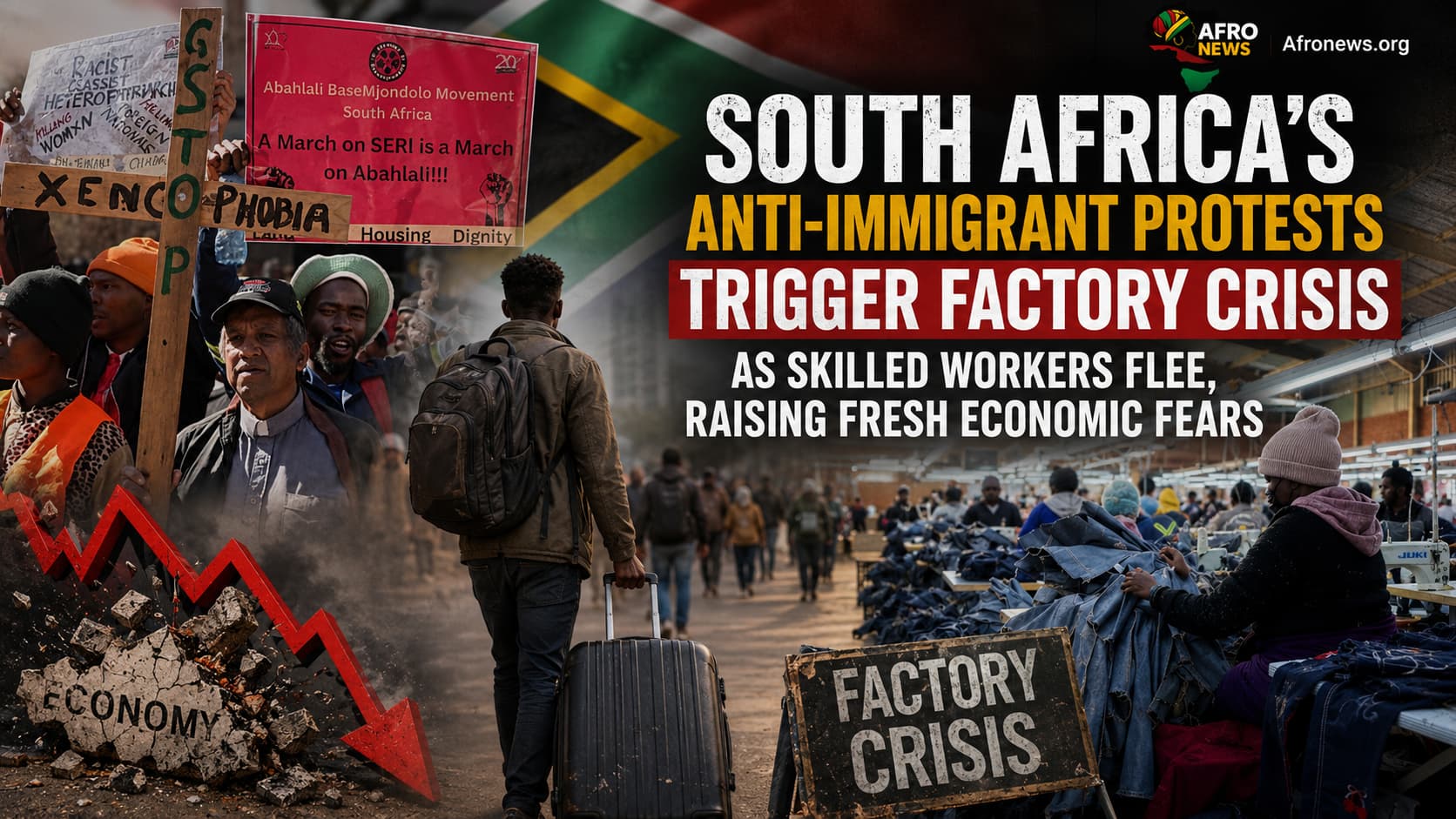
South Africa’s manufacturing sector is beginning to feel the economic fallout from renewed anti-immigrant protests, with clothing factories reporting severe labour shortages after thousands of foreign workers fled amid rising xenophobic attacks.
Factory owners in the industrial town of Newcastle, one of South Africa’s largest textile and garment manufacturing centres, say production has been disrupted as skilled migrant workers abandon their jobs out of fear for their safety.
Some manufacturers say they have already lost up to 19% of their workforce, leaving production lines understaffed and jeopardising contracts with major retailers.



Industry leaders now warn that unless the situation is brought under control, factory closures, job losses and declining investor confidence could become the next chapter in South Africa’s long-running migration crisis.
Factories Losing Skilled Labour
Employers insist many of the workers who fled possessed years of experience in garment manufacturing, particularly in industrial sewing and textile production skills that cannot be replaced overnight.
Several factory operators say attempts to recruit local workers have yielded little success, arguing that many South Africans are reluctant to take physically demanding factory jobs that offer relatively modest wages.
However, labour unions reject claims that migrants are irreplaceable.
Union representatives argue that the real challenge is poor pay, rising transportation costs and difficult working conditions, not a shortage of South African workers.
Whatever the cause, manufacturers agree on one point: production schedules are slipping, customer orders are under pressure and the financial losses continue to mount.
The Growing Cost of Xenophobic Violence
South Africa has paid a heavy economic and diplomatic price for repeated waves of xenophobic violence over the past two decades.
Violent attacks targeting foreign nationals in 2008, 2015, 2019 and subsequent years resulted in dozens of deaths, widespread destruction of businesses and billions of rand in economic losses through damaged property, disrupted commerce and declining investor confidence.
The unrest has also strained South Africa’s diplomatic relations with several African countries, including Nigeria, whose government has repeatedly condemned attacks on its citizens. In 2019, violence against foreign-owned businesses prompted diplomatic protests and the temporary closure of some South African businesses operating in Nigeria.
Tourism, one of South Africa’s key economic sectors has also suffered reputational damage whenever images of violence against African migrants dominate international headlines, discouraging visitors and raising concerns among investors about stability.
Migrants Have Been Key Contributors to South Africa’s Economy
Contrary to common misconceptions, economists say migrant workers have played an important role in supporting South Africa’s economy.
Thousands of Nigerians have established successful businesses across sectors including retail, hospitality, technology, entertainment, healthcare and education, creating employment opportunities for South Africans while contributing taxes and consumer spending.
Similarly, Ghanaian migrants have built businesses in commerce, education, professional services and religious organisations, becoming active contributors to local economies.
Beyond entrepreneurship, migrants from across Africa occupy essential roles in manufacturing, agriculture, construction, healthcare, domestic services and hospitality industries that frequently struggle to fill vacancies with local labour alone.
Many also bring specialised technical skills that help businesses remain competitive in an economy already battling high unemployment, electricity shortages and sluggish growth.
Economic Growth at Risk
The departure of experienced migrant workers could have consequences extending well beyond Newcastle’s clothing factories.
Reduced production could weaken South Africa’s manufacturing output, disrupt supply chains and reduce export earnings at a time when the country is working to revive economic growth.
Businesses forced to operate below capacity may cut investment, delay expansion plans or relocate production elsewhere, placing additional pressure on an economy already facing unemployment rates exceeding 30%.
Economists warn that persistent labour shortages could increase production costs, fuel inflation and reduce South Africa’s competitiveness in regional and international markets.
A Crisis That Could Spread Beyond the Factory Floor
If anti-immigrant sentiment continues to intensify, analysts fear South Africa could face a broader socio-economic crisis.
A prolonged exodus of skilled foreign workers could deepen labour shortages, discourage foreign direct investment, strain diplomatic ties with fellow African nations and weaken regional trade under the African Continental Free Trade Area (AfCFTA).
The unrest could also trigger retaliatory measures against South African businesses operating elsewhere on the continent, further undermining commercial relationships that have taken decades to build.
Perhaps most worrying is the social cost. Continued attacks risk deepening divisions between communities, fuelling insecurity and creating an environment where fear, not opportunity determines who contributes to Africa’s largest industrial economy.
As factories struggle to replace skilled workers and confidence begins to erode, South Africa faces a defining question: can it afford to drive away the very people helping keep parts of its economy running?
Sources
- Reuters – https://www.reuters.com/world/africa/
- International Organization for Migration (IOM) South Africa – https://southafrica.iom.int/
- United Nations High Commissioner for Refugees (UNHCR) South Africa – https://www.unhcr.org/za
- Statistics South Africa – https://www.statssa.gov.za
- South African Human Rights Commission – https://www.sahrc.org.za
- African Centre for Migration & Society (University of the Witwatersrand) – https://www.migration.org.za
- International Labour Organization (ILO) – https://www.ilo.org
- BBC News Africa – https://www.bbc.com/news/world/africa