
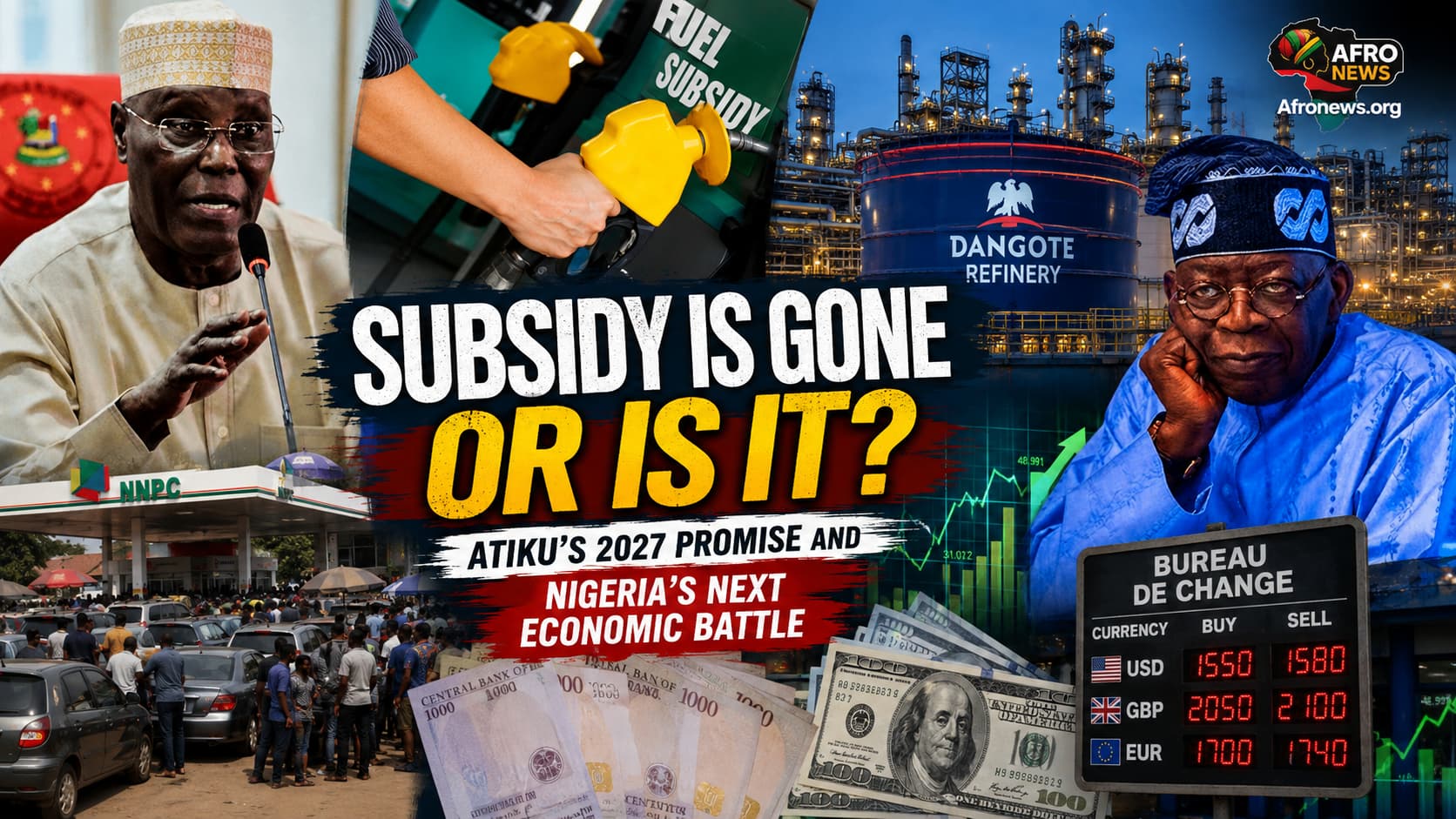
“Subsidy is gone.”
Those words from President Bola Ahmed Tinubu at his inauguration on May 29, 2023, carved a course that has now become a major campaign issue ahead of the 2027 presidential election and may yet become an albatross in his re-election bid.
More than three years later, the ghosts of that declaration have returned to Nigeria’s political battlefield.
Related Post


Former Vice President and presidential candidate of the African Democratic Congress (ADC), Atiku Abubakar, has promised that if elected president in 2027, he will bring back a form of petrol subsidy.
That declaration is particularly striking because Atiku once stood on almost the opposite side of the argument.
During his 2022 presidential campaign, he advocated the removal of fuel subsidy and described the system as a “huge fraud.” His position then was that money being spent subsidising petrol should instead be invested in infrastructure, education, healthcare and other productive sectors.
Now, Atiku says circumstances have changed.
In a subsequent clarification, he said he is not proposing a return to the old, opaque import-subsidy system. Instead, his proposed Atiku Economic Recovery Plan (AERP) 2027 envisages a targeted, capped, budgeted and independently audited production subsidy, with government support moving from imported petrol to Nigerian refineries.
The distinction is important.
But so is the political question: Is this an economic rethink or an electoral rethink?
The pain of “subsidy is gone”
There is no serious argument that the removal of the subsidy was painless.
Petrol prices rose sharply. Transportation costs followed. Businesses that depend on generators and logistics faced higher operating expenses. Food distribution became more expensive, while households saw their purchasing power squeezed.
The World Bank anticipated that subsidy removal would initially increase inflation. Subsequent economic assessments have continued to acknowledge the difficult short-term consequences of the reforms.
For millions of Nigerians, therefore, the debate is not an abstract argument about fiscal discipline.
It is about the price of a bus ride.
The cost of transporting food from farm to market.
The price of diesel and petrol for small businesses.
The monthly household budget.
And ultimately, whether economic reform is improving their lives or merely improving government balance sheets.
That is where Atiku’s argument acquires political power.
He is essentially asking Nigerians: If subsidy was removed to free money for development, where is the transformation?
The Federal Government has a counterargument. The reforms have substantially changed public finances, increased revenues available to the three tiers of government, strengthened external balances and helped restore investor confidence. The World Bank has estimated that subsidy and foreign-exchange reforms could generate trillions of naira in fiscal savings over several years.
The Finance Minister, Taiwo Oyedele, has also argued that the reforms helped avert a potential economic collapse, although he acknowledged the painful consequences for citizens.
So Nigeria now faces an uncomfortable paradox:
The economy may be becoming structurally healthier while many Nigerians still feel economically poorer.
And that gap between macroeconomic statistics and household reality could decide an election.
Was subsidy ever really good for Nigerians?
For more than five decades, fuel subsidy was defended as a social intervention.
Nigeria introduced the subsidy system in the 1970s partly to protect citizens from international oil-price shocks. It was supposed to make transportation and basic economic activity more affordable.
In that sense, subsidy did provide a form of relief.
Cheap petrol helped motorists, transport operators and businesses. It also indirectly supported food distribution and helped moderate some of the inflationary effects of higher energy costs.
But there was a fundamental problem.
The subsidy was never properly targeted at the poor.
An affluent Nigerian who owned several cars received the same implicit price benefit per litre as a low-income worker who depended on public transport. Research has described Nigeria’s petrol subsidy as socioeconomically regressive because wealthier households generally consume more petrol.
Worse, the system became associated with fraud, opaque accounting, questionable import claims and enormous fiscal obligations.
So the real question is not simply:
“Was subsidy good or bad?”
It is:
“Was Nigeria’s old subsidy system the best way to help Nigerians?”
The evidence suggests it was a very expensive and poorly targeted way of providing relief.
The danger of bringing it back
This is where Tinubu’s criticism of Atiku becomes economically significant.
The President described Atiku’s proposal as evidence of “serious ignorance” of governance and the economy, arguing that the old subsidy system placed enormous pressure on government finances and contributed to the inability of many states to meet their obligations.
The danger of a broad subsidy is straightforward: government must pay the difference between what petrol costs and what consumers pay.
That money has to come from somewhere.
It can come from oil revenue.
It can come from borrowing.
It can come from taxation.
It can come from reduced government spending elsewhere.
Or, in the worst scenario, from monetary financing that ultimately fuels inflation.
Reintroducing an unlimited subsidy could therefore undermine some of the fiscal gains of the past three years.
It could also recreate the incentive for powerful interests to manipulate the system.
And there is another danger: policy uncertainty.
Nigeria has spent years trying to move towards market-based pricing, domestic refining and a more unified foreign-exchange system. Abruptly changing direction could make investors question whether Nigerian economic policy survives political transitions.
The World Bank has specifically warned against returning to multiple exchange-rate regimes and sector-specific implicit subsidies while recommending continued fiscal and structural reforms.
But Atiku says this is not the old subsidy
This is perhaps the most interesting part of the debate.
Atiku’s proposal attempts to redefine subsidy.
Instead of subsidising imported petrol, government would subsidise domestic refining.
Instead of an open-ended liability, there would be a fiscal ceiling.
Instead of unverifiable claims, there would supposedly be independent audits.
Instead of simply making petrol cheaper, the objective would be to lower the cost of energy across the economy.
Under his proposed model, qualifying Nigerian refineries would receive crude at preferential prices, subject to production, efficiency, transparency and domestic-supply conditions.
In Atiku’s words, “the subsidy will follow the barrel.”
Conceptually, that is a more sophisticated proposition than simply resurrecting the old subsidy.
If properly designed, a production subsidy could theoretically strengthen local refining, reduce dependence on imported petroleum products, support jobs and lower domestic energy costs.
But there is a giant “if.”
Who determines the subsidy?
Who qualifies?
How much crude is subsidised?
Who audits the figures?
What prevents political favouritism?
What happens if international crude prices rise dramatically?
And how does government ensure that the benefit actually reaches the consumer rather than becoming another subsidy windfall for refinery owners?
These are not minor details.
They are the policy.
And then there is Dangote
The debate becomes even more complicated because Nigeria is no longer the same refining market it was in 2023.
The emergence of the Dangote Industries Limited refinery has changed the strategic equation.
A production-based subsidy could benefit domestic refiners by reducing their effective crude input costs. That could potentially help the Dangote refinery compete more aggressively with imported products.
But it could also create a new regulatory battle.
If government supplies crude to refiners at below-market prices, refinery operators would have to demonstrate that the benefit is actually transmitted to Nigerian consumers.
For Dangote, the rational response would likely be to protect margins through greater operational efficiency, secure reliable crude supply, optimise product pricing and distribution, diversify export opportunities and insist on a predictable regulatory environment.
It would also have a powerful incentive to ensure that any subsidy framework is industry-wide and rules-based, rather than designed around one refinery.
That matters because if subsidy becomes a political instrument, the refinery sector could move from competing in the market to competing for government favour.
Nigeria has seen that movie before.
What happens to the Naira?
This is another area where campaign promises can become economic complications.
A subsidy that increases petrol consumption without sufficiently expanding domestic refining could increase demand for imported petroleum products and, consequently, foreign exchange.
That would place additional pressure on the naira.
But Atiku’s model attempts to avoid precisely that problem by supporting domestic refining.
If Nigerian refineries can supply most of the domestic market, the country could reduce its dependence on imported refined petroleum products and retain more foreign exchange at home.
That could support the Naira rather than weaken it.
So the effect is not automatic.
A consumption subsidy funded through imported fuel could worsen Nigeria’s FX problem. A carefully designed production intervention that reduces imports could potentially improve the country’s external position.
The difference is implementation.
And what happens to GDP?
Again, the answer is more complicated than “subsidy equals growth” or “subsidy equals decline.”
Lower fuel prices can stimulate economic activity.
Transport operators spend less. Farmers face lower logistics costs. Manufacturers spend less on energy. Traders can move goods more cheaply. Households have more disposable income.
Those savings can circulate through the economy.
In theory, that could boost consumption, production and GDP.
But the government must pay for the subsidy.
If subsidy spending crowds out infrastructure, education, healthcare and productive investment, the economy may gain short-term consumption while sacrificing long-term productivity.
That is the central Nigerian dilemma:
Should government spend scarce public resources making today’s petrol cheaper, or invest those resources in making tomorrow’s Nigerian economy cheaper to run?
Perhaps the answer does not have to be entirely one or the other.
A temporary, transparent and tightly targeted intervention could potentially provide relief while structural reforms continue.
But an indefinite subsidy would simply postpone the problem.
The biggest beneficiary could be the political argument itself
There is an even bigger issue hiding underneath the petrol debate.
Nigeria may finally be forced to confront the question of fiscal federalism.
Why should the Federal Government remain the central distributor of resources when states and regions possess enormous economic potential?
Why should states depend so heavily on monthly allocations?
Should producing states have greater control over natural resources?
Should more revenue remain where it is generated?
Should states be empowered to develop energy, agriculture, tourism, mining and other sectors rather than continually waiting for Abuja?
The subsidy debate could therefore become a gateway to a much larger conversation about resource control, revenue sharing and the structural realignment of Nigeria’s federation.
The removal of subsidy has already changed the relationship between federal revenues and the states. The increased allocations have strengthened state finances, but critics argue that the increased revenue has not translated sufficiently into improved living standards.
That contradiction deserves serious national examination.
Can Atiku be trusted?
This may be the most uncomfortable question for the ADC candidate.
Atiku’s supporters will say there is nothing inconsistent about changing policy when circumstances change.
His critics will say he is telling Nigerians what they want to hear because 2027 is approaching.
After all, the man who called subsidy a fraud and advocated its removal is now campaigning on restoring a version of it.
That reversal will inevitably invite accusations of political opportunism.
The Presidency has already suggested that Atiku’s new position is electorally motivated, particularly because the subsidy issue has become a powerful symbol of the hardship experienced by Nigerians since 2023.
But dismissing Atiku’s argument simply because it is politically convenient would also be intellectually lazy.
Politics and policy are inseparable.
If millions of Nigerians are suffering, a presidential candidate has every right to propose a different solution.
The real test is whether he can explain how much it will cost, where the money will come from, who will benefit, how long it will last and how he will prevent the corruption that destroyed the old system.
Promises are easy.
Budgets are harder.
Would the IMF and World Bank approve?
Probably not a return to the old model.
The International Monetary Fund and World Bank have consistently supported Nigeria’s movement away from costly fuel subsidies and towards stronger fiscal management.
The IMF has specifically recognised fuel-subsidy removal and foreign-exchange reforms as important structural reforms under Tinubu.
But that does not mean either institution would automatically reject every form of government intervention in the petroleum sector.
A transparent, temporary, budgeted production incentive that strengthens domestic refining is fundamentally different from an opaque, open-ended import subsidy.
Still, international lenders would almost certainly scrutinise its fiscal cost, transparency and effect on public debt and macroeconomic stability.
The question Nigerians must answer
Ultimately, the debate should not be reduced to Tinubu versus Atiku.
It should be reduced to one question:
What economic system actually makes Nigerians better off?
If subsidy removal has strengthened government finances but impoverished households, government must address the distributional consequences.
If restoring subsidy would provide immediate relief but recreate fiscal instability, Nigerians must understand that cost too.
If a targeted production subsidy can lower energy prices while strengthening domestic refining, then its merits deserve examination.
But if it becomes another expensive political promise whose bill will arrive after the election, Nigerians should reject it.
Nigeria has spent decades treating petrol as both an economic product and a political entitlement.
Perhaps it is time to stop asking whether fuel should be cheap and start asking why everything in Nigeria has become so expensive.
That means confronting electricity, transport, infrastructure, taxation, local production, crude oil theft, refining capacity, exchange rates, productivity and the cost of governance.
The subsidy debate has therefore arrived at a much bigger crossroads than the price of petrol.
It is a debate about the Nigerian state itself.
And as 2027 approaches, the political calculation is becoming impossible to ignore.
Atiku believes the North remains a crucial pillar of his electoral coalition, and the question is whether his promise of cheaper petrol will resonate with voters who have borne the brunt of rising transport and food costs or whether memories of subsidy corruption will make them wary of bringing the old system back in a new political wrapper.
Tinubu, meanwhile, must convince Nigerians that the pain of reform has a destination and that the promised economic gains will eventually reach their homes, businesses and pockets.
Because by 2027, Nigerians may no longer be asking “Who removed the subsidy?”
They may be asking something much more dangerous for any incumbent:
“Who made our lives better after it was removed?”
And that answer could determine whether “Subsidy is gone” becomes the defining legacy of Tinubu’s presidency or the sentence that helped send his government into opposition.
Reference links
Reuters — Nigeria reforms and the economic impact of subsidy removal�
The Guardian — Presidency and Atiku reignite the fuel subsidy debate�
Atiku’s proposed targeted production subsidy model�
President Tinubu’s response to Atiku’s subsidy proposal�
World Bank — Nigeria Development Update and subsidy reform�
World Bank — Fiscal savings from subsidy and FX reforms�
IMF — Nigeria’s structural reforms and fuel subsidy removal�
ODI — History and distributional impact of Nigeria’s fuel subsidy�