

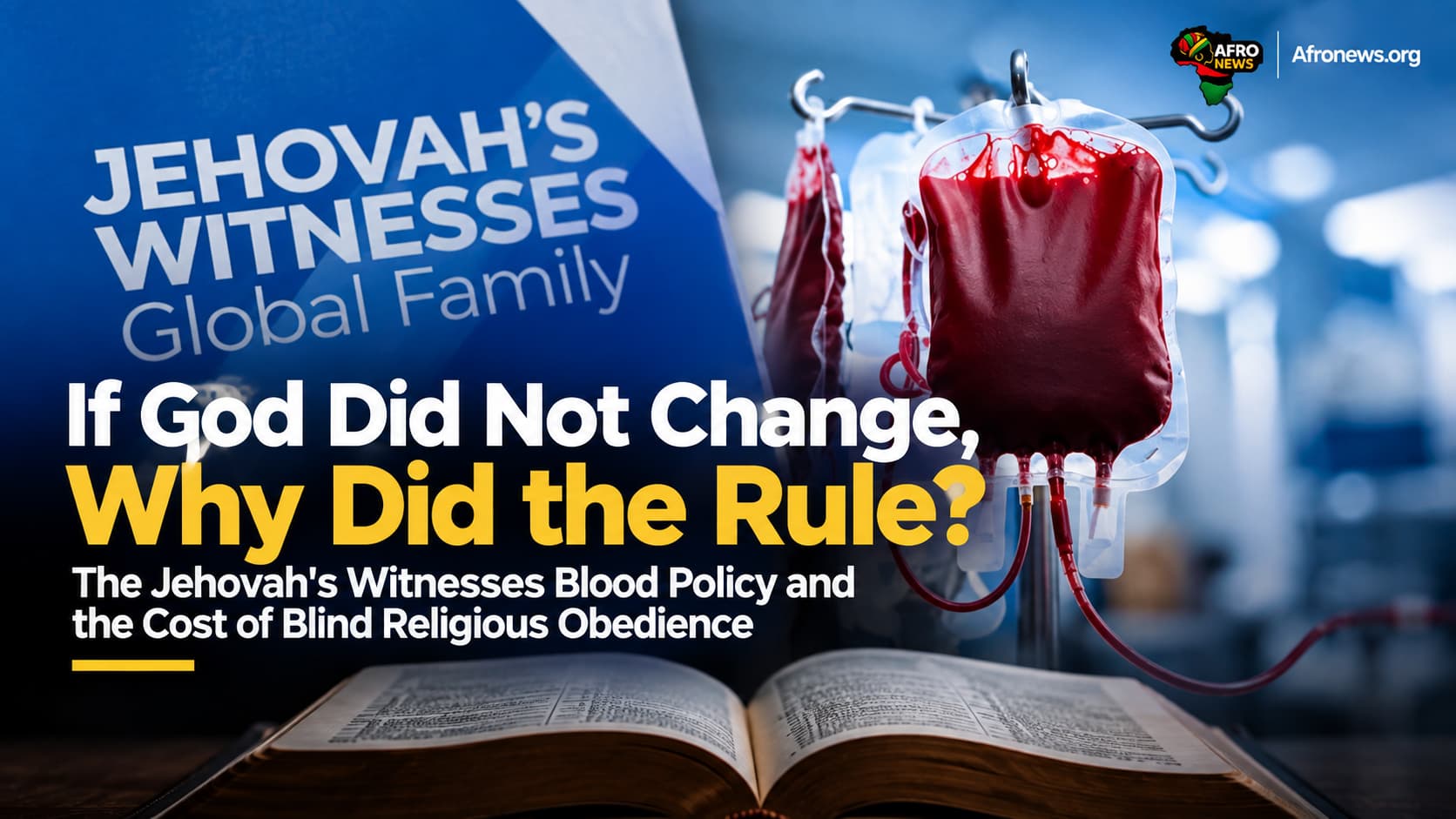
Religion can be a beautiful source of faith, hope, discipline, community and moral direction, but the moment human interpretation is presented as an unquestionable command from God, believers have every reason to pause, examine the evidence and ask whether they are following God or simply following people who claim to speak on His behalf.
On September 18, 2026, the Governing Body of Jehovah’s Witnesses announced that individual members may now decide according to personal conscience whether to accept or donate four major components of blood: red blood cells, white blood cells, plasma and platelets. The organisation, however, maintained its longstanding prohibition on whole-blood transfusions.
If God did not change, if the Bible did not change and if the fundamental scriptural passages being relied upon did not change, what exactly changed? The answer appears to be the interpretation and that is precisely why this development should encourage believers, regardless of denomination, to think carefully about the difference between God’s word and human interpretation of God’s word.




When a Religious Rule Changes, Someone Has Changed Their Understanding
For decades, Jehovah’s Witnesses maintained a strict position against blood transfusions based on their interpretation of biblical commands to “abstain from blood,” extending that interpretation over time to the major components of blood. The September 2026 announcement is a significant adjustment: members may now personally decide on red cells, white cells, plasma or platelets, while the prohibition on whole-blood transfusion remains.
The organisation explains that the change follows the principle already applied to certain blood fractions and to a person’s own blood, arguing that Scripture does not specifically address these medical situations, so the decision belongs to individual conscience. That raises an important question: if Scripture was silent about these procedures all along, why were believers previously given so little room to decide for themselves? That is not an attack on faith, it is a question about authority. When an institution says a procedure is forbidden by God, the believer may hear it as an absolute divine command rather than an institutional interpretation of Scripture. Were followers previously obeying God, or an interpretation of God?
The Real Problem Is When Human Interpretation Becomes God’s Voice
There is nothing unusual about religious interpretation changing; theological disagreement has produced different denominations and doctrines for centuries. The problem begins when an interpretation is presented not as an interpretation but as an unquestionable expression of God’s own command. Once that happens, challenging the institution can feel like challenging God. “God does not permit this” and “we interpret Scripture to prohibit this” are not the same claim, one is divine authority, the other is human understanding. The distinction matters most in medicine, where a believer’s decision may carry consequences that cannot later be reversed.
Ghana Has Seen Religious Rules Change Too
This is not a problem exclusive to Jehovah’s Witnesses. In 2010, The Church of Pentecost in Ghana announced that head covering had no categorical biblical basis for salvation and that female visitors in decent trousers should be welcomed, acknowledging the culturally diverse nature of its membership. The point is not to condemn that church, which offered its own theological reasoning, the broader question is what this tells believers about religious rules generally: how many things Christians have been told are God’s commands are actually interpretations shaped by culture, history, tradition and institutional practice? Because religious institutions are run by human beings, the distinction between Scripture, interpretation, tradition and institutional policy matters enormously.
The Difference Becomes Critical When Human Lives Are Involved
A church changing its stance on clothing has limited consequences; a medical doctrine affecting whether someone accepts potentially life-saving treatment is fundamentally different, which is why the blood policy deserves serious examination. A 2026 multicentre retrospective study in the American Journal of Gastroenterology examined 131 Jehovah’s Witness patients with gastrointestinal bleeding who declined transfusion against 131 matched non-Witness patients, finding no statistically significant difference in 30-day mortality, though Witness patients more often needed intermediate-level care and bloodless-management interventions. That shows declining transfusion does not automatically mean death, but the reverse conclusion would be equally irresponsible, since successful bloodless treatment in some cases does not mean transfusion is never necessary. The deeper issue is not simply whether refusing blood always leads to death, but why the person was refusing it in the first place. A freely made, well-informed choice is one situation; refusing because one believes acceptance would disobey an absolute command from God, only to later learn the organisation revised that interpretation, raises a very different ethical question.
What About Those Who Died?
This uncomfortable question should not disappear simply because the policy changed. Medical literature has documented serious cases of Witness patients who declined transfusion; not every death can be attributed to that refusal, but the issue is not theoretical, people have made real, sometimes fatal, medical decisions under religious conviction. A policy can be changed on paper, but a human life cannot be restored by a policy revision. For someone who lost a loved one after a refusal grounded in religious conviction, a doctrinal change may raise difficult emotions no institutional statement can erase. Religious institutions should therefore exercise extraordinary caution when converting scriptural interpretation into rigid rules about medical treatment.
Faith Should Not Require the Suspension of Reason
There is a dangerous misconception that questioning shows weak faith while unquestioning obedience shows strong faith. A person can believe in God and still question a pastor, respect a denomination and still examine its doctrines, love the Bible and still question someone’s interpretation of it, pray for healing and still listen to doctors, and hold deep faith while asking, “Where exactly does Scripture say this?” The Bible itself contains examples of people examining teachings rather than accepting every claim blindly, faith need not be the enemy of reason. Conviction without examination can become vulnerability, and wherever an institution holds enormous influence over its followers, intellectual independence becomes even more important.
The Jehovah’s Witnesses Change Makes the Point Even More Clearly
What makes the September 2026 development significant is that the organisation itself now emphasises personal conscience, stating that each Witness must decide on red cells, white cells, plasma or platelets and that the congregation will not intervene in decisions belonging to individual conscience. If individual conscience can be trusted now, it is fair to ask why it could not play a greater role before. If the answer is that the organisation’s understanding of Scripture has developed, believers should recognise that religious interpretation can develop. The lesson is not that every teaching is false or that religious leaders are dishonest, it is simpler: religious leaders are human beings, and human beings can sincerely be wrong. No believer should surrender every ounce of personal judgment to an institution merely because it uses religious language.
The Business of Religion Requires Scrutiny Too
When a religious organisation changes a longstanding doctrine, it can be tempting to conclude that religion is merely a business designed to control people or extract money, but that conclusion requires evidence, and a doctrinal change by itself does not prove financial exploitation. What can reasonably be said is that religious institutions carry enormous social, psychological and moral influence, and where that influence exists, teachings deserve scrutiny, particularly when obedience affects family relationships, medical decisions, education, finances or personal freedoms. Religion should not treat uncomfortable questions as rebellion, and no religious leader should present institutional preference as though God wrote it personally. A pastor is not God. A bishop is not God. An apostle is not God. A governing body is not God. A denomination is not God, these are human institutions, operated by human beings who interpret religious texts according to their own understanding.
The Question Is Bigger Than Jehovah’s Witnesses
This debate should not become an opportunity simply to attack Jehovah’s Witnesses while pretending other religious organisations have never changed their rules. Every believer should be able to ask whether a doctrine comes directly from Scripture, is an interpretation of Scripture, is cultural tradition, institutional policy, or simply a leader’s opinion. When those categories are blurred, ordinary believers can end up attributing supernatural authority to decisions made by ordinary human beings, and once a human decision is labelled “God’s command,” challenging it becomes extraordinarily difficult. That is where critical thinking becomes not an enemy of religion, but a protection for the believer.
God Does Not Need Us to Stop Thinking
The most important lesson from the Jehovah’s Witnesses’ latest adjustment is not that religion is inherently bad or that every previous decision was automatically wrong. The lesson is simpler and more powerful: human beings interpret religion, and human interpretations can change. The organisation has changed its position on four major blood components while maintaining its prohibition on whole-blood transfusion, and has explicitly placed those decisions in the hands of individual conscience. If something can be presented for decades as an absolute requirement from God and later become a matter of individual conscience, believers have every right to ask how much certainty should be attached to human interpretations in the first place.
Religion can teach people to believe, to serve, to love and to forgive, but religion should never teach people that thinking is a sin. If God gave human beings conscience, intelligence and the ability to reason, using those gifts responsibly should not automatically be regarded as rebellion against Him. The ultimate responsibility for one’s conscience and decisions cannot simply be outsourced to another human being because that person speaks from a pulpit or invokes God’s name.
Believe, but think. Pray, but examine. Respect religious authority, but remember that religious authority is still human authority.
And whenever someone tells you, “God said it,” do not be afraid to ask the most important question of all: “Where did God say it?”
Sources and Further Reading
Jehovah’s Witnesses — Associated Press report on the September 18, 2026 blood-policy adjustment:
AP: Jehovah’s Witnesses allow blood-derived products but keep ban on whole-blood transfusions
Jehovah’s Witnesses — Official news feed (Governing Body Updates):
JW.org — Global News / Governing Body Updates
AJWRB (reform-advocacy) commentary on the 2026 policy shift:
AJWRB: The 2026 Autologous Pivot — A Victory for Conscience, a Failure of Accountability
The Church of Pentecost (Ghana) — 2010 clothing and head-covering rule change, reported by MyJoyOnline:
MyJoyOnline: Pentecost Church relaxes trousers and head-covering rules for females
2026 matched-cohort study on Jehovah’s Witness patients with gastrointestinal bleeding who declined transfusion: