

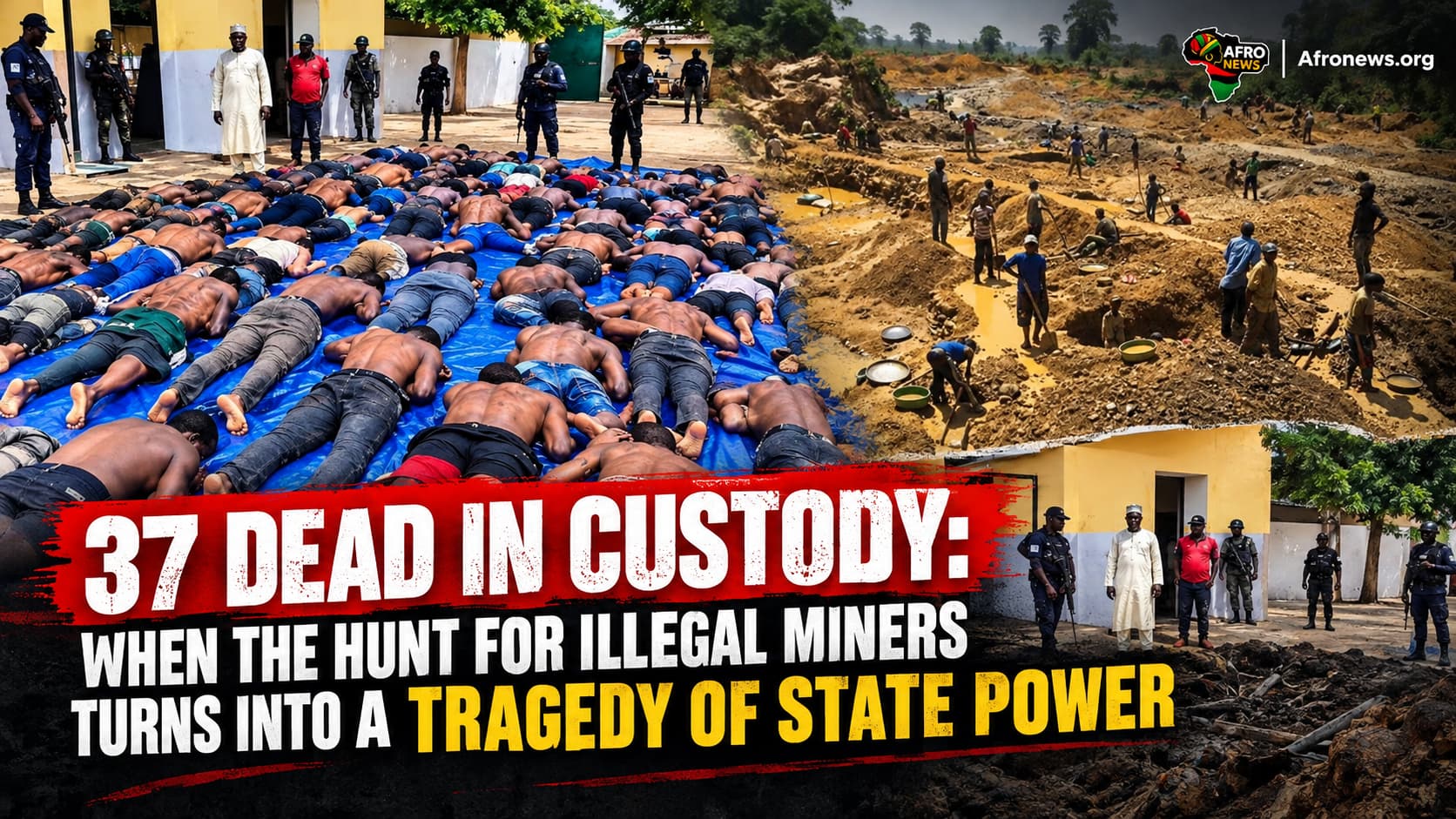
“They started dying one after another.”
That is how one survivor reportedly described the horror inside an overcrowded detention cell in Minna, Niger State.
Another survivor said they complained repeatedly that the cell was too small. Then, according to his account, something smelling like perfume or pepper was sprayed into the cell. Soon, people began struggling to breathe. Some became disoriented. Others collapsed.
Related Post




The cries for help allegedly continued.
But the doors, according to survivor accounts reported by Reuters, remained locked.
Then the deaths began.
One.
Then another.
And another.
By the time the horror was over, 37 people suspected of illegal mining were dead in the custody of the Nigeria Security and Civil Defence Corps, NSCDC.
Thirty-seven.
Not thirty-seven people killed in a mine collapse.
Not thirty-seven people caught in a gun battle with bandits.
Not thirty-seven soldiers lost on a battlefield.
They were people who had been arrested and placed under the control of the state.
And that distinction matters.
Because once a government takes a person into custody, responsibility does not end with the arrest.
It begins.
THE QUESTIONS INSIDE THAT CELL
The circumstances surrounding the deaths remain under investigation. Survivors have alleged overcrowding, poor ventilation, beatings, denial of basic necessities and exposure to an unidentified substance.
Reuters reported that several survivors independently described a substance being sprayed into the overcrowded cell, after which detainees began experiencing breathing difficulties, disorientation and collapse. Reuters also stressed that it could not independently verify the accounts or establish what substance was used
That uncertainty makes an independent investigation even more important.
But uncertainty about the exact cause of death should not become an excuse for uncertainty about responsibility.
If 67 people were indeed squeezed into a cell and 37 died, as reported by Niger State Governor Umaru Bago, then somebody must answer a very basic question:
Who authorised that detention arrangement?
The governor has said the state government was not informed about the arrests before the deaths became public
That raises another question.
If a security agency operating within a state can arrest dozens of people, transport them to a detention facility and hold them without the knowledge of the state government, what exactly are the lines of accountability?
And if those people were suspected of breaking the law, why were they apparently subjected to conditions that could allegedly endanger their lives?
Being suspected of illegal mining does not make someone disposable.
It does not suspend the Constitution.
It does not cancel the right to life.
It does not give security personnel permission to humiliate, torture or recklessly endanger detainees.
President Bola Tinubu himself made this point after the tragedy, saying that the suspected miners retained their rights to life, dignity and humane treatment while in government custody. He ordered a full and transparent investigation and said officers whose actions, abuse or negligence contributed to the deaths should face prosecution where the evidence warrants it.
That is the standard the investigation must now meet.
WHEN ENFORCEMENT BECOMES ABUSE
There is a legitimate national security argument for fighting illegal mining.
Illegal mining damages the environment. It deprives government of revenue. In some parts of Nigeria, authorities and researchers have linked illicit mining networks to criminal groups and insecurity. Niger State itself has repeatedly raised concerns about the relationship between mining, environmental degradation and insecurity.
So, yes, the government must act.
But enforcement cannot become a license for brutality.
This is where the NSCDC deserves particularly tough scrutiny.
The Corps exists to protect lives and critical national assets, enforce relevant laws and support national security. Its personnel are armed representatives of the Nigerian state.
That power comes with enormous responsibility.
The allegation that detainees were beaten, overcrowded, denied basic necessities or exposed to a substance without adequate emergency intervention if established would represent something far more serious than an operational mistake.
It would raise questions about institutional culture, command responsibility, training, detention standards and abuse of state power.
The government cannot simply suspend officers and move on.
Suspension is not accountability.
The Interior Ministry has now suspended officers connected to the incident and constituted a 10-member independent committee to investigate the arrests, detention conditions, deaths and possible responsibility. The committee has two weeks to submit its report.
That is a necessary step.
But Nigerians will be watching what happens after the report.
Will findings be published?
Will evidence be preserved?
Will responsible officers face criminal prosecution where warranted?
Will victims’ families receive compensation?
Will the chain of command be examined?
And perhaps most importantly:
Will anything actually change?
THE GOVERNOR’S GRIEF AND A COMMUNITY’S ANGER
Governor Umaru Bago’s response has also revealed another layer of the tragedy.
Niger State has been struggling with the complicated reality of a mineral-rich economy in which mining provides income for people who may have few alternatives.
The governor has previously acknowledged the damage associated with illegal mining while advocating a more organised and responsible mining sector. In 2024, the state established a task force to identify illegal mining sites, tackle child labour and improve regulation.
After the latest tragedy, Bago declared mourning and expressed concern over the deaths.
But grief from government officials, however sincere, cannot replace accountability.
For the families, the language of condolences is not enough.
A father who lost a son does not need another government statement.
He needs to know what happened.
A mother who expected her child to return home needs answers.
A community that watched young people disappear into detention and emerge as corpses needs justice.
And a country watching all of this needs reassurance that custody by the state does not become a death sentence.
BUT WHY DO PEOPLE ENTER ILLEGAL MINING IN THE FIRST PLACE?
This is where the conversation must go beyond arrests.
Illegal mining is not only a security problem.
It is also an economic problem.
Where formal jobs are scarce, where farming is threatened by insecurity and climate pressures, and where families struggle to survive, a gold deposit can become more than a mineral resource.
It becomes an emergency income source.
The World Bank notes that artisanal and small-scale mining provides livelihoods for millions globally and can serve as a major non-farm source of income in rural communities. At the same time, informal mining can expose workers to dangerous conditions and other risks.
Nigeria’s broader employment challenge makes the issue even more complicated. The World Bank says millions of Nigerians enter the labour force every year while poverty and limited quality employment remain significant challenges.
So the question is not simply:
Why are these people mining illegally?
It should also be:
What legitimate economic alternative did we give them?
You cannot arrest poverty.
You cannot handcuff unemployment.
You cannot prosecute hunger.
And you cannot permanently police an economic activity without creating a legal alternative for the people who depend on it.
A DIFFERENT WAY TO FIGHT ILLEGAL MINING
Nigeria needs a strategy that separates criminal mining networks from desperate artisanal workers.
First, legalise and organise genuine artisanal miners through cooperatives, simplified licensing and community-based mining schemes.
Second, go after the financiers, exporters and criminal networks, not merely the young people at the bottom of the chain.
Third, establish properly monitored mining zones with safety standards, environmental requirements and government oversight.
Fourth, make registration simple and affordable. If obtaining a legal licence is expensive, slow and inaccessible, informality will continue to thrive.
Fifth, create alternative livelihoods in farming, agro-processing, vocational training and small businesses in mining communities.
Sixth, strengthen surveillance of mineral supply chains so that illegally extracted gold and other minerals cannot easily enter legitimate international markets.
And finally, security agencies must be subjected to strict detention protocols.
Every detainee should be registered.
Every detention facility should have a documented capacity.
Medical screening should be mandatory.
Overcrowding should trigger immediate intervention.
CCTV and custody records should be preserved.
And independent human-rights monitors should have access to detention facilities.
Because the greatest test of a security agency is not how aggressively it can arrest a suspect.
It is how responsibly it treats that suspect after the arrest.
TINUBU’S WARNING MUST BECOME MORE THAN WORDS
President Tinubu has said the government will continue fighting illegal mining but insisted that enforcement must remain within the law. He also warned that suspension of officers should not substitute for determining criminal responsibility where evidence supports prosecution.
Interior Minister Olubunmi Tunji-Ojo has similarly described the deaths as deeply disturbing and said the government owes the families and Nigerians a transparent account. He ordered the suspension of officers involved and warned against the destruction or concealment of evidence and intimidation of witnesses.
Those words are important.
But the real test begins after the cameras disappear.
Because Nigeria has seen investigations before.
The bigger question is whether this investigation will produce consequences strong enough to change behaviour.
The 37 dead cannot testify.
Their families can.
The survivors can.
The evidence can.
And the detention records can.
THE GOLD WAS UNDERGROUND. BUT SO WERE THE QUESTIONS.
There is an uncomfortable irony in this tragedy.
The government went looking for illegal mining beneath the ground.
Instead, it uncovered something much deeper about the relationship between citizens and the state.
A country cannot fight lawlessness by allowing law enforcement to operate without accountability.
It cannot demand respect for the law from citizens while public officials are suspected of breaking the very rules they are sworn to enforce.
And it cannot defeat illegal mining simply by filling detention cells.
The miners may have been accused of breaking the law.
But who was responsible for protecting them once the state took away their freedom?
Who decided how many people could be placed inside that cell?
Who heard the cries?
Who allegedly sprayed the substance?
Who failed to open the door?
Who knew?
Who didn’t know?
And when the final report arrives, will Nigeria finally get answers or will the 37 names become another painful footnote in the country’s long history of deaths in custody?
Because the real tragedy may not be that 37 people died while Nigeria was fighting illegal mining.
It may be that, unless accountability follows, their deaths will teach the system nothing.
References
Reuters — Survivor accounts and investigation into the Minna deaths�
Presidency — Tinubu orders transparent investigation and accountability�
Ministry of Interior — Independent committee and suspension of NSCDC officers�
Channels Television — Governor Bago on the arrests and detention�
Niger State Government — Task force on illegal mining�
World Bank — Artisanal and small-scale mining livelihoods�