
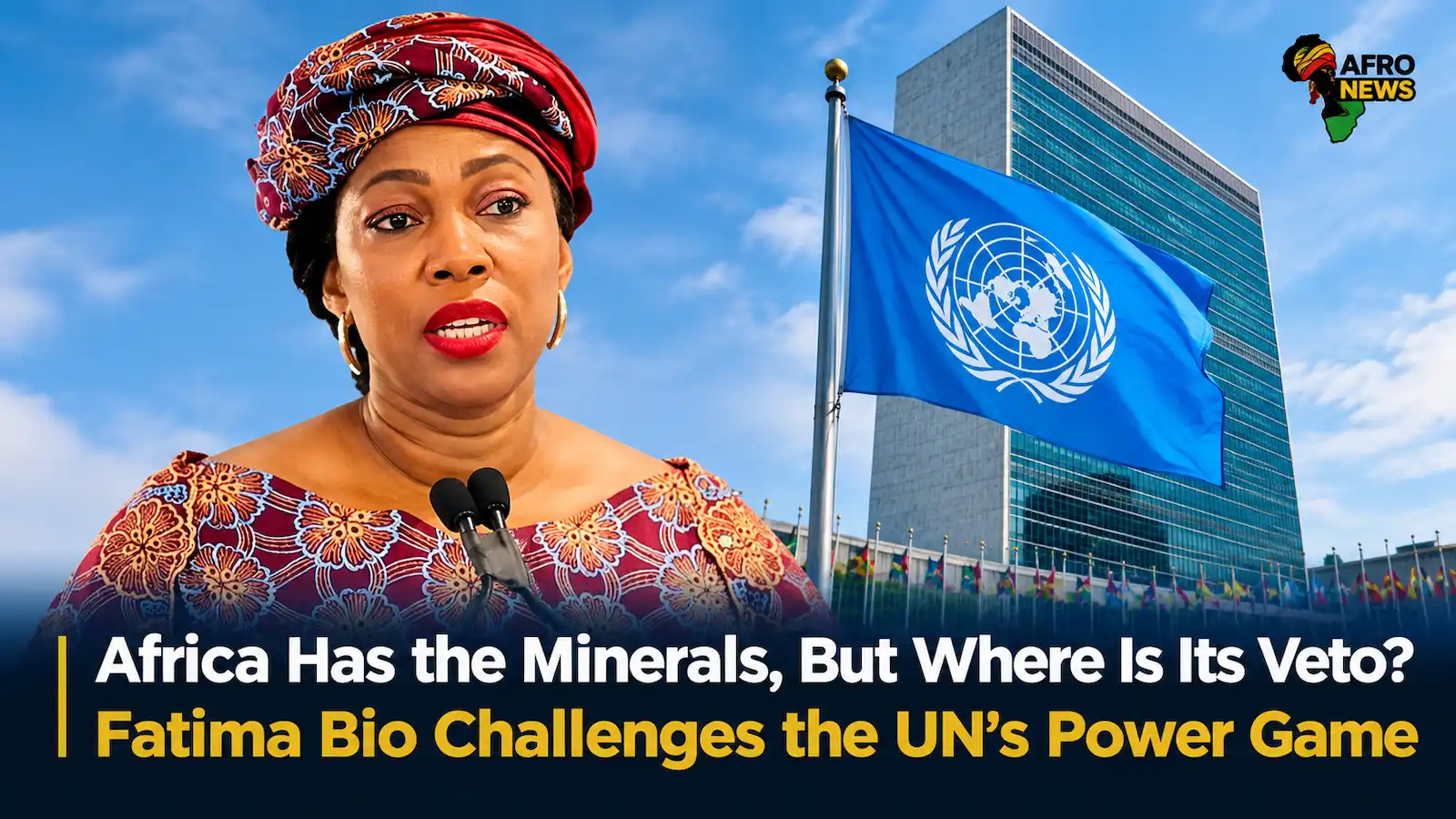
Sierra Leone’s First Lady, Fatima Maada Bio, has reignited debate over Africa’s place in the global order after questioning why a continent of 54 countries remains without a permanent seat on the United Nations Security Council despite its enormous population, strategic importance and economic potential.
Speaking at a Harvard event, Bio argued that Africa must be treated as a partner in global decision-making rather than as a collection of countries whose affairs can be discussed without giving the continent permanent influence over decisions that directly affect its future.
Her frustration exposes a contradiction that has survived for decades: Africa accounts for 54 of the United Nations’ 193 member states, yet none of its countries has permanent representation on the Security Council, whose five permanent members, the United States, United Kingdom, France, Russia and China possess veto power over substantive resolutions. The UN confirms that a negative vote from any one of the five permanent members can prevent the adoption of a substantive resolution. (United Nations)
Related Post


The African Union has consequently called for at least two permanent African seats and five non-permanent seats, with the same privileges of permanent membership, including veto power for as long as the veto remains part of the Council’s structure. The AU has maintained this position through its Common African Position, also known as the Ezulwini Consensus. (AfricanLII)
But Bio’s argument extends beyond representation in New York; it raises a broader question about who has the power to shape decisions affecting Africa and who benefits from the continent’s strategic importance.
Africa Has What the World Wants, But Who Controls the Value?
Africa’s mineral wealth makes that question particularly significant. The continent possesses major deposits of cobalt, copper, manganese, graphite, lithium, gold and other resources increasingly important to modern industries. The OECD’s 2026 regional assessment of critical minerals notes the growing importance of Africa in global mineral supply chains and highlights the significant role played by Chinese and other international companies in extraction, processing and investment across the continent. (OECD)
The Democratic Republic of Congo provides a particularly important example, with cobalt playing a central role in the country’s mineral economy and in global supply chains for technologies associated with the energy transition. The International Energy Agency has identified the DRC as the dominant source of mined cobalt globally, underscoring the strategic importance of the country’s resources to international markets.
The concern is not that foreign investment is inherently exploitative, since international capital can provide technology, employment, infrastructure and access to global markets. Rather, the difficult question is whether African countries are capturing enough value from their resources when significant parts of processing, manufacturing and downstream production take place outside the continent.
That economic imbalance gives greater weight to Bio’s call for Africa to be treated as a genuine partner, particularly as global competition for critical minerals intensifies. The OECD notes that governments across Africa are increasingly seeking greater transparency, local content, environmental standards and domestic value addition in mineral projects. (OECD).
The World Has Changed, Has the UN?
The debate over Africa UN Security Council reform therefore sits within a much larger conversation about the continent’s bargaining power, political independence and ability to determine the terms of its engagement with the rest of the world.
A permanent African presence at the Security Council would not automatically resolve corruption, weak governance, infrastructure deficits or unfavourable resource agreements, and African governments must take responsibility for those challenges. However, supporters of reform argue that meaningful participation in global institutions would give the continent greater influence over international decisions that affect its security and development.
The issue has already received significant attention within the UN itself. During a high-level Security Council debate in August 2024, Sierra Leone’s President Julius Maada Bio argued that Africa remains underrepresented in global decision-making and reiterated the continent’s demand for two permanent seats and five non-permanent seats. UN Secretary-General António Guterres also acknowledged that the Council was designed around the power structures of 1945, when most African countries were still under colonial rule and had no voice in international affairs. (press.un.org)
There is one factual correction worth making to the original remarks: there are five veto-holding permanent members, not seven. They are China, France, Russia, the United Kingdom and the United States. The UN’s official voting rules confirm that these five countries possess the veto. (United Nations)
The correction does not erase the larger issue Bio raised about the concentration of global decision-making power.
The world has changed considerably since the United Nations was established in 1945, when most African countries were still under colonial rule and had no meaningful voice in designing the international system. Eight decades later, the African Union continues to describe the continent’s absence from the permanent category as a historical injustice and has maintained a common position in negotiations over reform. (AfricanLII)
Africa’s case is strengthened by the fact that the continent is no longer a peripheral actor in global affairs. Its population, markets, strategic location, natural resources and growing geopolitical relevance make it increasingly difficult to justify an international system in which Africa remains without permanent representation in its most powerful security institution.
At the same time, representation alone will not guarantee better outcomes for the continent. African governments would still need stronger institutions, better governance, greater regional coordination and more effective negotiations to ensure that political representation translates into tangible economic and security gains.
Bio’s intervention therefore adds a prominent voice to a campaign that African governments and the African Union have pursued for years, while also raising a broader question about whether the global system is prepared to reflect the realities of the 21st century.
At its heart is a straightforward demand: Africa should not merely be discussed at the global table; it should have the power to participate meaningfully in deciding what happens there.
Whether that change comes through an expanded Security Council, a reform of the veto system or a broader restructuring of global governance will ultimately require difficult negotiations among existing and aspiring powers.
For Africa, however, the argument is increasingly clear: if the continent is expected to contribute to global peace, economic growth and the management of strategic resources, its representation in the institutions that shape those decisions should reflect its importance in the world today.
References
United Nations Security Council. (n.d.). Current members. United Nations.
African Union. (2025, September 21). Keynote address on the 20th anniversary of the Ezulwini Consensus and the Sirte Declaration: Two decades of the African common position, correcting historical injustices, promoting equity and inclusion in the United Nations Security Council [Speech transcript].
UN News. (2025, September 25). Africa’s voice is not heard’: Leaders issue call for equity, justice and courage. United Nations.
OECD. (2026). Regional note on critical minerals in Africa. OECD Publishing.