
Western hypocrisy – There are speeches that disappear the moment the applause fades. Then there are speeches that linger because they expose uncomfortable truths.
On 26 May 2025, speaking from Birmingham, England, Zimbabwean philosopher and author Dr. Joshua Maponga delivered one such challenge. Rather than offering a conventional political speech, he posed a series of piercing questions that struck at what many Africans have long regarded as one of the greatest contradictions in modern international relations: Western hypocrisy.
“What kind of people wake up in the morning to manufacture weapons to kill other people? Are you okay?”
Related Post



His words were provocative, not because they promoted hatred, but because they invited reflection.
Whether one agrees entirely with his conclusions or not, Maponga’s remarks force the world to examine an uncomfortable reality: why do some nations that claim the moral high ground often engage in practices that contradict the very principles they advocate?
The Contradiction of Resource Extraction
Africa possesses approximately 30% of the world’s known mineral reserves.
It supplies much of the world’s gold, cobalt, platinum, diamonds, manganese, chromium, lithium and numerous strategic minerals powering today’s green technologies.
Yet many of the communities where these resources originate remain among the poorest on earth.
For decades, multinational corporations have extracted enormous wealth from African soil while leaving behind polluted rivers, toxic waste, abandoned pits and devastated ecosystems.
Maponga summarizes this contradiction with remarkable simplicity:
“You come to Africa, dig up the whole place, poison rivers with cyanide, take the gold and lock it away in vaults.”
This observation reflects documented environmental challenges.
Across parts of Africa, industrial mining has contaminated water systems with heavy metals and toxic chemicals, affecting agriculture, fisheries and public health.
The paradox is striking.
Gold that serves little practical industrial purpose beyond finance and luxury often receives extraordinary protection inside fortified vaults, while the communities from which it came struggle with contaminated water and degraded land.
If sustainability truly matters, should environmental responsibility not begin where extraction occurs?
Conservation or Convenience?
Perhaps Maponga’s sharpest criticism concerns wildlife conservation.
He observes that African communities are frequently criticised for wearing traditional animal skins or practising cultural customs involving wildlife products.
Meanwhile, some of the same societies making these criticisms continue consuming leather on a massive industrial scale.
Leather furniture.
Leather shoes.
Leather belts.
Luxury vehicle interiors.
Fashion accessories.
The issue is not whether wildlife should be protected.
It absolutely should.
Rather, the question concerns consistency.
If animal welfare is genuinely a universal ethical concern, then moral expectations should apply equally across cultures instead of selectively targeting African traditions while normalising industrial consumption elsewhere.
Conservation loses credibility when it appears selective.
Climate Change and Historical Responsibility
Another point raised by Maponga concerns climate justice.
Many African countries are encouraged to transition rapidly toward renewable energy despite contributing only a small fraction of historical global greenhouse gas emissions.
According to scientific assessments by the Intergovernmental Panel on Climate Change (IPCC), industrialised economies have produced the overwhelming majority of cumulative carbon emissions since the Industrial Revolution.
Africa, despite housing nearly one-fifth of humanity, has historically contributed only a small share of global emissions.
Yet climate negotiations often ask developing economies to slow industrialisation while wealthier nations continue consuming resources at disproportionately high levels.
Maponga captures this frustration succinctly:
“You pollute the whole world with carbon, then you come around and say, ‘Let’s do green energy.’”
The criticism is not directed at renewable energy itself.
Renewable energy remains essential.
Rather, it challenges unequal expectations.
Climate justice requires acknowledging historical responsibility alongside future commitments.
The Global Arms Industry
Maponga’s opening question about weapons manufacturing also deserves careful consideration.
According to international defence data, the overwhelming majority of global arms exports originate from a small group of industrialised nations.
Weapons manufactured in advanced economies frequently end up fuelling conflicts across developing regions.
Ironically, the same governments promoting peace initiatives often remain among the world’s largest exporters of military equipment.
This contradiction has long troubled peace advocates.
If peace is the ultimate objective, reducing incentives for global arms proliferation deserves equal attention.
Human Rights and Selective Morality
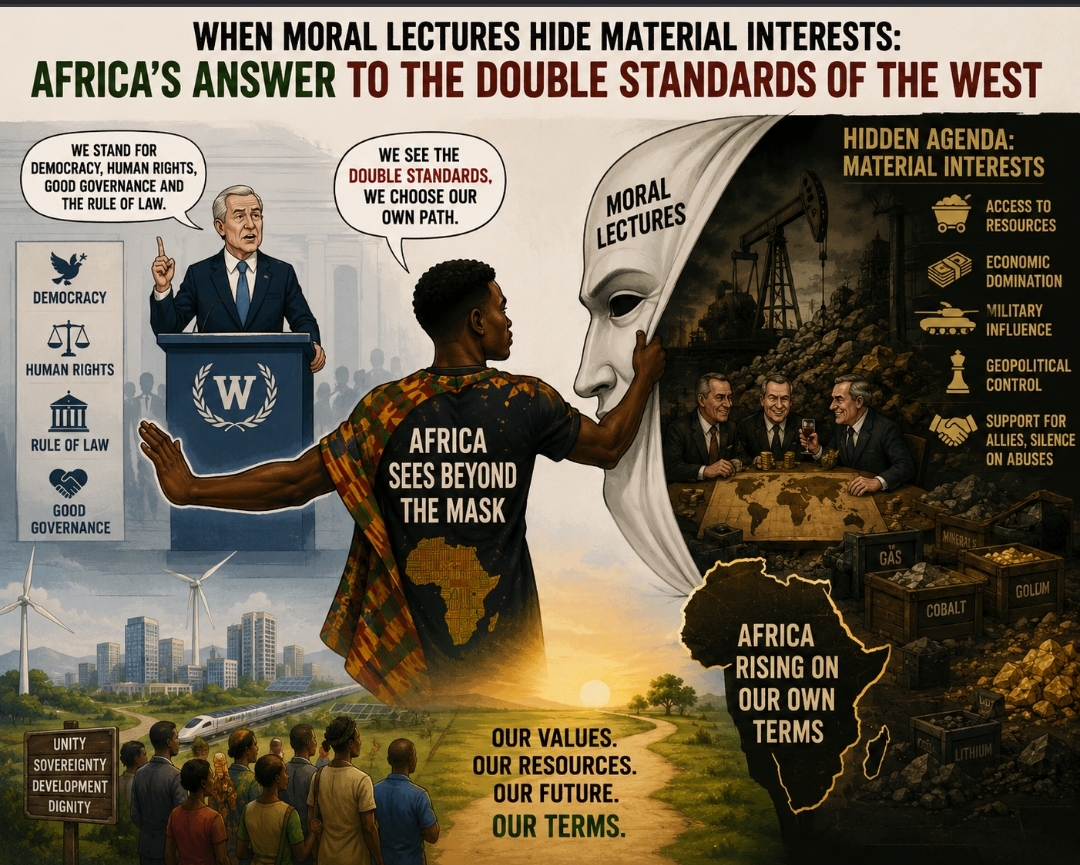
One recurring criticism of international politics concerns selective application of human rights principles.
Violations committed by geopolitical rivals often attract swift condemnation, sanctions and extensive media coverage.
Similar actions by strategic allies may receive more restrained responses.
This inconsistency weakens confidence in the universality of international norms.
Human rights should never depend upon political convenience.
Justice cannot remain credible if it changes according to geography, alliances or economic interests.
Africa Is Not Rejecting Cooperation
Critics sometimes interpret speeches like Maponga’s as anti-Western.
That interpretation misses the deeper point.
Africa does not reject international cooperation.
Africa rejects unequal cooperation.
The continent continues to welcome investment, scientific collaboration, education, technology transfer and mutually beneficial trade.
What many Africans increasingly question is a system where lectures about governance, conservation, climate and ethics are delivered by institutions whose own historical and contemporary records often reveal profound contradictions.
Partnership requires mutual respect.
Respect requires consistency.
A New Generation Refuses Double Standards
Across Africa, a younger generation is asking difficult questions.
Why should African nations remain exporters of raw materials rather than manufacturers?
Why should environmental damage occur where extraction takes place while profits accumulate elsewhere?
Why should traditional African practices face scrutiny while industrial consumption escapes similar criticism?
These are not questions born from resentment.
They arise from a growing desire for fairness.
Africa is becoming more confident in defining its own development priorities instead of merely responding to external expectations.
The Honeymoon of Unquestioned Narratives Is Ending
Dr. Joshua Maponga concluded his remarks with a striking declaration:
“You have lied to us for too long, and the honeymoon of lies is over.”
Whether one agrees with every aspect of his argument, one reality is increasingly difficult to ignore.
The world is changing.
Africa is no longer simply listening.
It is questioning, it is researching and it is negotiating.
It is demanding consistency between rhetoric and reality.
Ultimately, Western hypocrisy is not merely an African concern.
It is a global concern.
Any international order built upon double standards eventually loses moral authority.
The future belongs not to those who preach the loudest, but to those whose actions most closely resemble the values they proclaim.
For Africa, the conversation has moved beyond seeking sympathy.
The continent is asking for something far more fundamental:
Equal standards.
Equal dignity.
Equal accountability.
Nothing more.
Nothing less.
References
- Intergovernmental Panel on Climate Change (IPCC). Sixth Assessment Report (AR6): Climate Change 2023 – Synthesis Report.
- United Nations Environment Programme (UNEP). Environmental Impacts of Mining and Sustainable Resource Management.
- United Nations Conference on Trade and Development (UNCTAD). Economic Development in Africa Reports.
- Stockholm International Peace Research Institute (SIPRI). Trends in International Arms Transfers.
- African Development Bank (AfDB). African Economic Outlook.
- World Gold Council. Gold Demand Trends and Central Bank Gold Reserves.
- African Minerals Development Centre (AMDC). Africa Mining Vision.
- Dr. Joshua Maponga. Public address delivered in Birmingham, England, 26 May 2025.