
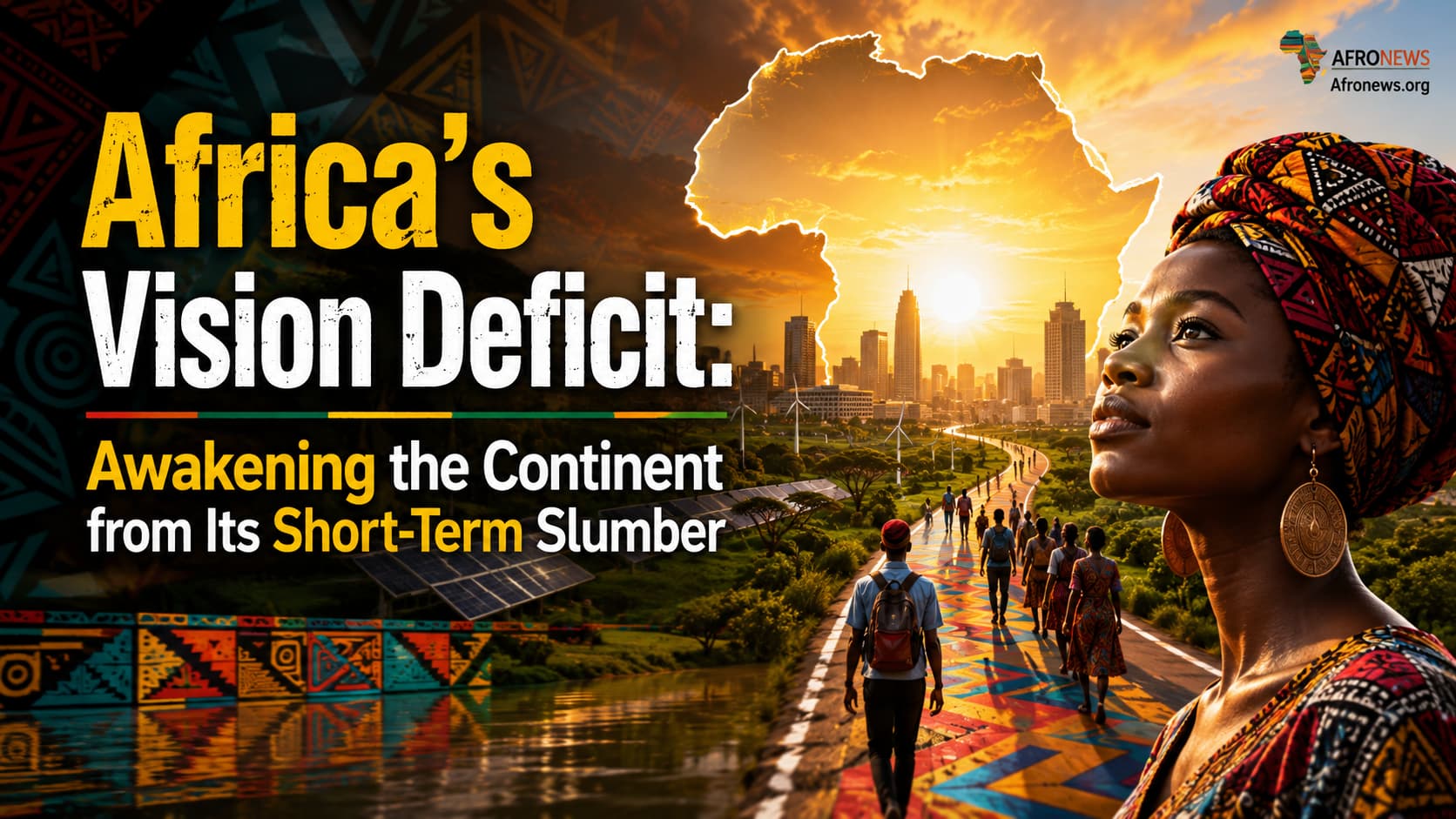
Africa stands on a mountain of wealth, human, natural, and spiritual, yet it remains grounded by one of the most invisible but dangerous forces of underdevelopment: the absence of long-term vision. In a world that is sprinting toward the future with calculated precision, Africa is still trapped in a cycle of reactive governance. Drawing on a searing observation from Pan-Africanist Professor PLO Lumumba, who contrasted China’s century-long planning with Africa’s spiritual fatalism, this paper explores the continent’s chronic short-termism. It offers a nuanced critique of inherited systems, leadership failures, and cultural complacency, while laying out bold, practical solutions that could awaken Africa from its planning paralysis. Enriched with real-life examples and the voices of great leaders, this is not just an indictment of the present, but a summons to reimagine the future.
The Crisis of Imagination
In a moment of painful honesty, Professor PLO Lumumba once recounted watching CGTN, the Chinese state-run media outlet, where over 6,000 delegates sat in deliberation, not about next year, or the next five but about China’s place in the world a hundred years into the future. As he watched them debate strategies to shape not only their national destiny but global geopolitics, Lumumba reflected on the African situation and concluded: “In many African countries, if you ask what will happen tomorrow, they say, ‘Only God knows.’”
That chilling observation is not merely a cultural critique, it is a diagnosis of a systemic disease. Africa, with its stunning potential and youthful energy, remains a continent largely stuck in the now. While other nations plan for their great-grandchildren, many African states govern for the next election, or worse, the next applause. It is a crisis not of competence, but of imagination.
Related Post


A Tale of Two Philosophies: China and Africa
China offers a striking contrast. Its transformation from a war-ravaged, famine-stricken state in the 1940s to a global technological and economic superpower was not fueled by luck, nor even natural resources, it was driven by long-term planning. From Deng Xiaoping’s reform policies in the late 1970s to Xi Jinping’s vision for the “Chinese Dream,” each generation of leadership has pursued a strategic continuum shaped by the “Two Centenary Goals.” China’s civil service and party machinery are obsessed with continuity, vision, and national dignity. In Xi’s own words:“Success does not belong to us alone; we plan for generations to come”. Contrast this with many African states where national development plans are frequently discarded with every political turnover. Policies are written for donors, not for citizens. National budgets prioritize consumption over investment. The obsession is not with tomorrow’s prosperity, but today’s survival and even that is poorly managed.
The Legacy of Inherited Systems
To understand this vision vacuum, one must revisit Africa’s painful inheritance from colonial rule. The administrative systems left behind were not built for indigenous progress; they were designed for extraction, surveillance, and obedience. Post-independence leaders, even the most visionary among them, were forced to operate within frameworks crafted by former empires. Kwame Nkrumah warned early on:“Political independence is meaningless unless it is accompanied by economic independence”. But economic independence requires planning and planning requires vision. The tragedy is that after decades of independence, many African states are still trapped in externally imposed economic models. The aid industry, in particular, has become both a crutch and a curse. While aid can offer temporary relief, it often imposes short-term targets and donor-driven policies that conflict with the deep structural transformation Africa desperately needs.
Leadership and the Worship of Now
The planning crisis is also a reflection of Africa’s political culture. Too many African leaders govern as if their time is borrowed, not entrusted. Political capital is spent on vanity projects and populist gestures. Megaphone development, where announcements matter more than results, has replaced sober, strategic governance.
Festus Mogae, the former President of Botswana, once lamented,“We do not think in terms of generations. We think in terms of terms”. The result is that institutions atrophy, plans stall, and visionary initiatives are buried under the sands of political rivalry. Worse still, there is little to no continuity. Where Singapore had Lee Kuan Yew’s decades-long national roadmap, Africa has a conveyor belt of manifestos. A new administration often sees itself not as a custodian of national progress but as a messianic corrective to its predecessor, thus, long-term plans are scrapped with impunity.
The Cultural Element: Fatalism vs. Foresight
Africa is deeply spiritual, and rightly so. But the distortion of that spirituality into fatalism has undermined responsibility. The phrase “Only God knows” is now a national philosophy in some regions. It discourages planning and encourages passivity in the face of obvious problems.
Nelson Mandela offered a different theology:
“It always seems impossible until it’s done.”
Spirituality should fuel resilience, not apathy. Religion must coexist with strategic thinking, not substitute for it. The future, after all, is not predetermined, it is designed.
Glimmers of Hope: When Vision Prevails
Despite the gloom, Africa is not without examples of strategic foresight. Rwanda’s Vision 2050 is one of the most coherent national plans on the continent. Under Paul Kagame’s leadership, Rwanda has invested heavily in data systems, digital transformation, and institutional capacity. Vision is treated not as an idea but as infrastructure. Similarly, Ethiopia’s Grand Renaissance Dam, though controversial, represents a bold national ambition to own its energy future. South Africa’s National Development Plan 2030, if properly revived, could offer a framework for inclusive growth. These are not utopias; they are glimpses of what is possible when leadership, institutions, and public will align.
The Way Forward: Planting Trees We May Never Sit Under
What Africa needs now is not another summit or slogan. It needs a philosophical shift, a civilizational awakening. It must rediscover the virtue of long-term thinking. Like the Chinese plant trees for generations unborn, Africa must begin to write a future it may not immediately live to see. This transformation requires bold action. National constitutions must enshrine long-term development plans beyond electoral cycles. Future Councils, staffed by technocrats, youth, and civil society, must be mandated to envision and monitor intergenerational progress. Education systems must be redesigned to produce not just employees, but architects of the future. Diaspora communities must be harnessed, not pitied. They hold the skills, exposure, and capital that can help African countries leapfrog into the future. If Israel can turn a diaspora into a military and technological power, Africa can turn its own into a strategic asset. As Barack Obama said during his 2009 visit to Ghana:
“Africa doesn’t need strongmen. It needs strong institutions.” But institutions don’t build themselves. They are born out of visions, nurtured, protected, and invested in over time.
Conclusion: Beyond Today, Beyond Ourselves.
Professor Lumumba’s words are not just a critique; they are a call. A call to rise from the dust of indifference, to unshackle ourselves from imported limitations, and to chart a destiny bold enough to outlive us. Africa must begin to think like those 6,000 Chinese delegates, not as individuals seeking benefit, but as a civilization seeking permanence. Let this be the century where Africa breaks free from the tyranny of now. Let this be the era where we choose plans over prayers, vision over vanity, and sacrifice over applause. Because the future is not a gift. It is a decision.
References
- Nkrumah, K. (1963). Africa Must Unite. New York: F.A. Praeger
- Obama, B. (2009, July 11). Remarks by the President to the Ghanaian Parliament. The White House, Office of the Press Secretary.
- Xi Jinping. (2017, October 18). Secure a Decisive Victory in Building a Moderately Prosperous Society in All Respects and Strive for the Great Success of Socialism with Chinese Characteristics for a New Era. Address to the 19th National Congress of the Communist Party of China.
- Mandela, N. (1994). Long Walk to Freedom. Boston: Little, Brown and Company.
- Kagame, P. (2020). Rwanda Vision 2050. Republic of Rwanda, Ministry of Finance and Economic Planning (MINECOFIN).
- World Bank. (2023). Delivering Growth to People through Better Jobs. Africa’s Pulse, No. 28 (October 2023). Washington, DC: World Bank. (Note: this replaces the working title “Africa’s Development Report: Institutions and Accountability,” which does not correspond to an actual World Bank publication.)
- Patrick Loch Otieno Lumumba. (2025, July 3). Can Africa change its future? [Video]