
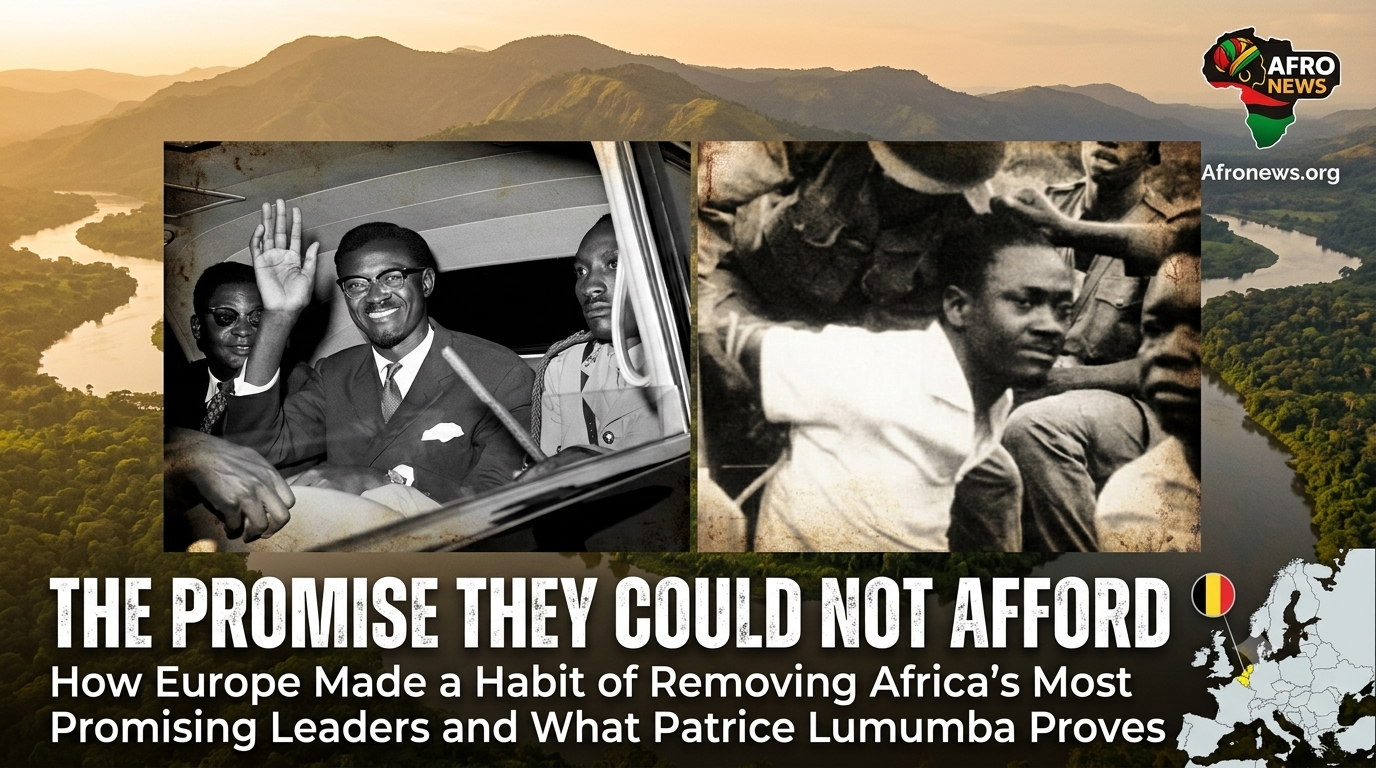
Patrice Lumumba’s murder is often told as an isolated tragedy: one brilliant, hot-headed young Prime Minister crushed by Cold War paranoia and Belgian greed. This paper argues the opposite. Lumumba was not an exception. He was the clearest instance of a pattern that recurred, with minor variations, across the continent for three decades after independence: whenever an African leader combined popular legitimacy, ideological independence, and control over strategic resources, that leader was removed, and a European or European-aligned hand was somewhere in the room. Lumumba is the strongest single case because the documentary record, from a Belgian parliamentary commission to an active 2026 war-crimes prosecution, is unusually explicit. Read alongside Nkrumah, Olympio, and Sankara, his death stops looking like an anomaly and starts looking like a method.
I. The Pattern Stated Plainly
The claim is not that every coup or assassination in postcolonial Africa was a European operation. It is narrower and more falsifiable than that: leaders who threatened to convert African resources, labour, or trade routes into African-controlled wealth were disproportionately removed by force, and European governments or their intelligence services were disproportionately implicated in that removal. The pattern has a consistent shape. A leader nationalises or threatens to renegotiate a resource contract. That leader is framed, domestically and internationally, as unstable, communist, or dangerous. A coup, assassination, or engineered secession follows within a few years of independence. A Western-aligned successor restores the prior arrangement, often on worse terms for the country than before.
This is the shape of Congo in 1960 and 1961. It is also, with local variation, the shape of Ghana in 1966, Togo in 1963, and Burkina Faso in 1987.
Related Post



II. Lumumba: The Clearest Case on Record
The offence was economic, not ideological
Lumumba’s government inherited a Congo whose copper, cobalt, diamonds, and gold had financed Belgium for eighty years while the Congolese population saw almost none of the return. His demand, that this reverse, was not radical by later standards. It was intolerable to Brussels because Belgian firms still ran the mines. Within days of independence in 1960, Belgium backed the secession of mineral-rich Katanga, deliberately fracturing the new state before Lumumba’s government could consolidate.
The removal was direct, not incidental
Lumumba was arrested, beaten by Belgian and Congolese officers in transit, and delivered to the Katangan secessionists who executed him by firing squad on 17 January 1961. A Belgian parliamentary commission of inquiry concluded in 2001 that Belgian authorities, up to and including King Baudouin, bore moral responsibility for failing to prevent an assassination they knew was coming [1]. Belgium apologised formally in 2002. As of March 2026, a Brussels court has ordered Etienne Davignon, the last surviving Belgian among ten once implicated, to stand trial for war crimes tied to Lumumba’s unlawful detention and killing, the first criminal prosecution connected to his death in sixty-five years [2, 3, 4].
The erasure was deliberate
Belgian police commissioner Gerard Soete oversaw the exhumation and dissolution of Lumumba’s body in acid, a disposal method chosen specifically to prevent a grave from becoming a shrine. That degree of forensic determination to erase a single man is not the behaviour of a government that stumbled into a regrettable outcome. It is the behaviour of one that understood exactly what it had done and wanted no physical trace of it to survive.
III. Lumumba Was Not Alone
Kwame Nkrumah, Ghana, 1966
Ghana’s first President and a leading architect of Pan-Africanism was overthrown in a 1966 coup while travelling abroad. Nkrumah had nationalised key industries, championed continental economic union, and openly criticised Western control of African commodity markets. Declassified CIA, National Security Council, and UK Foreign Office documents, along with statements from Ghana’s own government, indicate that both Washington and London actively worked to create conditions favourable to his removal [5, 6, 7].
Sylvanus Olympio, Togo, 1963
Togo’s first President, who had resisted French pressure over post-independence defence and monetary arrangements, was assassinated in the first military coup in postcolonial sub-Saharan Africa, just over a year after French colonial rule ended. Responsibility for the coup is genuinely contested in the historical record: some accounts implicate neighbouring Ghana, others point to French logistical and political sympathy for the plotters, and France’s rapid recognition of the new regime raised lasting suspicion. What is not contested is that Olympio’s removal restored precisely the relationship with Paris he had been resisting [8, 9].
Thomas Sankara, Burkina Faso, 1987
Sankara, a revolutionary moderniser who rejected foreign aid dependency, cancelled debt he called illegitimate, and pushed for African economic self-sufficiency, was assassinated in a coup led by his former ally, Blaise Compaoré, who restored the conventional relationship with Paris that Sankara had disrupted. A Burkinabe military tribunal convicted Compaoré of complicity in 2022 and confirmed that French agents were present in Ouagadougou the day after the killing, reportedly destroying wiretap evidence. France’s direct role in ordering the assassination remains judicially unproven, and French governments have repeatedly promised, without fully delivering, complete declassification of the relevant archives [10, 11].
IV. Why the Pattern Persisted
Each case shares a common logic. Independence transferred political sovereignty to African governments but left economic infrastructure, mining concessions, currency arrangements, and military dependencies largely in European hands. A leader who tried to close that gap threatened not an abstraction but a specific, quantifiable revenue stream flowing to specific European firms and treasuries. The mechanism for removing that threat did not need to be a grand imperial conspiracy coordinated from a single desk in Brussels, Paris, or Washington. It needed only a recurring alignment of interests: a European government protecting its economic position, a domestic faction willing to act, and an international framing, communist infiltration during the Cold War, instability or corruption afterward, that made the removal legible as necessary rather than predatory.
V. Complicating the Narrative
A rigorous version of this argument has to hold its own counter-evidence. Historians who study this period caution against over-reading a pattern from a small set of high-profile cases: most African leaders who lost power in the 1960s and 1970s fell to purely domestic rivals, ethnic or regional coalitions, or military factions with no proven foreign hand, and treating every coup as externally engineered can flatten the agency of African political actors themselves. The Cold War also cuts both ways: the Soviet Union and its allies backed their own preferred leaders and interventions on the continent, so the record is not one of a uniquely European pattern of interference but of two blocs competing for influence, with Africa as the terrain. Finally, some scholars argue that structural dependency, debt, currency pegs, trade terms, did more long-run damage to African economic sovereignty than any individual assassination, however dramatic, making the leader-removal narrative a compelling story but not the full explanation for the continent’s postcolonial trajectory.
VI. Conclusion
None of that changes what the documentary record shows in Lumumba’s case specifically: a Belgian-backed secession, a Belgian-facilitated transfer to his executioners, a Belgian commission’s own admission of moral responsibility, and a Belgian court, in 2026, still working through who exactly should answer for it. When that same shape, resource nationalism met by force, recurs across Ghana, Togo, and Burkina Faso, coincidence becomes a harder argument to sustain than pattern. Lumumba’s prophecy, that Africa would eventually write its own history, was not naive optimism. It was a bet that the pattern could not hold forever. Sixty-five years on, a continent renegotiating its own mineral contracts and a Brussels courtroom finally asking hard questions suggest he was right to make it.
References
Belgian Chamber of Representatives, Parliamentary Commission of Enquiry — Conclusions (2001) — https://www.lachambre.be/kvvcr/pdf_sections/comm/lmb/conclusions.pdf
Al Jazeera — “Ex-Belgian diplomat ordered to stand trial over murder of Congo’s Lumumba” (2026) — https://www.aljazeera.com/news/2026/3/17/belgium-diplomat-ordered-to-stand-trial-over-killing-of-patrice-lumumba
Reuters (via AOL) — “Belgium orders ex-diplomat to stand trial for 1961 murder of Congo’s Lumumba” — https://www.aol.com/articles/belgium-orders-ex-diplomat-stand-144647684.html
Wikipedia — “1966 Ghanaian coup d’état” (declassified NSC/CIA documentation summary) — https://en.wikipedia.org/wiki/1966_Ghanaian_coup_d’%C3%A9tat
Declassified UK — “Top Secret Document Exposes UK Role in Ghana Coup” — https://www.declassifieduk.org/top-secret-document-exposes-uk-role-in-ghana-coup/
GhanaWeb — “Declassified US documents show the CIA orchestrated Kwame Nkrumah’s removal” — President Mahama — https://www.ghanaweb.com/GhanaHomePage/NewsArchive/Declassified-US-documents-show-the-CIA-orchestrated-Kwame-Nkrumah-s-removal-Mahama-1974290
Encyclopaedia Britannica — “Sylvanus Olympio” — https://www.britannica.com/biography/Sylvanus-Olympio
Wikipedia — “1963 Togolese coup d’état” — https://en.wikipedia.org/wiki/1963_Togolese_coup_d’%C3%A9tat
France 24 — “Suspects face trial in 1987 murder of ‘African Che Guevara’ Thomas Sankara” — https://www.france24.com/en/africa/20211010-murder-trial-of-african-che-guevera-thomas-sankara-to-finally-begin
CADTM — “The Sankara Affair: Press release of the Network Justice for Sankara” — https://www.cadtm.org/The-Sankara-Affair-Press-release-of-the-Network-Justice-for-Sankara