
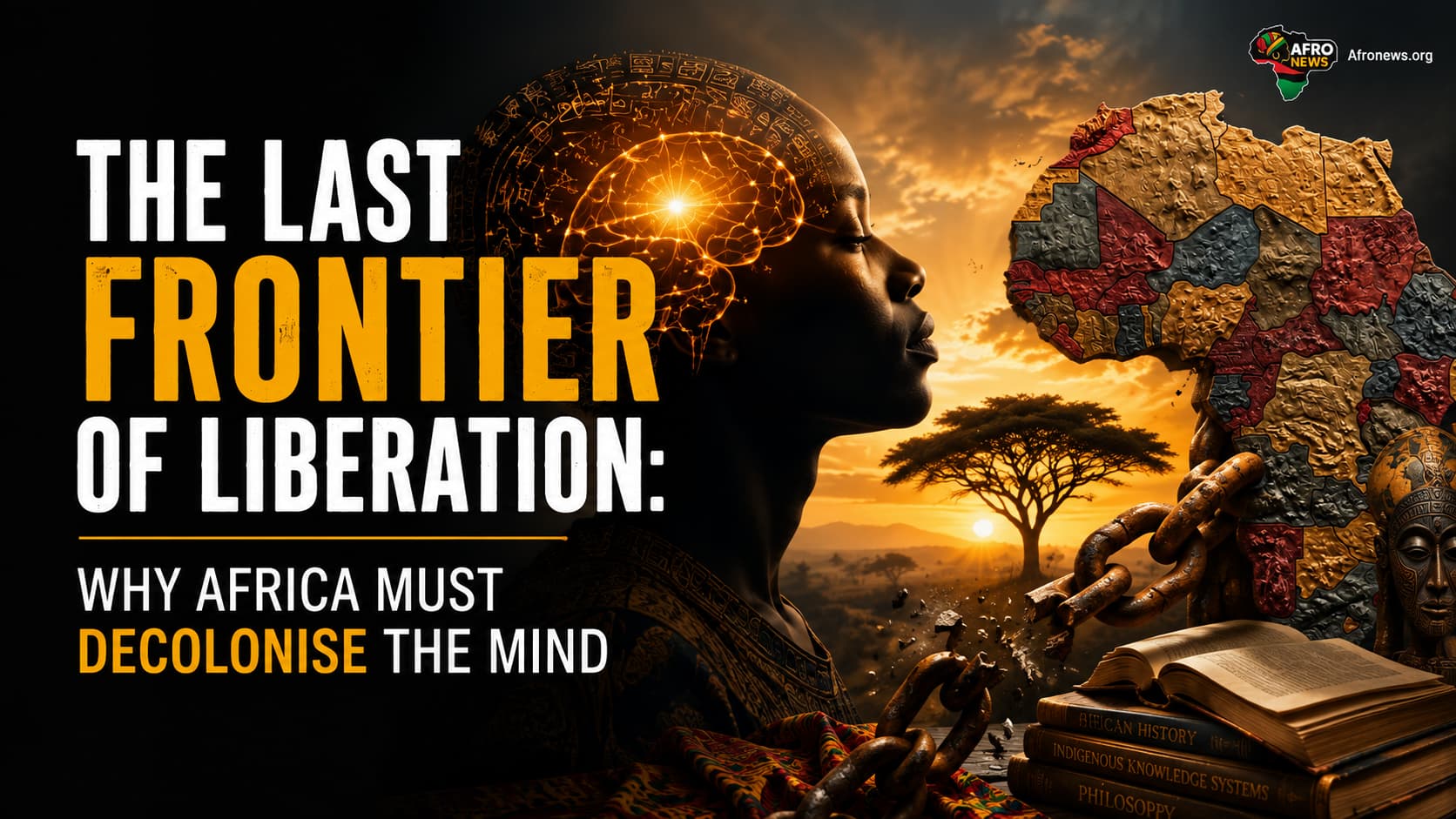
“The greatest prison is not built with bricks and iron; it is built inside the mind.”
That timeless truth lies at the heart of one of Professor P. L. O. Lumumba’s most thought-provoking reflections on Africa’s future.
When Lumumba asks:
Related Post



“Why do you want to Islamise us? This God who created us—the Nuer, Dinka, Zulu, Xhosa, Herero, Nama, Ovambo, Ovimbundu, Igbo, Luo, Agĩkũyũ, Dogon, Wolof, Yoruba and Fulani—was He stupid? If He is all-wise, is He not a God of diversity who desires to be celebrated in different and diverse ways?”
he is not attacking religion. He is challenging a far deeper crisis—Africa’s lingering colonial mindset.
His message is clear: diversity is not a mistake but part of humanity’s design. Every civilisation possesses its own history, language, philosophy and worldview that deserves recognition and respect.
For Africa, the greatest struggle of the 21st century is no longer the fight for political independence. It is the fight for intellectual freedom.
Political liberation without mental liberation remains unfinished business.
The First Colony Was the Mind
Colonialism did far more than seize African land, labour and natural resources. Its most enduring legacy was psychological domination.
For decades, Africans were taught to regard their cultures, languages and traditional knowledge as inferior, while European ideas were presented as the universal standard of civilisation.
This psychological conditioning continues to influence education, governance, religion, economics and even personal identity long after the colonial flags came down.
As renowned Kenyan scholar Ngũgĩ wa Thiong’o argued in Decolonising the Mind, language is far more than a communication tool—it is the carrier of memory, culture and identity. When people lose confidence in their language, they gradually lose confidence in themselves.
Africa’s greatest decolonisation project, therefore, is not geographical.
It is psychological.
Beyond Colonial Thinking
Cameroonian philosopher Achille Mbembe argues that Africa cannot shape its future while trapped within colonial frameworks of thought.
True decolonisation does not require rejecting ideas from Europe, Asia or any other civilisation. Knowledge belongs to humanity.
The real challenge is different.
Africa must stop consuming ideas uncritically and start producing knowledge confidently.
A liberated society borrows from others without losing its identity.
It learns from the world while remaining rooted in its own history and values.
“I Think, Therefore I Am”
French philosopher René Descartes famously declared:
“Cogito, ergo sum” — “I think, therefore I am.”
Although written centuries ago, the statement carries profound relevance for modern Africa.
Societies eventually become what they consistently believe about themselves.
If Africans internalise narratives of inferiority, dependency and helplessness, those beliefs inevitably shape leadership, institutions, education and economic outcomes.
But confidence produces a different future.
A liberated mind nurtures innovative education.
Innovative education drives scientific discovery.
Scientific discovery fuels industrialisation.
Industrialisation creates wealth.
The journey from poverty to prosperity begins not in the mines—but in the mind.
Africa’s Wealth, Others’ Prosperity
Professor Lumumba repeatedly asks uncomfortable but necessary questions.
Why does Africa produce most of the world’s cocoa while Europe dominates the global chocolate industry?
Why are diamonds mined in Botswana, Namibia, Sierra Leone and South Africa but generate most of their wealth abroad?
Why do African tea, coffee and other agricultural products often become globally recognised under foreign commercial brands?
The answers reveal more than economic injustice.
They expose intellectual dependency.
Africa continues exporting raw materials because it has not invested sufficiently in research, innovation, manufacturing and value addition.
Natural resources alone have never made nations prosperous.
Ideas have.
The Missing Ingredient: Confidence
Mental colonisation breeds something equally dangerous—low self-belief.
It convinces societies that progress, innovation and salvation must always come from somewhere else.
But history tells a different story.
When people rediscover their dignity, they begin believing in themselves.
When they believe in themselves, they create.
When they create, they innovate.
When innovation becomes culture, economies flourish.
Africa’s greatest untapped resource is not buried beneath its soil.
It exists within the imagination of its people.
Learning Without Losing Identity
Decolonising the mind does not mean isolating Africa from the rest of the world.
It means engaging globally without abandoning local identity.
China modernised while preserving its civilisation.
Japan industrialised without surrendering its language.
India emerged as a technological powerhouse while remaining deeply connected to its cultural heritage.
Africa can do the same.
The goal is not rejection of modernity.
It is freedom from dependency.
The New Currency of Power
The defining resources of the 21st century are no longer gold, oil or diamonds alone.
Power increasingly belongs to nations that generate ideas.
Artificial intelligence.
Scientific research.
Technology.
Innovation.
Education.
Creative industries.
These are the true currencies shaping the global economy.
With a population exceeding one billion people, Africa’s greatest strategic asset is not its mineral wealth.
It is the creativity, talent and intellectual potential of its citizens.
The continent that gave humanity the civilisations of Ancient Egypt, Nubia, Axum, Mali, Songhai and Great Zimbabwe should never define itself through dependency.
Its future lies in innovation—not imitation.
In confidence—not inferiority.
In authentic identity—not borrowed narratives.
Conclusion
Africa’s greatest revolution will not begin in parliament.
It will not begin through foreign aid.
It will not begin beneath the earth.
It will begin inside the minds of Africans.
Professor P. L. O. Lumumba reminds us that liberation begins with dignity.
Ngũgĩ wa Thiong’o teaches that language is the home of culture.
Achille Mbembe urges Africa to think beyond colonial categories.
Frantz Fanon argues that decolonisation is ultimately the transformation of consciousness.
Kwame Nkrumah reminds us that political freedom means little without economic and intellectual independence.
René Descartes reminds humanity that existence itself begins with thought.
Together, their ideas point to one enduring truth:
Africa’s future will not be determined by what lies beneath its soil, but by what rises within the minds of its people.
When the African mind is liberated, confidence replaces doubt.
When confidence replaces doubt, creativity flourishes.
When creativity flourishes, innovation follows.
When innovation becomes culture, prosperity becomes inevitable.
Only then will Africa move beyond being the cradle of humanity to becoming one of the principal architects of humanity’s future.
References
African Development Bank. (2024). African Economic Outlook 2024: Driving Africa’s Transformation through Sustainable Development. https://www.afdb.org/en/documents/african-economic-outlook-2024
African Union. (2018). Agreement Establishing the African Continental Free Trade Area (AfCFTA). https://au.int/en/treaties/agreement-establishing-african-continental-free-trade-area
Descartes, R. (1637). Discourse on the Method of Rightly Conducting One’s Reason and Seeking Truth in the Sciences. Stanford Encyclopedia of Philosophy. https://plato.stanford.edu/entries/descartes/
Fanon, F. (1961). The Wretched of the Earth. Grove Press. https://groveatlantic.com/book/the-wretched-of-the-earth/
Mbembe, A. (2001). On the Postcolony. University of California Press.
Mbembe, A. (2016). Decolonizing Knowledge and the Question of the Archive. Wits Institute for Social and Economic Research. https://wiser.wits.ac.za/system/files/Achille%20Mbembe%20-%20Decolonizing%20Knowledge%20and%20the%20Question%20of%20the%20Archive.pdf
Ngũgĩ wa Thiong’o. (1986). Decolonising the Mind: The Politics of Language in African Literature. James Currey. https://books.google.com/books?id=qlZBsYQtSeoC
Nkrumah, K. (1965). Neo-Colonialism: The Last Stage of Imperialism. International Publishers. https://archive.org/details/neocolonialismla00nkru
United Nations Conference on Trade and Development (UNCTAD). (2023). Economic Development in Africa Report 2023: The Potential of Africa to Capture Technology-Intensive Global Supply Chains. https://unctad.org/publication/economic-development-africa-report-2023
World Bank. (2024). Africa’s Pulse, Volume 29.
Additional References
Asante, M. K. (2007). An Afrocentric Manifesto. Polity Press.
Mazrui, A. A. (1986). The Africans: A Triple Heritage. BBC Publications.
Rodney, W. (1972). How Europe Underdeveloped Africa. Bogle-L’Ouverture Publications.
Cheikh Anta Diop. (1974). The African Origin of Civilization: Myth or Reality. Lawrence Hill Books.
Wiredu, K. (1996). Cultural Universals and Particulars: An African Perspective. Indiana University Press.
UNESCO. (2021). Reimagining Our Futures Together: A New Social Contract for Education. https://unesdoc.unesco.org/
World Intellectual Property Organization (WIPO). (2024). Global Innovation Index 2024. https://www.wipo.int/global_innovation_index/en/