
The Development Question Africa Cannot Escape
In the race to modernise, nations often become obsessed with visible signs of progress. New highways, spectacular buildings, airports, and city skylines become symbols of national ambition. They create powerful images of advancement and send a message to the world: we are moving forward.
But development is not merely about what a country can display.
Related Post

It is about what its people can experience.
A nation may have a magnificent skyline and still have citizens who lack clean drinking water. It may host international conferences in luxurious buildings while rural schools struggle with basic learning materials. It may celebrate economic growth figures while millions of young people search endlessly for opportunities.
This tension between appearance and reality was one of the central concerns of Tanzania’s founding president, Mwalimu Julius Kambarage Nyerere.
Long before the modern debates about inclusive growth, human development, and sustainable development became global conversations, Nyerere was asking Africa a fundamental question:
Development for what purpose and for whose benefit?
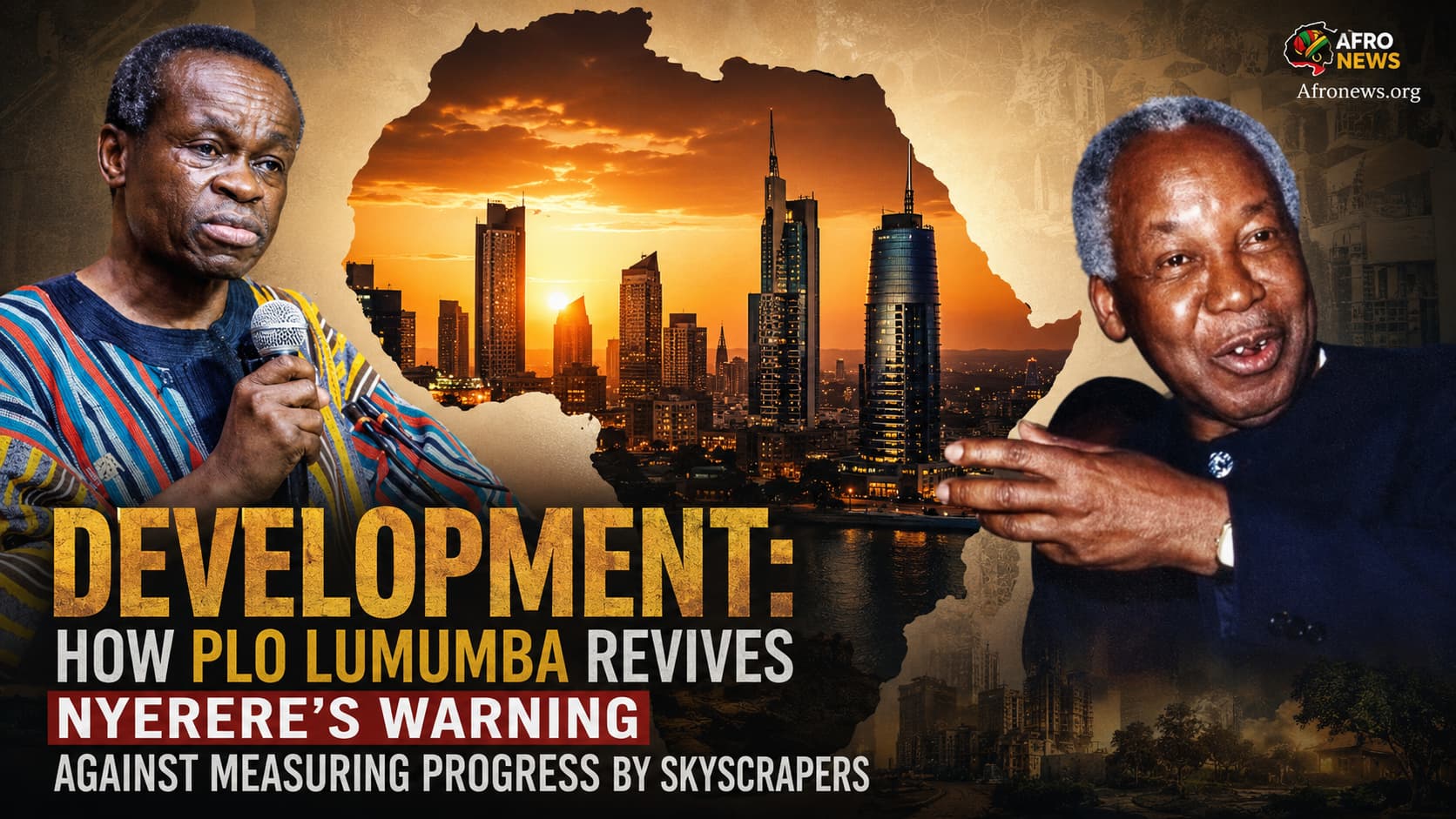
Today, that question has been revived with renewed urgency by Professor PLO Lumumba, whose Pan-African lectures continue to challenge African leaders and citizens to rethink the meaning of progress.
Nyerere’s Vision: Development Begins With Human Dignity
When African nations gained independence in the 1960s, political freedom was only the first step. The bigger challenge was transforming societies that had been shaped by colonial extraction and unequal systems.
Nyerere understood that independence without human development would remain incomplete.
For him, the purpose of government was not simply to construct impressive institutions but to create conditions where ordinary people could live meaningful lives.
In his famous reflection on development, Nyerere argued:
“There is nothing wrong with skyscrapers, but let the Americans go to the moon; we are going to provide water to our villagers.”
The power of this statement lies in the priority it establishes.
Nyerere was not against skyscrapers.
He was against skyscrapers becoming substitutes for social progress.
He recognised that countries at different stages of development face different responsibilities. A nation that has already secured basic necessities may invest heavily in advanced scientific ambitions. A nation where citizens still struggle for water, healthcare, education, and food security must first address those foundations.
His argument was simple:
The first responsibility of development is to improve the human condition.
A water project in a rural community may never appear on an international television broadcast. It may never become a national monument. But for the woman who no longer walks several kilometres daily to collect water, it represents freedom.
For the child who can now attend school instead of spending hours searching for water, it represents opportunity.
That was Nyerere’s understanding of development.
The Problem of Symbolic Development
Africa today faces a dilemma that Nyerere anticipated decades ago: the temptation to confuse modern appearance with genuine transformation.
Infrastructure matters. Roads, airports, technology parks, and urban development are essential for economic growth. No serious development thinker would argue otherwise.
The problem arises when infrastructure becomes an end in itself rather than a means to improve lives.
A highway should not only connect cities; it should connect farmers to markets.
A technology hub should not only look impressive; it should create opportunities for young innovators.
A modern hospital should not only exist as a building; it should provide quality healthcare.
The difference between construction and development is impact.
A building is an object.
Development is an outcome.
Africa’s challenge is not that it builds too much. The challenge is ensuring that what it builds contributes to the transformation of society.
PLO Lumumba’s Message: Africa Must Define Itself
This is where Professor PLO Lumumba’s contribution becomes important.
Through his speeches, Lumumba has consistently argued that Africa’s greatest challenge is not a shortage of resources but a crisis of leadership, vision, and self-definition.
His message echoes Nyerere’s belief that Africa cannot simply copy external models without considering its own realities.
A country cannot measure success only by comparing itself to another nation’s achievements. Development must emerge from understanding the unique needs, strengths, and aspirations of its people.
Lumumba often challenges Africans to look beyond political independence and pursue what he describes as a deeper form of liberation: the ability to think, plan, and act according to African interests.
The question is not:
“How can Africa become another continent?”
The question is:
“How can Africa become the best version of itself?”
This is the intellectual bridge between Nyerere and Lumumba.
Both reject dependency of thought.
Both demand self-definition.
Both argue that Africa’s future requires confidence in its own capacity.
The Evidence From Successful Nations
The experience of countries that transformed themselves economically reinforces this argument.
South Korea, once a poor country after the Korean War, did not become an industrial powerhouse simply by constructing modern cities. It invested heavily in education, research, skills development, and industrial capability.
Singapore’s rise was not built only on its impressive skyline. Behind its global image were decades of investment in human capital, efficient institutions, and strategic economic planning.
China’s transformation involved massive infrastructure development, but its foundation was a deliberate effort to improve productivity, expand manufacturing, and lift hundreds of millions of people out of poverty.
The lesson is not that infrastructure is unnecessary.
The lesson is that human development must drive physical development.
A country’s buildings are strongest when they are built upon educated, healthy, and productive citizens.
Africa’s Greatest Resource Is Its People
Africa is frequently described as a continent rich in natural resources. This is true.
But the greatest resource of Africa is not beneath the ground.
It is within its people.
The young entrepreneur creating solutions despite limited resources.
The farmer feeding communities despite difficult conditions.
The scientist researching African problems.
The teacher shaping future generations.
The engineer designing local solutions.
The creativity and resilience of Africans represent the continent’s greatest wealth.
The responsibility of leadership is to create an environment where this potential is converted into progress.
Conclusion: Beyond Buildings, Toward Better Lives
Julius Nyerere left Africa with a challenge that remains relevant:
Before we celebrate what we have built, we must ask who has benefited from it.
PLO Lumumba’s revival of this philosophy is a reminder that Africa’s development journey requires more than economic growth statistics and impressive projects.
It requires a new definition of success.
A successful Africa is not simply one with modern cities.
It is one where children have opportunities, citizens live with dignity, communities have basic services, and human potential is fully unlocked.
Skyscrapers may represent ambition.
But people represent achievement.
Because ultimately, the true measure of a nation is not how high its buildings reach toward the sky.
It is how many lives it lifts from the ground.
References
- Nyerere, J. K. (1973). Freedom and Development: Uhuru na Maendeleo: A Selection from Writings and Speeches, 1968–1973. Oxford University Press.
https://books.google.com/books?id=bkYsAAAAMAAJ
- Lumumba, P. L. O. (n.d.). Lectures, speeches and reflections on African leadership, governance and development. PLO Lumumba Foundation.
- Sen, A. (1999). Development as Freedom. Oxford University Press.
https://global.oup.com/academic/product/development-as-freedom-9780192893307
- United Nations Development Programme. (2024). Human Development Report 2023/2024: Breaking the Gridlock: Reimagining Cooperation in a Polarized World. United Nations Development Programme.
1.African Union Commission. (2015). Agenda 2063: The Africa We Want. African Union.