

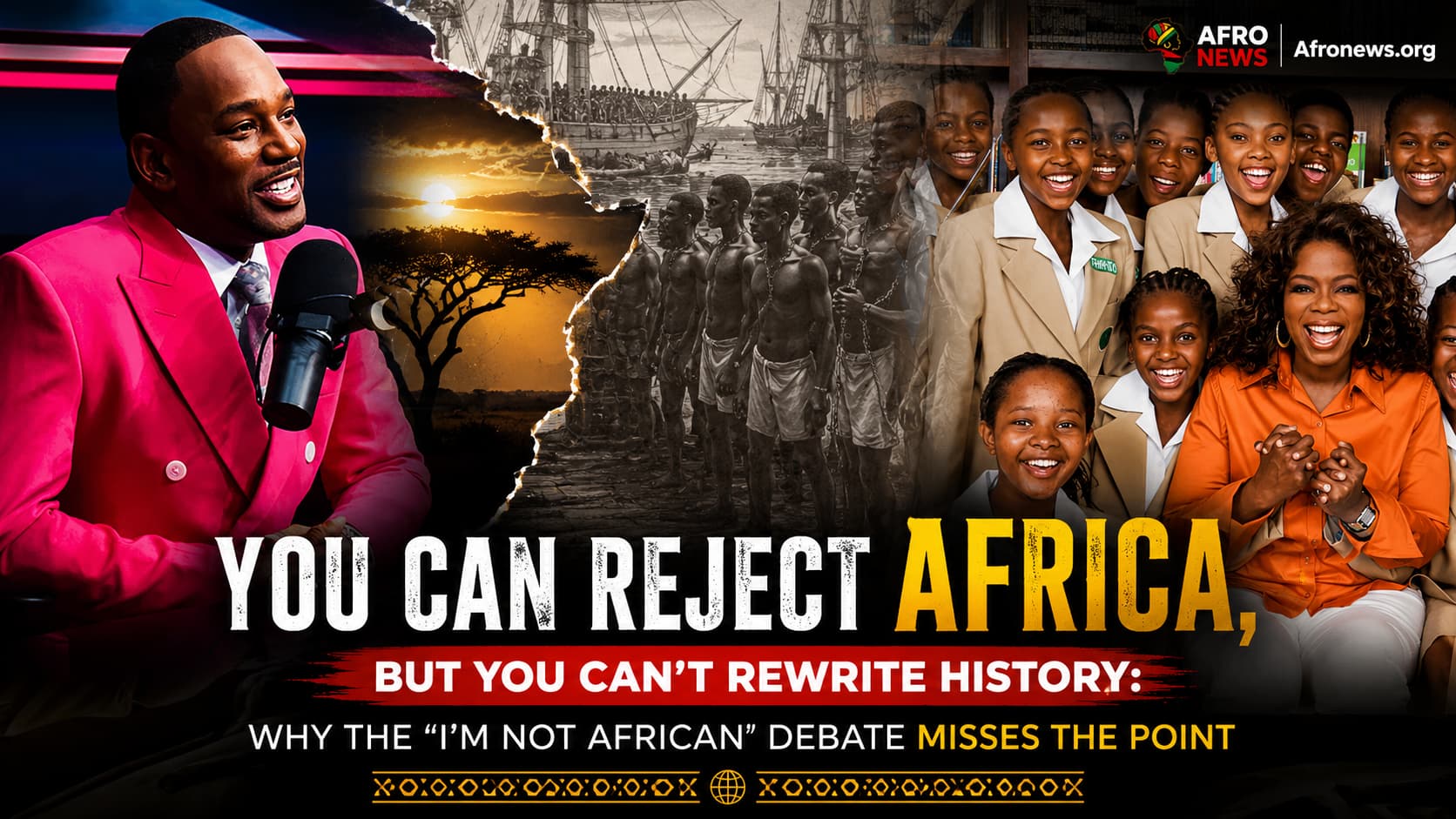
When American rapper Cam’ron bluntly declared during a discussion that he was not African and had no connection to Africa, he reignited one of the most emotional debates in the Black world. His comments spread rapidly across social media, drawing applause from some African Americans and sharp criticism from Africans across the continent and the diaspora.
For many Africans, the statement was shocking. For many African Americans, however, it reflected a long-held belief that centuries of slavery, segregation and the creation of a unique African American identity severed any meaningful connection to Africa.
But while identity can evolve, history cannot be erased.
Related Post




The argument that African Americans are “not African” is not only historically inaccurate,it is intellectually weak, culturally divisive and ultimately harmful to Black solidarity.
History Doesn’t Ask for Permission
No serious historian disputes the origins of African Americans.
Between the 16th and 19th centuries, millions of Africans were forcibly kidnapped from regions that today include Nigeria, Ghana, Senegal, Benin, Angola, Congo and several other African nations. They were transported across the Atlantic in one of humanity’s greatest crimes,the transatlantic slave trade.
Their languages were stripped away.
Their names were changed.
Their cultures were suppressed.
But their ancestry remained African.
A person whose ancestors were taken from Africa does not cease to have African roots simply because generations have passed.
Nobody argues that Irish Americans stopped having Irish ancestry because they have lived in America for centuries. Italian Americans still celebrate Italian heritage. Jewish communities preserve centuries-old traditions despite global dispersion.
Why should African ancestry be treated differently?
Identity and Ancestry Are Not the Same Thing
This is where many online arguments collapse.
African Americans have every right to identify as Americans. They have built a unique culture,through music, food, language, literature and political struggle,that deserves global recognition.
But being American by nationality does not erase African ancestry.
One is citizenship.
The other is genealogy.
Rejecting ancestry because it is uncomfortable or politically inconvenient is like denying one’s family tree because the branches grew in another country.
Social Media Turned Identity Into a Battlefield
The debate has become especially heated on X (formerly Twitter), where thousands of users regularly argue over identity.
Some posts that have gone viral include statements such as:
“I’m Black American, not African.”
“Africa sold us. Stop calling us African.”
“We don’t owe Africa anything.”
These posts often generate millions of views and thousands of replies.
Africans frequently respond with arguments such as:
“You don’t have to love Africa, but you can’t deny where your ancestors came from.”
“Rejecting Africa doesn’t change your DNA.”
“History isn’t based on feelings.”
The exchanges quickly descend into accusations of betrayal, ignorance, tribalism and historical revisionism.
Instead of building bridges, social media algorithms reward outrage.
The Celebrity Divide
The debate is also reflected among prominent Black American celebrities.
Those who have proudly embraced Africa
Many influential figures have publicly acknowledged and celebrated their African heritage.
- Oprah Winfrey has repeatedly spoken about the importance of reconnecting with Africa and investing in African education.
- Viola Davis emotionally traced her ancestry to West Africa through DNA research.
- Lupita Nyong’o, though Kenyan-Mexican rather than African American, has become a powerful bridge between continental Africans and the Black diaspora.
- Michael Jordan has participated in African philanthropic initiatives.
- Beyoncé’s Black Is King celebrated African history, symbolism and identity before a global audience.
- Alicia Keys has publicly discussed her African ancestry and visited several African countries.
- Chance the Rapper has repeatedly spoken about learning from Africa after visiting Ghana.
- Rick Ross has invested in African business opportunities and frequently expresses admiration for the continent.
- Dave Chappelle famously spent years living in South Africa and often speaks respectfully about the continent.
Their embrace of Africa has not made them any less American.
Instead, it has broadened their understanding of who they are.
Those who have rejected or distanced themselves
Some celebrities and public figures have made comments distancing themselves from Africa or minimizing any connection.
Cam’ron’s remarks are among the most recent examples.
Others have occasionally echoed similar sentiments in interviews or online discussions by emphasizing that they are exclusively “Black American” or “Foundational Black American (FBA),” arguing that their identity should not be merged with that of continental Africans.
However, many of these comments generate immediate backlash because critics argue they confuse cultural identity with ancestral origin.
The FBA Movement
The rise of the Foundational Black American (FBA) movement has further intensified these debates.
Supporters argue that descendants of enslaved people in the United States have developed a distinct identity deserving separate political recognition.
That argument has merit.
African Americans absolutely possess a unique historical experience.
Where the movement often loses credibility is when some supporters go beyond cultural distinction and begin denying African ancestry altogether.
Culture can change.
Geography can change.
Nationality can change.
DNA cannot.
Africa Is Not Responsible for Slavery Alone
One recurring online claim is that Africans sold Africans into slavery.
History is more complicated.
Yes, some African kingdoms and merchants participated in the slave trade.
But European empires created, expanded, financed and industrialized the transatlantic slave system on an unimaginable scale.
Reducing centuries of history to “Africa sold us” ignores the colonial machinery, economic incentives and military power that sustained slavery for hundreds of years.
It also unfairly assigns collective guilt to modern Africans for crimes committed centuries before most African nations even existed in their current form.
Why Rejecting Africa Hurts Everyone
The greatest victims of this identity war are Black people themselves.
When Africans and African Americans fight over who is “really Black,” everyone else watches.
Shared opportunities disappear.
Economic partnerships weaken.
Cultural exchange suffers.
Political influence diminishes.
The global Black community becomes easier to divide.
Ironically, the same racism that once refused to distinguish between Africans and African Americans is now being mirrored by Black people drawing increasingly rigid lines among themselves.
Five Reasons African Americans Should Embrace Their African Roots
- History cannot be changed. Every credible historical record traces African American ancestry back to Africa.
- Knowing your roots strengthens identity. Embracing ancestry does not erase American identity; it enriches it.
- Economic opportunities are expanding. Africa is one of the world’s fastest-growing regions, offering opportunities in business, technology, entertainment and tourism.
- Cultural exchange benefits everyone. Music, fashion, film and entrepreneurship become stronger when the diaspora collaborates instead of competing.
- Unity creates influence. Nearly two billion people of African descent worldwide possess enormous cultural, political and economic potential if united by shared heritage rather than divided by historical misunderstandings.
The Conversation We Should Be Having
Perhaps the real question is not whether African Americans are African.
History has already answered that.
The real question is why acknowledging African ancestry has become so controversial.
No one asks Italian Americans to reject Italy.
No one demands Irish Americans deny Ireland.
Yet some people celebrate denying Africa as though rejecting one’s ancestral homeland is an achievement.
Identity should never become a prison.
Nor should ancestry become a source of shame.
African Americans are Americans.
They are also descendants of Africans.
Both truths can exist simultaneously.
One does not erase the other.
As debates continue across podcasts, television studios and social media timelines, one uncomfortable question remains:
If generations before us fought so hard to rediscover the history slavery tried to erase, why are some now choosing to erase it themselves?