
Introduction
Africa stands today as a continent of immense potential, rich cultural heritage, and extraordinary resilience. Yet no honest discussion about Africa’s present and future can ignore the historical forces that profoundly shaped its development. The story of Africa is not merely one of victimhood; it is also a story of resistance, survival, and renewal. However, before a people can fully chart their future, they must understand their past.
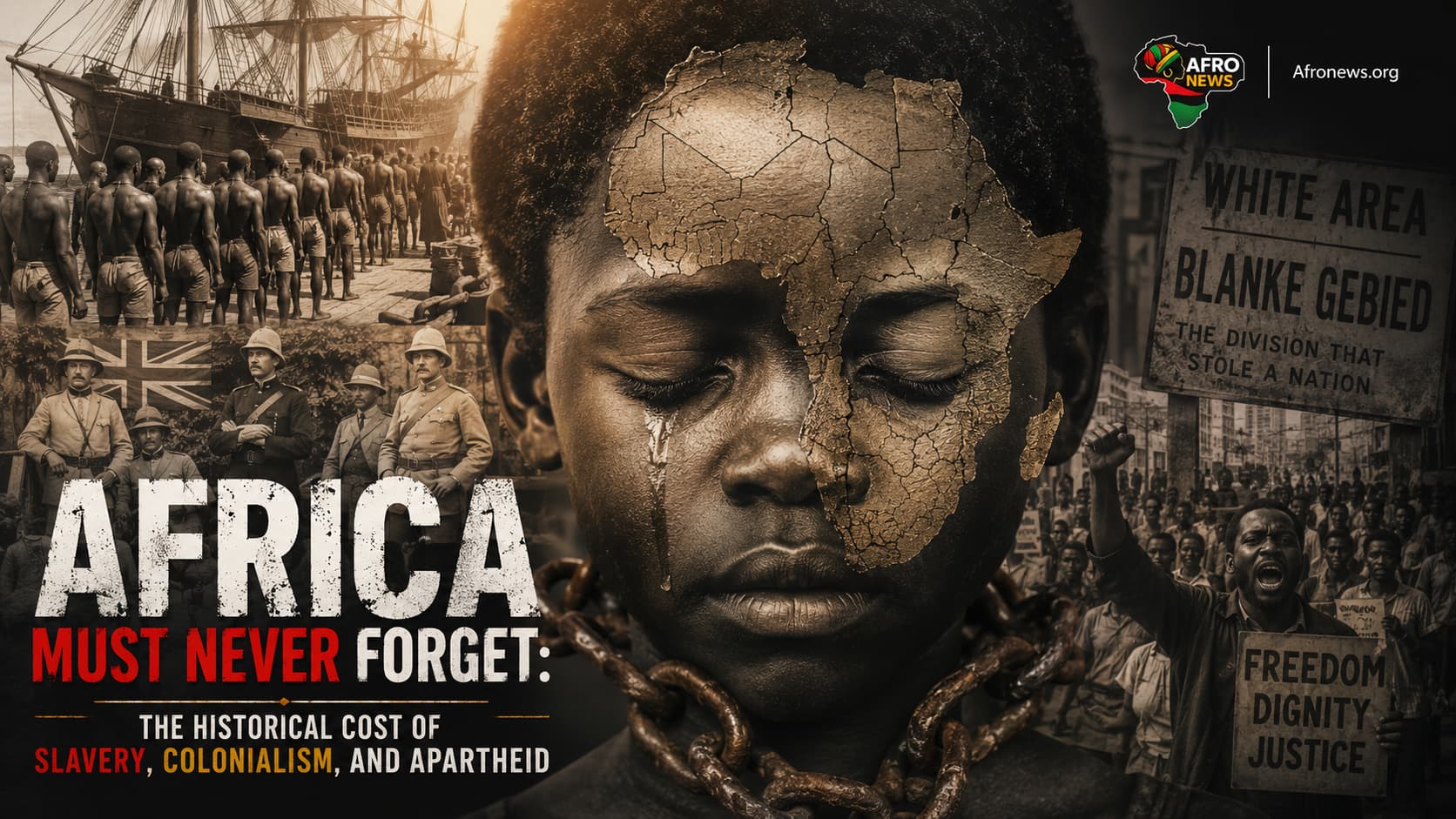
Africa must never forget.
Not because memory should produce hatred.
Related Post




Not because history should become a weapon.
But because truth matters.
The centuries-long removal of millions of Africans through slave trades, the exploitation of Africa during colonial rule, and the institutionalized racism of apartheid left deep political, economic, demographic, and psychological scars whose effects are still visible today.
To forget these events would be to forget millions whose lives were stolen, families that were destroyed, cultures that were disrupted, and opportunities that were denied.
The Great Human Drain: The Transatlantic Slave Trade
One of the greatest tragedies in human history was the transatlantic slave trade.
From the fifteenth century through the nineteenth century, millions of Africans were forcibly transported across the Atlantic Ocean to the Americas and the Caribbean.
UNESCO describes the transatlantic slave trade as the trafficking of millions of African men, women, and children who were forcibly displaced from Africa to enrich imperial powers and colonial economies.
Historians generally estimate that more than 12 million Africans were embarked on slave ships bound for the Americas. Countless others died before reaching the coast, during raids, wars, forced marches, imprisonment, disease outbreaks, and the brutal conditions of slave ships.
The impact on Africa was devastating.
Entire regions lost significant portions of their productive population. Young men and women, the very people needed to build economies, defend communities, raise families, and transmit knowledge, were removed.
The slave trade did not merely take individuals.
It took generations, labour, skills, future leaders, future inventors and it took future mothers and fathers.
The consequences extended far beyond the individuals enslaved. Communities were destabilized, warfare increased in some regions, and economic development was distorted as human beings became commodities in an international market.
Meanwhile, wealth generated through enslaved labour contributed substantially to the growth of plantation economies in the Caribbean and the Americas and helped fuel the economic expansion of European empires.
The Trans-Saharan, Red Sea, and Indian Ocean Slave Trades
Africa’s encounter with slavery was not limited to the Atlantic world.
For centuries, Africans were also transported through the Sahara Desert, across the Red Sea, and through Indian Ocean trade networks into North Africa, the Middle East, and parts of Asia.
Unlike the transatlantic trade, records for these systems are often less complete, making precise calculations difficult. Historians continue to debate the total number of Africans affected. Nevertheless, there is broad agreement that millions of Africans were removed through these networks over many centuries.
Historical evidence also documents the castration of some enslaved African males destined for service as eunuchs in courts and elite households. This practice inflicted severe physical suffering and prevented many family lines from continuing.
Africa must remember these victims as well.
Their suffering should not be forgotten simply because it received less attention in global historical narratives.
The memory of African suffering belongs to no single region, religion, or empire.
It belongs to history.
Colonialism: The Partition and Exploitation of Africa
As slavery declined, colonial domination intensified.
During the nineteenth century, European powers competed for control of African territory. The so-called “Scramble for Africa” resulted in the partition of most of the continent among European empires.
Colonial governments often imposed borders that ignored existing ethnic, cultural, linguistic, and political realities.
The consequences remain visible today.
Many modern African states inherited borders created primarily to serve colonial interests rather than African realities.
Colonial administrations extracted enormous quantities of wealth from the continent.
Gold from South Africa, Diamonds from Southern Africa, Rubber from Central Africa, Cocoa from West Africa, and Copper from Central and Southern Africa.
Agricultural products, minerals, and labour flowed outward while decision, making power remained concentrated in colonial capitals.
In many territories, infrastructure was built primarily to facilitate extraction rather than broad-based African development. Africa supplied resources and others accumulated wealth.
The imbalance helped shape global inequalities that remain subjects of debate among economists and historians today.
Apartheid and the Religious Justification of Racial Oppression
Perhaps nowhere was racial domination more systematically organized than in apartheid South Africa.
Apartheid was a legal system of racial segregation that denied the majority Black population equal political rights and enforced separation in virtually every aspect of life.
A particularly troubling aspect of apartheid was the role played by some religious institutions and theologians in providing theological justification for racial separation.
Historical scholarship confirms that the Dutch Reformed Church had a long association with apartheid and its theological justification. Researchers have documented how some theologians used biblical interpretations to defend racial segregation and separate development.
This does not mean Christianity itself created apartheid.
Nor does it mean all Christians supported apartheid.
Many churches, clergy, and Christian activists courageously opposed racial injustice.
Nevertheless, history records that sections of the Dutch Reformed Church and some influential theologians used scripture to support policies that denied millions of Africans their dignity and rights.
The lesson is profound:
Any ideology, religious, political, or cultural, that strips human beings of their humanity must be challenged.
Why Africa Must Remember?
Some argue that Africa should forget the past and focus only on the future.
But forgetting history is dangerous.
History explains how current realities emerged.
History teaches lessons about power, exploitation, resistance, and resilience.
History honours those who suffered and those who fought for freedom.
Remembering slavery does not mean hating Europeans.
Remembering the Arab slave trades does not mean hating Arabs.
Remembering colonialism does not mean rejecting cooperation with former colonial powers.
Remembering apartheid does not mean rejecting reconciliation.
Instead, remembering means acknowledging truth.
Modern generations should not be held personally responsible for crimes committed centuries ago. However, societies have a responsibility to understand history honestly and recognize how historical systems shaped present realities.
This principle increasingly informs international discussions about historical justice, memory, and reparations. This year, 2026, the United Nations General Assembly adopted a resolution describing the trafficking of enslaved Africans as the gravest crime against humanity and called for measures addressing its enduring consequences.
The Future Africa Must Build
Africa’s future cannot be built solely on remembrance.
Memory must become action.
The greatest tribute to those who suffered is not merely to recount their suffering but to build the Africa they were denied.
An Africa that educates its youth.
An Africa that protects its resources.
An Africa that strengthens democratic institutions.
An Africa that combats corruption.
An Africa that values innovation.
An Africa that speaks confidently on the global stage.
Africa has survived slavery.
Africa has survived colonialism.
Africa has survived apartheid.
The challenge of the twenty-first century is not merely to survive.
It is to lead.
Conclusion
Africa must never forget.
It must never forget the millions carried across the Atlantic.
It must never forget those taken across the Sahara, the Red Sea, and the Indian Ocean.
It must never forget the exploitation of colonial rule.
It must never forget the injustice of apartheid.
But remembrance alone is not enough.
The purpose of memory is wisdom.
The purpose of wisdom is action.
And the purpose of action is to ensure that never again will Africans, or any people anywhere in the world, be treated as commodities, conquered as possessions, or denied their humanity.
A continent that remembers its history possesses the power to shape its destiny.
References
1.General History of Africa
Available at: https://www.unesco.org/en/general–history–africa
2.Voyages: The Trans-Atlantic Slave Trade Database Available at: https://www.slavevoyages.org
3.South African History Online (SAHO). The Dutch Reformed Church and Apartheid Available at: https://www.sahistory.org.za/article/dutch–reformed–church–drc