

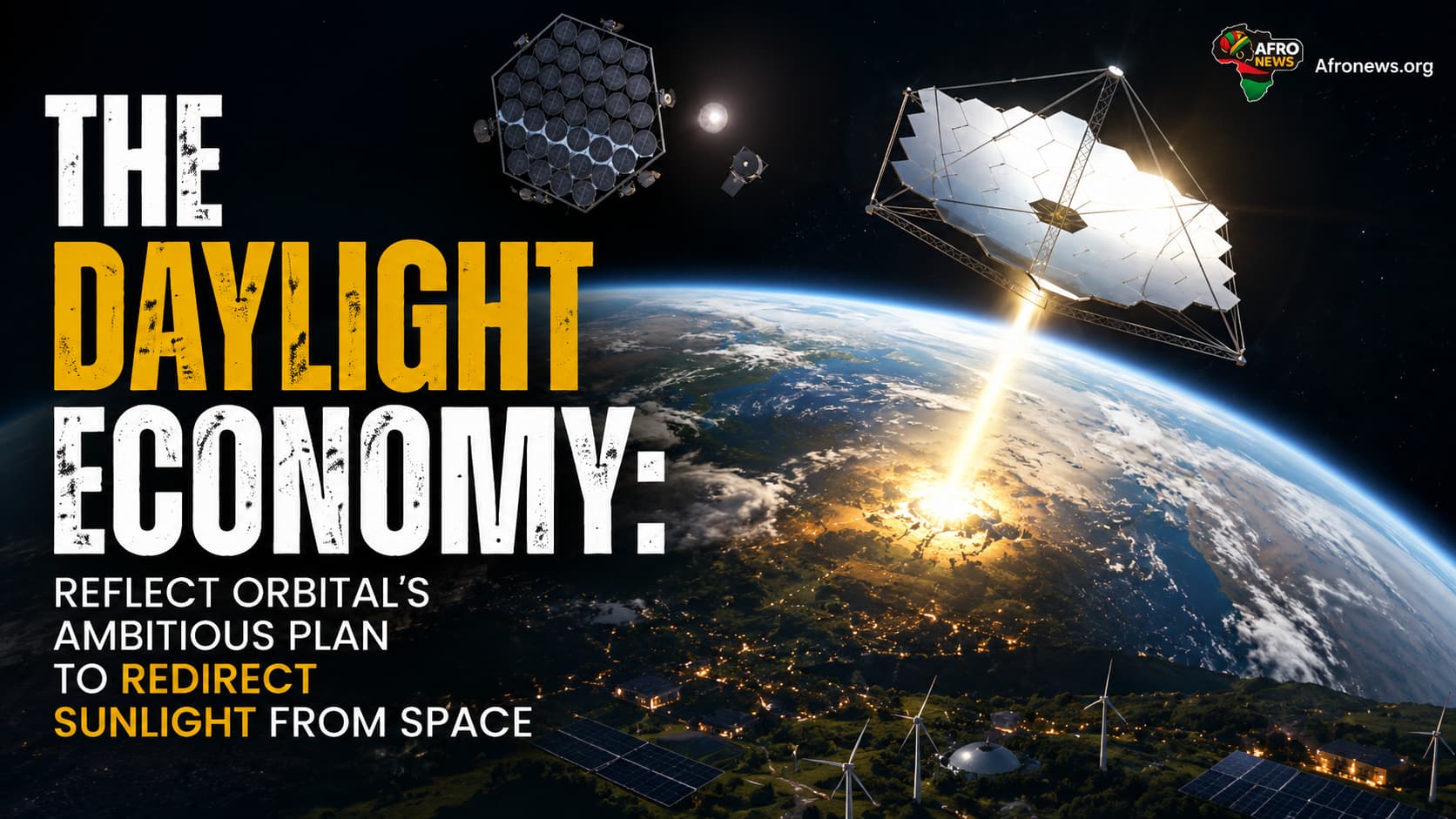
There was a time when the idea of buying sunlight would have sounded like science fiction. The Sun belonged to everyone, darkness arrived according to nature’s schedule, and humanity simply adapted to the rhythm of day and night. Now, California-based space startup Reflect Orbital is attempting to change that arrangement by developing satellites capable of redirecting sunlight toward Earth after sunset.
The idea moved closer to reality on July 9, 2026, when the United States Federal Communications Commission (FCC) authorized Reflect Orbital to construct, launch and operate Eärendil-1, a demonstration satellite designed to test its space-based sunlight-reflection technology. The satellite is expected to operate approximately 625 kilometres above Earth.
The authorization, however, is limited to one demonstration satellite. It does not approve Reflect Orbital’s proposed commercial constellation of tens of thousands of satellites or give the company blanket permission to provide reflected sunlight around the world. The larger commercial vision remains a future ambition.


Nevertheless, Eärendil-1 could become an important test of whether humanity can turn sunlight into something that is effectively available on demand.
How Reflect Orbital’s Technology Works
The concept is simple in principle. Instead of generating electricity or artificial light, Reflect Orbital wants to use large reflective surfaces in orbit to redirect sunlight toward selected areas on Earth.
Eärendil-1 is designed around an approximately 18-metre by 18-metre reflector. According to the American Astronomical Society, it is intended to produce a beam approximately five kilometres wide on Earth’s surface.
The motivation is one of solar energy’s most obvious limitations: the Sun sets.
Solar farms can generate significant electricity during daylight, but their output drops after sunset even when demand remains high. Reflect Orbital believes orbital reflectors could eventually provide additional sunlight to solar installations after sunset or before sunrise, potentially extending the hours during which solar infrastructure can contribute to electricity generation.
The company calls this broader idea “sunlight on demand.” Rather than creating another Sun, it is attempting to make sunlight available at a specific location and time when natural sunlight would otherwise be unavailable.
The potential applications extend beyond solar power. Reflect Orbital has discussed possible uses involving large-scale lighting, agriculture, emergency response and remote operations. A disaster-response operation working at night, for example, could potentially receive additional illumination without waiting for damaged electrical infrastructure to be restored.
The idea has already attracted serious investment. In September 2024, Reflect Orbital announced a $6.5 million seed funding round led by Sequoia Capital. In May 2025, the company announced a further $20 million Series A round led by Lux Capital, with participation from Sequoia Capital and Starship Ventures.
Investment does not guarantee commercial success, but it demonstrates that major technology investors see enough potential in the concept to finance its development.
From One Satellite to a Space-Based Constellation
Eärendil-1 is the experiment. Reflect Orbital’s larger ambition is much more dramatic.
The company has publicly discussed a long-term vision of deploying up to 50,000 satellites by 2035. At that scale, the project would move far beyond a technology demonstration and become a major commercial infrastructure system surrounding Earth.
That ambition is also where the controversy begins.
For astronomers, darkness is not simply a preference. It is an essential scientific resource. The American Astronomical Society has criticized the FCC’s approval of Eärendil-1, raising concerns about bright reflected light, interference with astronomical observations and potential effects on the natural nighttime environment.
The issue is particularly significant because astronomy is already dealing with the rapid growth of satellite mega-constellations. Satellites can appear as bright streaks across astronomical images, making observations of faint objects in the universe more difficult.
Reflect Orbital has said it intends to operate its technology responsibly and study where reflected sunlight travels. The company has also indicated that it does not want its service to unnecessarily interfere with humanity’s enjoyment of the natural night sky.
The debate therefore raises a much larger question: Who gets to decide how much of the night sky can be commercially modified?
The Night Sky, Regulation and the Cost of Innovation
The controversy extends beyond astronomy. Darkness has scientific, ecological and cultural value, while natural day-night cycles influence ecosystems and wildlife.
Reflect Orbital’s technology could eventually benefit energy producers, emergency services and industries operating after dark. However, widespread deployment could also reduce the availability of natural darkness for communities, researchers and ecosystems.
This creates a difficult trade-off. A technology can provide valuable services to some users while creating consequences for others who never asked for them.
The regulatory challenge is equally significant. The FCC’s July 2026 authorization allows Reflect Orbital to operate Eärendil-1, but it does not automatically approve a future constellation of 50,000 satellites.
A much larger system would raise questions involving astronomy, aviation, environmental effects, orbital congestion, space traffic management and international governance. A single experimental satellite and thousands of commercial reflectors would present very different regulatory challenges.
Then comes the economics.
Launching satellites, deploying large reflective structures, controlling them accurately and maintaining them in orbit will be technically and financially demanding. Nature has reported that Eärendil-1 will operate in an orbital environment where debris and atomic oxygen could pose risks to its reflective structure.
The real challenge is therefore not proving that a mirror can reflect sunlight. Humanity has known that for thousands of years. The challenge is proving that such a mirror can be launched, deployed reliably, accurately controlled and safely maintained at a cost that makes the service commercially viable.
Eärendil-1 is intended to begin answering those questions.
Are We Really Going to Pay for the Sun?
Probably not in the way viral headlines suggest.
Nobody is going to own the Sun or receive a bill for natural sunlight. What Reflect Orbital could eventually commercialize is something more specific: the ability to redirect sunlight.
A future customer would potentially pay for an engineered service involving satellites, reflective materials, orbital control systems and software that makes sunlight available at a selected location and time.
So, “selling sunlight” is catchy but technically misleading.
Reflect Orbital is not selling the Sun. It is attempting to commercialize access to sunlight when and where it is needed.
A New Chapter in Humanity’s Relationship With Daylight
For most of human history, civilization adapted to the movement of the Sun. People worked during daylight, rested after dark and eventually developed artificial lighting to push back the limits imposed by night.
Reflect Orbital is proposing another step: using space technology to redirect sunlight itself.
If the technology proves viable, it could create new possibilities for solar energy, emergency response, remote infrastructure and nighttime lighting, while establishing an entirely new category within the commercial space economy.
But technological capability does not automatically determine technological permission.
The important question is not simply whether humanity can redirect sunlight from orbit. It is whether humanity should, particularly at the scale envisioned by Reflect Orbital. How should the technology be regulated? How can astronomy and ecosystems be protected? And how should society balance commercial benefits against the shared value of a natural night sky?
Eärendil-1 could therefore become significant far beyond the success or failure of one startup’s first demonstration satellite. It may become an early test of whether humanity is prepared to turn one of nature’s most universal resources,daylight into another service of the commercial economy.
The Sun will remain free. What may become valuable is the ability to ask for more of it, exactly where and when you want it.
References
- Federal Communications Commission (FCC). (2026, July 9). Space Bureau grants Reflect Orbital authority to operate an NGSO space station (DA 26-706).[FCC — Official Decision and Authorization]
- American Astronomical Society (AAS). (2026, July 13). AAS public policy experts available to comment on FCC approval of Reflect Orbital’s Eärendil-1 mission.[American Astronomical Society — Official Statement]
- Reflect Orbital. (2024, September 24). Announcing our $6.5 million seed round.[Reflect Orbital — Seed Funding Announcement]
- Reflect Orbital. (2025, May 14). Reflect Orbital secures $20 million in Series A funding led by Lux Capital.[Reflect Orbital — Series A Announcement]
- Glickman, K. (2026, July 17). Can giant space mirrors boost green energy on Earth? A start-up aims to find out. Nature.[Nature — Space Mirrors and Solar Energy]
- American Astronomical Society. (2026, March 9). Petition to deny Reflect Orbital application to construct and launch an NGSO satellite.[AAS — Petition to Deny]
- Federal Communications Commission. (2026). Reflect Orbital, SAT-LOA-20250701-00129: Public notice concerning Eärendil-1.[FCC — Eärendil-1 Filing Information]
- Reflect Orbital. (2026). News and insights.[Reflect Orbital — Official News and Insights]